
Optics of Command in a Compressed Crisis Cycle
The juxtaposition at the heart of this episode is stark: on a night marked by major U.S. strikes against Iranian targets—an event that typically elevates alert levels across diplomacy, defense, and markets—President Donald Trump remained at Mar-a-Lago for a high-dollar fundraising engagement rather than returning immediately to the White House. In modern crisis governance, physical location is less determinative than operational control, yet public perception still treats proximity to the Situation Room as a proxy for urgency, focus, and accountability.
From a business-and-technology lens, the deeper issue is not whether command authority was technically maintained, but whether the “availability signal” sent to stakeholders was strong enough. In geopolitically sensitive moments, markets and allies look for cues that decision-making is continuous, coordinated, and disciplined. When the public-facing posture emphasizes fundraising while the national security environment escalates, the administration invites questions about:
- Decision cadence: How quickly can the executive layer convene, reassess, and authorize next steps as conditions change?
- Delegation clarity: Are roles and responsibilities visibly defined so that continuity is credible even when the principal is off-site?
- Stakeholder confidence: Do coalition partners, investors, and the electorate perceive steadiness—or distraction—at the top?
In corporate terms, it resembles a CEO attending a major revenue event during a sudden supply-chain shock: it may be defensible operationally, but the optics can erode confidence if stakeholders cannot see the control framework. In the public sector, that confidence is not merely reputational—it can influence adversary calculations, allied coordination, and domestic political stability.
Executive Health as a Volatility Multiplier in the Information Economy
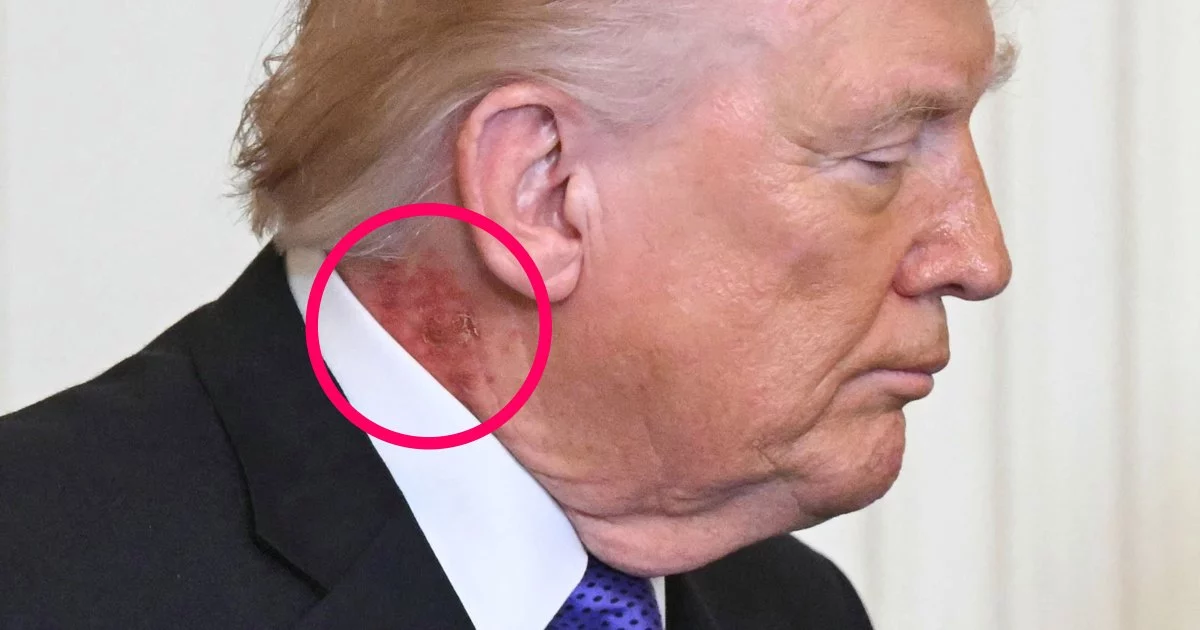
The next morning, Trump appeared publicly to present a Medal of Honor, but photographers captured a pronounced reddish lesion on his right neck and swelling or discoloration in his right hand. The White House medical team attributed the neck mark to a benign dermatological treatment and the hand issue to frequent handshaking. Yet the images quickly became raw material for online speculation—ranging from shingles to anticoagulant-related bruising or other underlying conditions.
This is not simply a tabloid-style health curiosity. In an era of high-resolution imagery, instant distribution, and algorithmic amplification, executive health becomes a systemic communications risk. The challenge is less about the medical facts—often mundane—and more about the information asymmetry created when partial visuals circulate faster than authoritative context.
Three dynamics matter for governance and markets:
- Rumor velocity outpaces verification. Social platforms convert ambiguous visuals into narrative certainty within minutes, often detached from clinical reality.
- Health ambiguity can be priced as political risk. Just as uncertainty around a CEO’s capacity can move a stock, uncertainty around a president’s condition can contribute to “political volatility” that bleeds into commodities, bond yields, defense equities, and currency risk premia.
- Crisis communications face a credibility test. Even accurate statements can be discounted if the public perceives them as reactive, incomplete, or overly dismissive of visible evidence.
For institutions—public or private—the lesson is that health transparency is no longer a periodic disclosure problem; it is a continuous narrative-management problem. The more the ecosystem rewards speculation, the more governance systems must anticipate it with calibrated, privacy-respecting disclosure protocols that reduce the space in which misinformation thrives.
Fundraising Economics Meets National Security Timing
Mar-a-Lago is not merely a venue; it is a fundraising instrument built on exclusivity and access economics. High-end political fundraising increasingly resembles premium hospitality: curated proximity, controlled environments, and a donor experience that signals status. That model can be highly effective—until timing collides with events that demand visible national stewardship.
The criticism here is not just moral or political; it is structural. When fundraising coincides with military escalation, the event’s ROI must be weighed against a different ledger: reputational exposure, governance optics, and stakeholder trust. This affects more than the campaign apparatus. It can ripple into adjacent ecosystems, including:
- Security contractors and event logistics providers, whose risk profiles change when geopolitical tensions spike
- Hospitality partners and premium venues, which become part of the story rather than a neutral backdrop
- Donor networks, which may face scrutiny over access and influence narratives during sensitive national security windows
In boardroom terms, it is the classic opportunity-cost dilemma: allocating executive time between capital formation (fundraising) and operational command (governance under stress). The sharper the external shock, the more stakeholders expect the balance to tilt toward visible stewardship.
Market, Supply-Chain, and Innovation Signals from a Single News Cycle
Even limited strikes can recalibrate expectations across energy, logistics, and defense technology. The immediate macro question is how risk premia adjust: oil markets may price disruption probability, insurers may reassess regional exposure, and multinationals may revisit contingency planning for shipping lanes and airspace constraints. For firms with Middle East-linked supply chains—or those dependent on stable commodity inputs—the episode reinforces the value of real-time geopolitical monitoring integrated into financial planning.
At the same time, periods of heightened tension often accelerate adoption of capabilities that sit at the intersection of defense and advanced technology. Expect intensified attention on:
- Autonomous systems and ISR (intelligence, surveillance, reconnaissance)
- Cyber-hardened communications and resilient networking
- Satellite surveillance and rapid analytics pipelines
- Defense procurement shifts that favor speed-to-field and interoperable platforms
A parallel, less discussed signal emerges from the health narrative: public speculation about shingles, clotting disorders, or dermatological interventions—regardless of accuracy—can increase attention to preventive medicine, vaccine markets, dermatology therapeutics, and remote monitoring. For digital health and life sciences, high-profile visibility can move demand curves, not because it changes epidemiology, but because it changes attention.
What ties the threads together is the modern reality that leadership optics, health transparency, and geopolitical risk now co-produce market signals. In a single news cycle, stakeholders are asked to assess executive focus, institutional continuity, and escalation risk—while filtering a torrent of images and claims. The organizations best positioned for this environment will be those that treat visibility, verification, and contingency planning as core infrastructure, not episodic crisis tools.

 By
By
 By
By
 By
By
 By
By
 By
By

 By
By