
Aerial improvisation becomes a defining feature of modern counter-UAV warfare
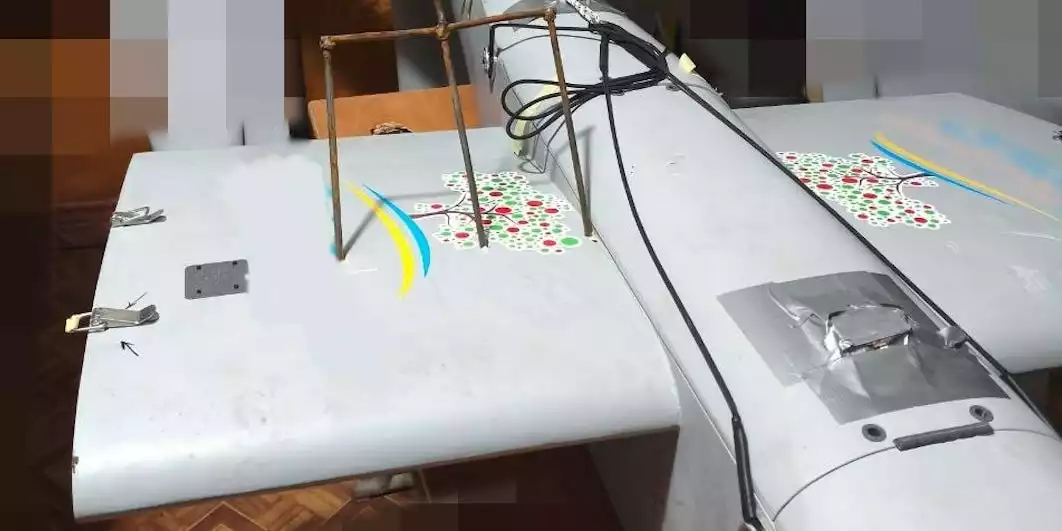
A striking episode from the Ukraine–Russia war has surfaced as a vivid illustration of how quickly uncrewed aerial warfare (UAV warfare) is evolving: a Ukrainian “Backfire” bomber drone reportedly returned from a mission with a 60-centimeter improvised steel-and-nail trident driven through its fuselage. The projectile—launched from another drone at more than 800 meters altitude—appears to be the first documented instance of a trident-style aerial countermeasure used in drone-on-drone combat.
Beyond the visceral imagery, the incident signals something more consequential for defense planners and the drone industry: the air domain at low and medium altitudes is becoming a dense, contested layer where adaptation cycles are measured in days, not years. The traditional model—ground-based air defense systems protecting forces from above—is being supplemented, and in some cases challenged, by air-launched counter-UAV tactics that are cheaper, faster to iterate, and easier to proliferate.
Key takeaways from the event are difficult to ignore:
- Improvisation is operationally relevant, not merely symbolic; low-tech mechanisms can generate real tactical effects.
- Drone-on-drone interception is expanding from ramming and electronic warfare into physical “hard-kill” methods launched from the air.
- Survivability and resilience—even for relatively low-cost platforms—are becoming differentiators as aerial attrition rises.
Drone-on-drone engagements are shifting the economics of air defense
The trident encounter underscores a central reality of the conflict: UAV saturation is forcing both sides to seek scalable countermeasures. When the sky is filled with reconnaissance drones, loitering munitions, and strike UAVs, the economic logic of air defense changes. Expensive interceptors and high-end radar-guided systems can be effective, but they are not always sustainable when targets are numerous, small, and comparatively cheap.
Ukraine’s reported ambition to produce low-cost interceptor drones at a rate of roughly 1,000 units per day reflects a strategy rooted in industrial scaling and cost-per-engagement discipline. This approach treats counter-UAV not as a boutique capability, but as a mass-manufactured consumable layer—closer in spirit to ammunition production than to traditional air defense procurement.
Russia, by contrast, is reported to be fitting some strike UAVs with air-to-air missiles, suggesting a different bet: fewer, more capable aerial assets that can defend themselves and potentially hunt other drones. These divergent approaches highlight a broader strategic fork:
- Quantity-first interception (Ukraine)
– Emphasis on rapid production, simplified designs, and distributed deployment
– Potential advantages in coverage density and replacement speed
– Heavy dependence on supply-chain continuity for motors, batteries, sensors, and radios
- Capability-first aerial armament (Russia)
– Higher per-unit cost, but potentially higher probability of kill per engagement
– Increased payload and integration complexity
– Greater reliance on specialized components and munitions supply
For defense technology firms and investors, the implication is clear: the market is increasingly rewarding systems that can be produced at scale, maintained with minimal logistics burden, and upgraded through fast iteration rather than long certification cycles.
Resilient airframes and “good-enough” lethality reshape design priorities
Perhaps the most underappreciated detail is that the Backfire drone survived despite being impaled—an outcome that points to the growing importance of airframe robustness. In a battlespace where drones face shrapnel, small arms fire, electronic warfare, collisions, and now improvised aerial projectiles, survivability is no longer reserved for high-end platforms.
This creates a design tension that will increasingly shape UAV development:
- Weight vs. durability: Reinforcement improves survivability but reduces range, payload, or endurance.
- Cost vs. resilience: Cheap drones can be expendable, but repeated losses can still overwhelm production and logistics.
- Modularity vs. structural integrity: Modular bays and quick-swap components speed repairs, but can introduce weak points.
The trident itself also illustrates the emerging principle of “good-enough lethality.” A projectile does not need sophisticated guidance if the engagement geometry is close, the target is slow enough, or the defender can create a timed intercept window. In other words, the future of counter-UAV may not always be defined by exquisite precision; it may be defined by repeatable, low-cost engagement opportunities created through tactics, numbers, and proximity.
What this signals for global drone markets, regulation, and security services
Battlefield innovation rarely stays on the battlefield. The Ukraine–Russia conflict is accelerating a global feedback loop that will influence commercial drone safety, critical infrastructure protection, and regulatory frameworks for years.
Several second-order effects are already coming into view:
- Counter-UAV as a service becomes more plausible as a commercial model, combining hard-kill interceptors with soft-kill electronic warfare and detection networks for airports, stadiums, ports, and energy sites.
- Export controls and component governance may tighten as governments recognize how readily off-the-shelf parts can be repurposed into military capabilities.
- Civilian drone engineering may absorb lessons from combat attrition—especially in collision tolerance, redundancy, navigation resilience, and rapid repairability.
The trident incident is not merely a battlefield anecdote; it is a snapshot of a new competitive landscape in which adaptability is a weapon system, manufacturing throughput is a strategic asset, and the line between improvised and industrialized capability is increasingly thin. In the contested airspace of modern conflict, the decisive advantage may belong to the side that can iterate fastest—then produce at scale.

 By
By
 By
By
 By
By

 By
By

 By
By