
A young Sun analog reveals the missing X‑ray “edge” of stellar protection
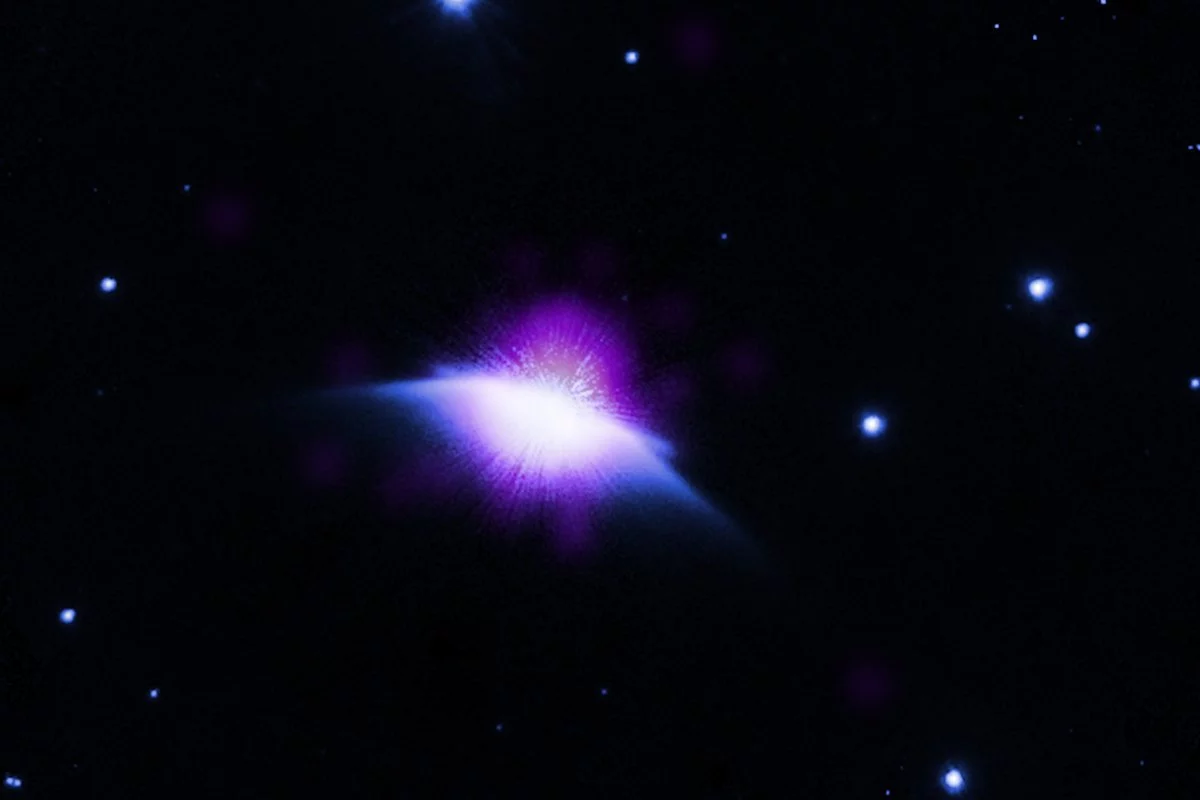
NASA’s Chandra X-ray Observatory has delivered a milestone that astrophysicists have pursued for decades: the first direct detection of an astrosphere around a Sun-like G‑type star, HD 61005, nicknamed “the Moth,” roughly 120 light-years from Earth. Astrospheres are the stellar counterparts to our heliosphere—vast bubbles carved by stellar winds that can deflect and modulate incoming cosmic rays and charged interstellar material.
What makes this detection especially consequential is not merely that it exists, but that it is measurable in a system that resembles a time capsule of our own solar past. HD 61005 is estimated to be ~100 million years old, dramatically younger than the ~5‑billion‑year‑old Sun, and it appears to be operating in a far more energetic regime. Observations indicate winds that are about three times faster and roughly 25 times denser than today’s solar wind, inflating a bubble on the order of ~200 astronomical units (AU).
The geometry is as striking as the physics: despite the star’s motion through a dense interstellar dust environment—a feature that has helped earn it the “Moth” moniker—its astrosphere remains nearly spherical. For researchers, that near-perfect symmetry is not aesthetic trivia; it is a constraint that helps separate competing explanations about how stellar winds, magnetic fields, and the local interstellar medium (ISM) negotiate the boundary where one environment yields to the other.
Why X‑ray astrosphere mapping changes the technical playbook
Historically, circumstellar environments have been inferred through infrared and radio signatures—excellent for dust and neutral gas, less direct for the high-energy particle interactions that define an astrosphere’s functional “shield.” Chandra’s contribution is to make the boundary visible in X‑rays, where emissions can trace charged particle interactions and energetic processes at or near the astrospheric interface.
That capability matters because astrospheres are not static shells; they are dynamic systems shaped by shocks, turbulence, and magnetic topology. The HD 61005 result strengthens a broader technical trajectory:
- High-energy observatories as space-environment instruments: X‑ray imaging is increasingly relevant not only to astrophysics but to radiation environment characterization, bridging heliophysics and stellar astrophysics.
- Model validation for magneto-hydrodynamic (MHD) simulations: Integrating Chandra data with MHD models refines estimates of termination shocks, boundary instabilities, and the degree of cosmic-ray modulation.
- A roadmap for next-generation missions: Future platforms such as ESA’s Athena and NASA concept missions like Lynx could extend this approach into a comparative survey—moving from a single landmark detection to a population-level atlas of Sun analog astrospheres.
For engineering and mission planning, the practical value is straightforward: better boundary physics improves forecasts of particle flux variability, which in turn improves how spacecraft designers calibrate instruments and harden systems against radiation-driven degradation.
Business and industrial implications: from deep-space risk models to sensor spinoffs
The astrosphere is often framed as a cosmic curiosity, but its real-world relevance is increasingly tangible as governments and private firms push beyond low-Earth orbit. If astrospheres govern the “background radiation climate” around planetary systems, then measuring them becomes a form of infrastructure intelligence for the space economy.
Key implications for industry include:
- Spacecraft electronics and crew protection
Better quantification of shielding effects informs radiation-hardened electronics, fault-tolerant architectures, and advanced shielding composites—all central to long-duration missions. As commercial and national programs plan lunar gateways, Mars habitats, and interplanetary logistics, astrospheric science becomes another input to probabilistic risk models alongside solar particle events and galactic cosmic rays.
- Remote sensing and space-weather adjacent markets
Techniques refined in X‑ray boundary detection can influence sensor design and data processing for monitoring high-altitude particle environments and improving satellite resilience. Over time, spinoffs may touch domains where cosmic-particle interactions are operational concerns, including aviation safety and specialized monitoring around nuclear facilities.
- Supply-chain pressure on critical components
As radiation resilience becomes a more explicit design driver, suppliers of semiconductors, composites, and shielding materials face rising expectations for certification against harsher and more variable environments. That can reshape procurement standards and elevate the strategic value of testing, traceability, and long-term reliability data.
The broader commercial signal is that “space environment” is no longer a narrow technical parameter—it is becoming a competitive differentiator, influencing cost of capital, insurance assumptions, and mission architecture decisions.
Strategic stakes: habitability metrics, policy leverage, and engineered “mini‑astrospheres”
HD 61005’s astrosphere arrives at a moment when space policy is being asked to justify big-ticket observatories not only as scientific instruments, but as platforms that de-risk future exploration and strengthen industrial capability. The discovery reinforces the case for interdisciplinary funding that connects astrophysics, heliophysics, and planetary science—especially as agencies coordinate on next-generation missions and probes such as IMAP.
Several forward-looking threads stand out:
- Exoplanet habitability and target prioritization
Habitability assessments increasingly incorporate stellar activity, atmospheric retention, and radiation exposure. Adding astrospheric strength as a parameter could re-rank targets for follow-up observations, influencing how scarce time on premium assets—such as JWST follow-ups and next-generation telescopes—is allocated.
- Planetary defense and dust/particle stream modeling
A clearer picture of boundary pressures and charged dust dynamics can feed models of interstellar object trajectories and dust stream behavior—inputs that intersect with planetary defense planning and space traffic considerations.
- A provocative engineering frontier: artificial astrospheres
Understanding how nature builds a protective plasma bubble invites serious exploration of engineered analogs—magnetically confined plasma “mini‑astrospheres” around deep-space habitats. Even if such systems remain experimental, the HD 61005 detection provides empirical grounding for the physics such concepts would rely on.
- Climate proxies and cosmogenic isotope research
If the Sun’s passage through denser interstellar regions altered cosmic-ray flux at Earth, it could leave signatures in cosmogenic isotopes preserved in ice cores. HD 61005 offers a live laboratory for testing these hypotheses with a young Sun analog embedded in a dust-rich environment.
Chandra’s view of “the Moth” is, at one level, a technical triumph in X‑ray astronomy. At another, it is a strategic data point: a measurable example of how stellar systems build—and maintain—radiation boundaries that can shape planetary environments, exploration risk, and the next wave of space-enabled industry.

 By
By
 By
By
 By
By

 By
By

 By
By