
When blockbuster AI earnings meet a skeptical market tape
Nvidia’s latest quarter delivered what most companies can only dream of: a 73% year-over-year surge in Q4 revenue, comfortably ahead of Wall Street expectations. Yet the stock still fell more than 5% in a single session, its sharpest one-day drop since mid-April. That apparent contradiction is increasingly emblematic of the current AI market cycle: investors are no longer rewarding growth alone—they are demanding credible, near-term pathways to durable margins, free cash flow, and disciplined capital allocation.
The broader market reaction underscored how tightly AI sentiment is now intertwined with macro risk. The Dow, S&P 500, and Nasdaq all declined, and February is tracking as the weakest month since March 2025. The message from public markets is not that AI demand has evaporated; rather, it is that the cost of pursuing AI scale—in silicon, power, real estate, and financing—has become impossible to ignore.
For Nvidia specifically, the sell-off reads less like a referendum on product leadership and more like a repricing of the assumptions embedded in the “AI data-center supercycle” narrative. Investors are increasingly parsing the difference between:
- Revenue acceleration driven by urgent infrastructure buildouts
- Economic value creation that depends on utilization rates, pricing power, and customer ROI
- Sustained profitability once the initial wave of capex normalizes and competition intensifies
In other words, the market is shifting from celebrating the *build phase* to interrogating the *payback phase*.
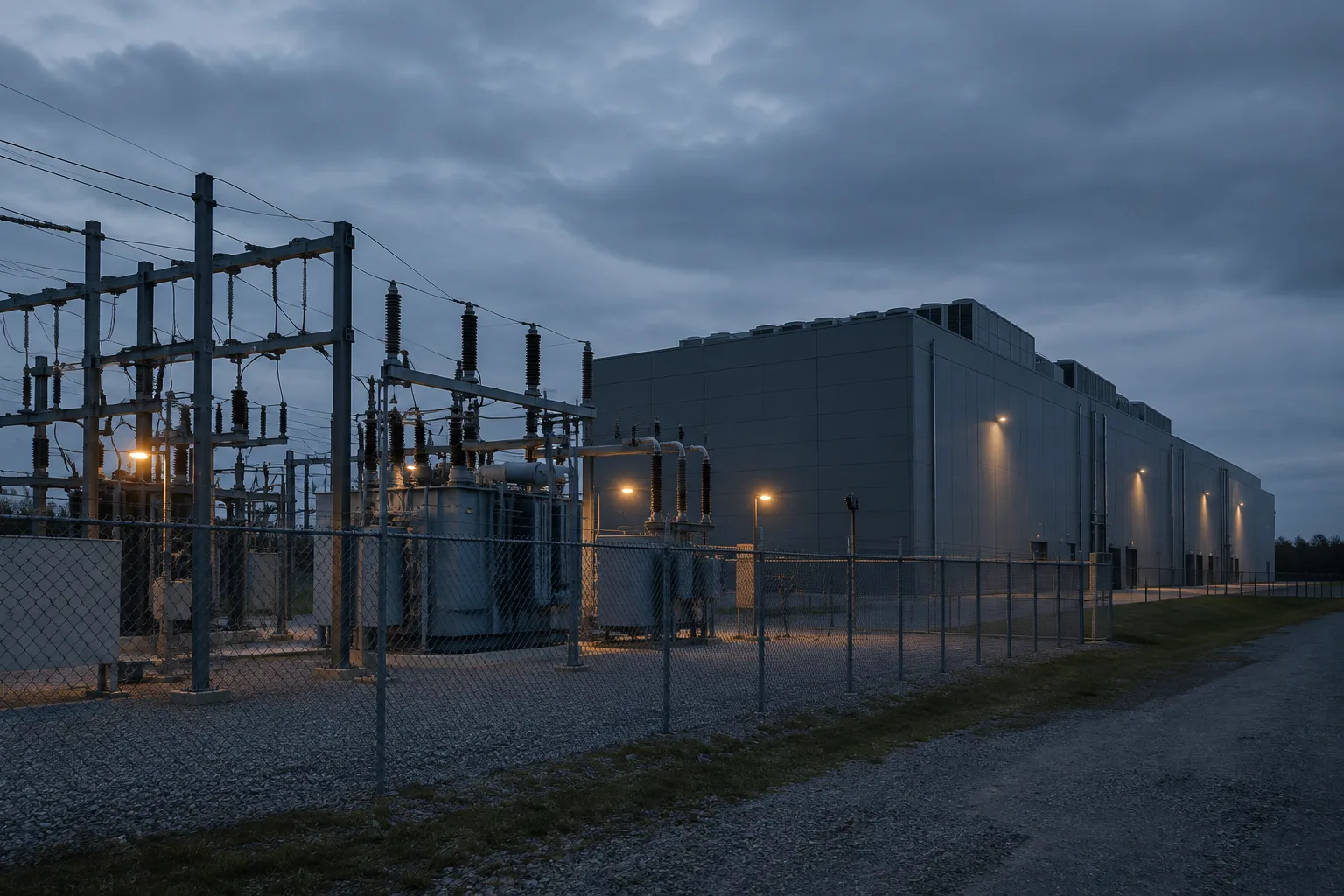
The AI data-center buildout: scale, power, and the specter of stranded assets
The rush to build AI-optimized data centers has taken on a “Moore’s Law for compute” momentum—more GPUs, more racks, more custom silicon, more hyperscale capacity. But the physical reality of AI infrastructure is now a first-order financial variable. These facilities are fixed-asset-heavy, power-hungry, and dependent on high utilization to justify their cost of capital.
That creates a new class of risk: stranded AI infrastructure. If enterprise adoption, inference workloads, or monetization timelines lag projections, the industry could be left with expensive capacity that is technically impressive but economically underutilized. The strategic question for executives is no longer “How fast can we deploy?” but “What is the marginal ROI of the next deployment versus optimizing what we already have?”
A more disciplined playbook is emerging—one that emphasizes software/hardware co-design, workload-specific accelerators, and inference efficiency rather than brute-force expansion. In practical terms, that means prioritizing:
- Higher utilization and scheduling efficiency across existing clusters
- Inference optimization (latency, throughput, cost per token) as a profit lever
- Modular, phased buildouts that reduce the risk of overcommitting to a single demand curve
- Energy-aware architecture choices, as power availability becomes a binding constraint
This is where Nvidia’s market reaction becomes instructive for the entire AI supply chain: even category-defining growth can be discounted if investors believe the ecosystem is drifting toward capex exuberance without clear unit economics.
Automation, layoffs, and the new productivity narrative in enterprise tech
While Nvidia’s results spotlight infrastructure economics, Block’s announcement of layoffs affecting nearly half its staff highlights a parallel theme: AI as an operating model, not just a product feature. Block attributed the cuts to AI-driven automation, and notably, its share price rose—a sign that equity markets are currently rewarding margin expansion and cost rationalization, even when the human impact is severe.
Yet the operational reality is more complex than the headline. Automation gains are not automatic; they depend on whether machine-learning systems are integrated into real workflows with the reliability, governance, and change management that regulated financial and payments environments require. The difference between “AI replaces tasks” and “AI improves outcomes” is often determined by unglamorous execution details:
- Data operations (DataOps/MLOps) maturity and monitoring
- Model governance (risk controls, auditability, bias and drift management)
- Systems engineering to connect models to customer-facing processes
- Workforce redesign, where remaining roles shift toward oversight, exception handling, and product iteration
Block’s move also reflects a broader corporate recalibration: the market is increasingly distinguishing automation that improves cash flow from AI initiatives that primarily expand experimentation budgets.
Capital discipline returns: inflation, rates, and the reshaping of AI dealmaking
January’s elevated producer-price inflation added another layer of uncertainty, challenging the notion that the economy is smoothly stabilizing. For AI, inflation matters less as an abstract macro indicator and more as a driver of financing costs and hurdle rates. Higher rates force companies to scrutinize long-dated projects—especially those tied to data centers, energy contracts, and specialized hardware—because the payback window stretches while the discount rate rises.
This macro pressure is already visible in the sector’s strategic divergence. On one end, marquee commitments such as Meta’s reported $60 billion engagement with AMD signal aggressive vertical integration and supply assurance—locking in compute to secure product roadmaps and competitive positioning. On the other, OpenAI’s reported decision to halve a $1.4 trillion spend plan points to a recognition that even the most ambitious AI players must reconcile vision with capital constraints.
Taken together, these moves suggest the next phase of the AI economy will be defined by selective scale rather than indiscriminate expansion. Expect more:
- Strategic partnerships and long-term supply agreements to reduce uncertainty
- M&A and licensing as mid-tier firms seek leverage against hyperscaler dominance
- Portfolio rationalization, focusing on use cases with measurable payback
- Regulatory and geopolitical friction, including export controls and antitrust scrutiny that can reshape supply chains and delay deployments
The market is not turning away from AI—it is demanding that AI mature into a business discipline. The winners will be those that can translate compute into customer value, customer value into pricing power, and pricing power into cash flow—without assuming that capital will remain cheap or patience unlimited.

 By
By
 By
By
 By
By


 By
By
 By
By
 By
By