

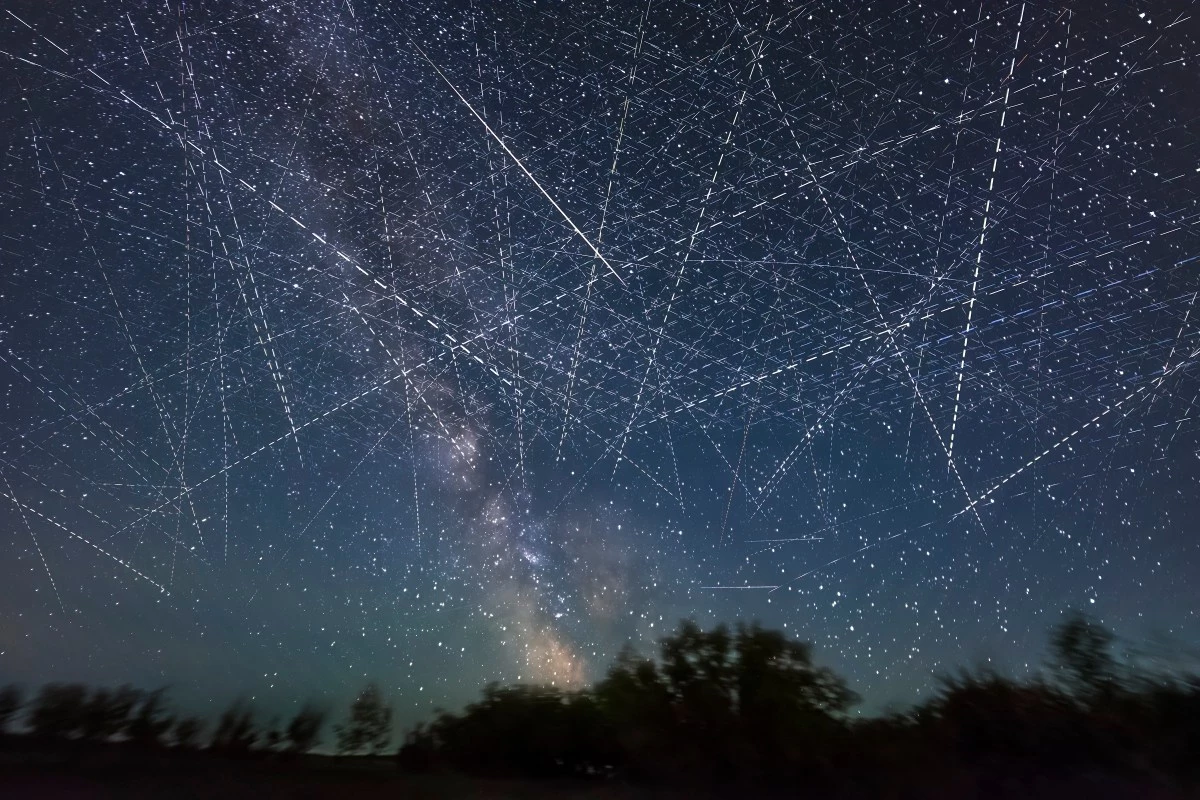

The Looming Orbital Crisis: From Exponential Growth to Systemic Risk
A silent transformation is unfolding above our heads. Low-Earth orbit (LEO), once the realm of a few hundred satellites, is now a bustling thoroughfare of nearly 8,000 active spacecraft—a number poised to balloon past 60,000 within the decade if current filings by SpaceX, Amazon, and their global peers are realized. This rapid proliferation, driven by the promise of ubiquitous connectivity and data, is colliding with the unforgiving realities of physics, risk, and governance. The specter of Kessler syndrome—an unstoppable cascade of orbital collisions—has shifted from distant science fiction to an acute, calculable threat.
The Tipping Point: Solar Storms and the “CRASH Clock”
Historically, orbital congestion was modeled as a slow-burn risk, its probability curve stretching across decades. That calculus has changed. New research reveals that a severe solar storm—akin to the Carrington Event of 1859—could abruptly disable satellite guidance systems, slashing reaction times for collision avoidance to a mere 5.5 days. In this scenario, dubbed the “CRASH clock,” collision trajectories could multiply every 36 seconds, overwhelming both human operators and automated systems.
SpaceX’s 2023 tally of over 300,000 avoidance maneuvers is a harbinger of this fragility. The industry’s reliance on deterministic collision-avoidance logic, fragmented real-time data sharing, and a patchwork of hardware standards leaves the orbital commons exposed. Most LEO satellites lack radiation hardening to NOAA’s stringent benchmarks, meaning a major geomagnetic event could trigger widespread system failures, overwhelming redundant controls and rendering swaths of the sky unmanageable.
- Orbital Carrying Capacity: Unlike the electromagnetic spectrum, orbital slots are not infinitely reusable. Every collision halves usable altitude bands and exponentially complicates station-keeping.
- Navigation Autonomy Limits: AI-driven deconfliction remains in its infancy, and cross-operator coordination is hampered by incomplete information.
- Hardware Hardening Gap: The majority of satellites are ill-equipped to withstand severe space weather, creating systemic vulnerability.
Economic Exposure: The Hidden Fragility of the Space-Enabled Economy
The stakes transcend the space sector. LEO satellites underpin broadband, earth observation, IoT, and positioning services—together forming the backbone of logistics, agriculture, finance, and energy, and touching nearly 5% of global GDP. A multi-day outage, triggered by orbital chaos, could erase tens of billions in output—an economic shock on par with a global cyberattack.
The insurance markets have already responded, with premiums for LEO assets soaring 20–40% for launches post-2022. A Kessler-linked loss event could force a wholesale rewrite of reinsurance treaties, reminiscent of the seismic shifts in aviation coverage after 9/11. Meanwhile, mega-constellation operators face mounting capital expenditures for satellite replenishment, with little margin for regulatory or operational surprises. For governments, the growing reliance on private constellations for defense and emergency communications means commercial fragility could swiftly morph into national-security exposure.
- Downstream Revenue at Risk: Disruptions ripple through critical supply chains and financial systems.
- Insurance Capacity Crunch: The scale of potential losses threatens the viability of current risk pools.
- CapEx Overhang: Investors may be underestimating the impact of congestion fees or regulatory moratoria.
- Sovereign Balance-Sheet Risk: Public reliance on commercial space assets blurs the line between private enterprise and national infrastructure.
Strategic Imperatives: Steering Away from Catastrophe
The path forward demands a synthesis of technological innovation, market incentives, and proactive governance. Industry and policy leaders must act before the orbital commons becomes irreparably compromised.
- Space Traffic Management (STM): The sector needs a neutral, near-real-time data clearinghouse—akin to SWIFT for LEO trajectories—to move beyond bilateral alerts and enable coordinated action.
- Debris-Neutral Design: Licensing and spectrum rights should be tied to demonstrated end-of-life deorbit capabilities and on-orbit servicing contracts, mirroring decommissioning bonds in offshore energy.
- Active Debris Removal (ADR): Market mechanisms such as orbital pollution credits or tax incentives could internalize the externalities of debris, much like carbon markets.
- Geomagnetic Hardening: Satellite system requirements must align with international standards, with phased mandates for new launches.
- Sector Stress-Testing: Regulators should require disclosure of satellite-dependency scenarios in corporate risk filings, paralleling climate-related financial disclosures.
Investors are beginning to treat orbital stewardship as an ESG imperative, and proxy motions on space sustainability are likely to become mainstream by 2026. The geopolitical dimension looms large: LEO congestion is now entangled with great-power rivalry, and anti-satellite capabilities threaten to weaponize debris creation. Cooperative debris mitigation could emerge as a diplomatic lever on par with nuclear test-ban treaties.
The Space Economy’s Precarious Ascent
Low-Earth orbit is no longer a boundless frontier—it is a congested, systemically vital layer of global infrastructure. The convergence of exponential satellite deployment and episodic space weather has created a risk curve too steep to ignore. Whether the space economy can continue its ascent will depend on the industry’s willingness to embrace robust governance, technological hardening, and market-aligned incentives. The coming years will determine if LEO becomes a sustainable platform for innovation—or a cautionary tale of unchecked ambition.

 By
By
 By
By

 By
By
 By
By

 By
By
 By
By







