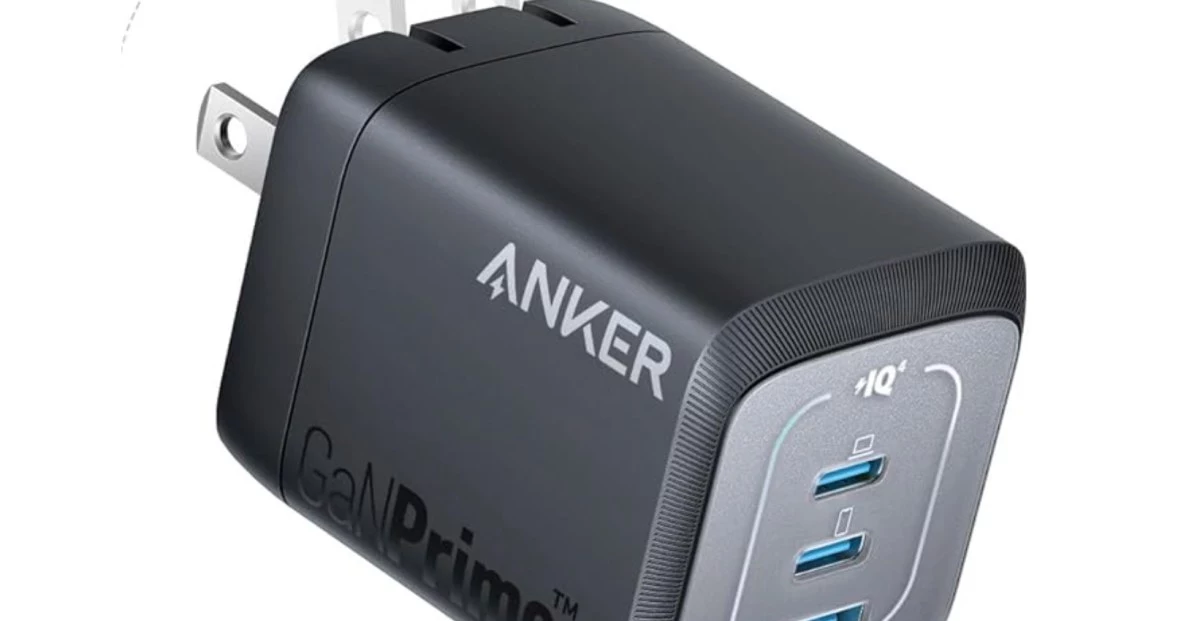

The Humble Charger as Harbinger: Anker’s 67W GaN Device and the Quiet Revolution in Power Electronics
A $34.99 travel charger, discounted ahead of the holiday rush, rarely commands headlines. Yet, beneath Anker’s promotion of its Prime 67W GaN charger, a deeper narrative unfolds—one that speaks to the convergence of semiconductor innovation, regulatory harmonization, and shifting consumer mobility. This is not merely a seasonal sale; it is a microcosm of the tectonic shifts reshaping the global power-accessory landscape.
Gallium Nitride’s Coming-of-Age and the USB-C Mandate
At the heart of Anker’s device lies gallium nitride (GaN), a material whose journey from niche to mainstream mirrors the broader evolution of the consumer electronics ecosystem. GaN’s efficiency—approaching 94% in this generation—delivers tangible benefits: lighter thermals, smaller form factors, and the kind of retractable-prong, shirt-pocket design that defines contemporary industrial aesthetics. The 67W power envelope, once reserved for premium early adopters, now lands comfortably in the sub-$40 mainstream, thanks to maturing supply chains and increasing wafer yields from foundries across Taiwan and Japan.
But the charger’s significance is not just material. Its dual USB-C ports, alongside a legacy USB-A, reflect a strategic anticipation of the regulatory future—most notably the European Union’s 2024 mandate for USB-C interoperability. This convergence is more than compliance; it is a calculated move to capture both the future-facing USB-C market and the long tail of legacy USB-A peripherals. Underneath, a microcontroller orchestrates dynamic power allocation across three ports, a quiet testament to the embedded intelligence that will soon underpin smart-home energy management and IoT integration.
Market Dynamics: Margins, Channels, and the Accessory Gold Rush
The global context for this release is equally telling. As smartphone giants like Apple and Samsung continue to exclude chargers from their boxes, the total addressable market for third-party power accessories expands, with margins that routinely outpace those of the handsets themselves. Anker’s early Q4 discounting—30% off at the start of the holiday quarter—signals more than generosity. It suggests a strategic channel fill, designed to stimulate demand and avoid the specter of post-holiday inventory write-downs. This pricing cadence, subtle but significant, offers a window into the cautious sentiment pervading the consumer electronics sector as 2024 approaches.
The GaN cost curve, meanwhile, is flattening. As device costs approach parity with traditional silicon at sub-100W nodes, manufacturers can offer advanced features without eroding margins—a development that will only accelerate as foundry capacity scales and economies of learning compound.
Ecosystem Strategies and Competitive Tensions
Anker’s approach is not merely transactional; it is architectural. By investing in UL/ETL certifications and leveraging Amazon’s review economy, the brand builds trust moats that low-cost, white-label competitors struggle to breach. The charger becomes, in effect, a proxy for safety and reliability—a modern echo of the “Intel Inside” era, where branding doubled as certification.
More strategically, Anker’s bundling of chargers with PowerCore batteries and Qi-2 wireless pads hints at a modular ecosystem, designed to create attach-rate synergies. This mirrors Apple’s MagSafe orbit, where each accessory reinforces the gravitational pull of the brand’s universe. Yet, the competitive landscape is fluid. Should OEMs reclaim charger revenues by bundling their own GaN devices or deploying proprietary fast-charge protocols, the third-party accessory share could compress. The moves of players like Oppo and OnePlus, with their 100W SuperVOOC technologies, bear close watching as early signals of this shift.
Beyond the Outlet: Cross-Industry Ripples and the Edge of Innovation
The implications of this charger reach far beyond the consumer’s suitcase. In aviation and hospitality, the reduced electrical load and capital expenditure of GaN chargers align with ESG-driven efficiency targets, enabling airlines and hotels to retrofit infrastructure with minimal disruption. The rise of the nomadic knowledge worker—untethered from the fixed desk—drives demand for lightweight, multi-port power solutions, echoing the laptop-to-tablet migration of a decade ago.
Perhaps most intriguingly, R&D investments in consumer GaN chargers are quietly accelerating competence in high-voltage applications, such as 650V automotive inverters. This cross-pollination is closing capability gaps between consumer electronics fabs and Tier-1 automotive suppliers, setting the stage for a new era of vertical integration in power electronics.
For industry leaders, the lessons are clear:
- Bundle and Differentiate: Pair GaN chargers with high-margin peripherals to capture value in a regulatory environment favoring USB-C uniformity.
- Read the Channel: Early Q4 discounting is a canary in the coal mine—adjust inventory and expectations accordingly.
- Invest in Intelligence: The next frontier is not just efficient electrons, but smart, connected power nodes that monetize data as well as energy.
The Anker Prime 67W GaN charger, then, is more than a travel accessory. It is a bellwether for the power-delivery architectures of tomorrow—a modest device, quietly signaling the next wave of innovation at the intersection of semiconductors, regulation, and user experience.


 By
By
 By
By


 By
By

 By
By