
When Humanoids Take the Court: A New Chapter in Robotic Dexterity
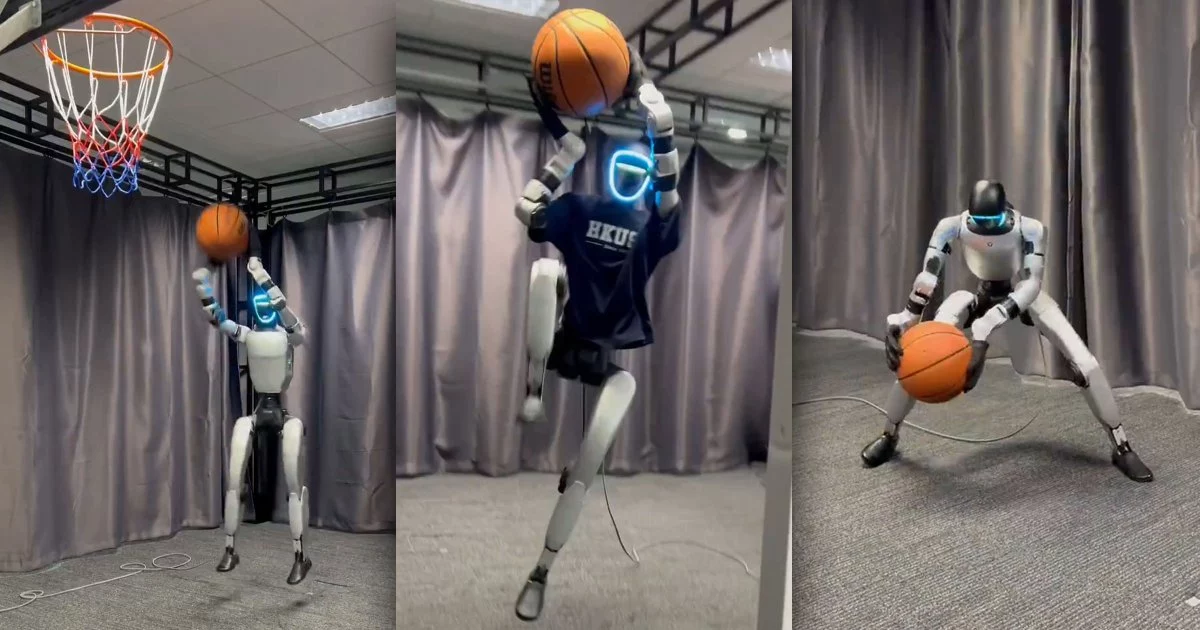
In a scene that might have once belonged to speculative fiction, a humanoid robot—Unitree’s G1—steps onto the basketball court at the Hong Kong University of Science and Technology (HKUST). Weighing in at 34 kilograms and powered by 33 actuators, the G1 pivots, dribbles, and executes jump shots with a fluidity that blurs the line between machine and athlete. This is not merely a technical spectacle; it is a harbinger of how robotics, powered by advanced imitation learning, is poised to redefine the boundaries of human–machine collaboration.
The SkillMimic Paradigm: From Human Motion to Robotic Mastery
At the heart of this breakthrough is “SkillMimic,” a data-driven learning pipeline that fuses motion-capture data of human–ball interactions with model-based control. Unlike traditional reinforcement learning, which often relies on millions of simulated iterations, SkillMimic leverages curated libraries of human motion. This approach dramatically reduces sample complexity and, crucially, provides deterministic safety bounds—an essential consideration when deploying humanoids in the real world.
The technical demands are formidable. The G1’s vision system must track a 24-centimeter basketball moving at up to 7 meters per second, solve six-degree-of-freedom pose estimation, and predict ball trajectories—all with sub-100 millisecond latency. These are benchmarks that have migrated from the world of autonomous vehicles to the more precarious, bipedal domain of humanoid robots.
Perhaps most significantly, the demonstration is less about basketball as a sport and more about the seamless chaining of complex skills. The ability to fluidly compose actions—dribble, pivot, shoot—without explicit transition data is a prerequisite for robots to operate in unstructured environments, from logistics warehouses to eldercare facilities.
Market Ripples: Investment, IP, and the Future of Labor
The economic implications of this technological leap are profound. Global venture capital investment in humanoid robotics surpassed $2.3 billion in 2023, with Asia rapidly asserting itself as a major player in the “robot-as-labor” ecosystem. HKUST’s work signals not only technical prowess but also regional ambition, echoing Asia’s earlier dominance in the commercial drone sector.
The commoditization of hardware, exemplified by Unitree’s decision to price the G1 at around $16,000 for developers, is reminiscent of the inflection point drones reached a decade ago. As ruggedized actuators and affordable platforms proliferate, the entry barrier for academic and enterprise R&D drops precipitously.
But the true economic engine may lie in data. Proprietary motion libraries—potentially derived from elite athletes—could become valuable intellectual property, spawning subscription-based “skill packs.” Sports leagues and talent agencies may soon find themselves licensing not just likenesses, but kinematic signatures. Meanwhile, brands and sponsors are likely to see humanoids as the next frontier in advertising: tireless, injury-proof, and unencumbered by labor regulations.
Strategic Fault Lines: Regulation, Risk, and the Road Ahead
For corporations, the arrival of dexterous humanoids invites both opportunity and caution. Early adopters are wise to view these robots as flex-capacity assets—ideal for peak-load scenarios, but not yet full human replacements. The calculus of return on investment will hinge on uptime, battery cycles, and mean time between failures—metrics that remain in flux as the technology matures.
The integration of humanoids into digital twin environments—already standard in advanced manufacturing—offers the tantalizing prospect of transferring motion policies directly from simulation to the factory floor, compressing deployment timelines and amplifying operational agility.
Yet, the risks are nontrivial. The benign setting of a basketball court belies the potential hazards of multi-degree-of-freedom robots with kilowatt-level joint output. Insurers and regulators will demand rigorous proof of failsafe mechanisms, torque limits, and auditable firmware.
Geopolitical considerations further complicate the landscape. Export controls on high-performance servos in China and U.S. restrictions on edge AI accelerators threaten to bifurcate supply chains, prompting enterprises to explore component localization and cross-licensing strategies.
The Emergence of Synthetic Athletes and Beyond
Looking forward, the implications extend well beyond the basketball court. In the next 12 to 18 months, expect to see pilot programs where humanoids perform repetitive sports drills in collegiate settings—ideal sandboxes for iterative refinement. Within two to three years, frameworks like SkillMimic are likely to generalize to service sectors, from retail restocking to last-meter delivery.
On a longer horizon, the convergence of generative AI and motion imitation could yield “synthetic athletes” capable of inventing plays and tactics beyond human imagination, feeding analytics firms and even reshaping betting markets. The very notion of labor may be renegotiated, as collective bargaining units emerge around “robot labor minimums”—a parallel to the evolution of carbon credits.
HKUST’s G1 demonstration is more than a showcase; it is a signal that humanoid robotics is entering a new era of reproducible, data-centric skill acquisition. For executives and strategists, these developments are not mere curiosities, but early proxies for a future where cross-domain dexterity becomes the norm, not the exception. The court, it seems, is only the beginning.

 By
By
 By
By

 By
By
 By
By