
A New Contender in High-Brightness Home Projection
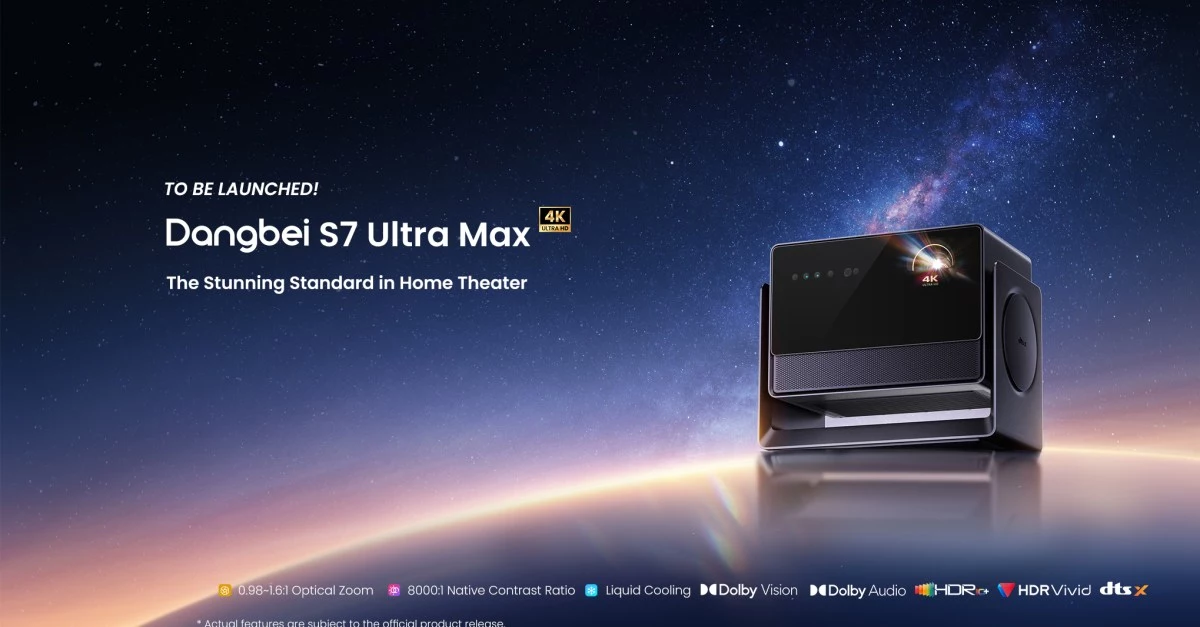
In the grand halls of IFA Berlin, where the future of consumer technology is annually staged, Dangbei’s unveiling of the S7 Ultra Max signals more than a product launch—it marks a pivotal moment in the evolution of home entertainment hardware. The S7 Ultra Max, previously a domestic marvel in China, is now poised for Western scrutiny, bringing with it a formidable 6,200-ISO-lumen RGB-laser engine, Dolby Vision processing, and a price tag that undercuts established titans. Its arrival is not just a technical exhibition but a strategic incursion into a market long dominated by legacy brands.
Engineering Brilliance: The Anatomy of the S7 Ultra Max
At the heart of Dangbei’s flagship lies a tiled-array of 48 discrete RGB laser modules, a configuration reminiscent of cinema-grade projection systems. This architecture, paired with advanced gallium-nitride (GaN) diodes and refined optical coatings, delivers a color spectrum and brightness envelope that, on paper, rivals commercial installations. The leap from CVIA to ISO lumen measurements—where ISO typically yields more conservative, globally recognized figures—serves as a calculated move to address Western skepticism over inflated specs. If Dangbei’s claims withstand ANSI-lumen verification, the S7 Ultra Max could redefine consumer expectations for real-world projector brightness.
Thermal management, often the Achilles’ heel of high-density optics, is addressed through an innovative liquid cooling system. This not only sustains peak performance in a compact chassis but also maintains acoustic output at a whisper-quiet 24 dB SPL, a feat more commonly associated with premium ultrabooks than home theater gear. The implications extend beyond projectors; as liquid cooling migrates into consumer electronics, it may foreshadow a broader shift in how high-performance devices are engineered and perceived.
The projector’s image processing suite, highlighted by native Dolby Vision and HDR10+ support, positions Dangbei alongside industry leaders like LG and Sony. In an era when studios increasingly master content in Dolby Vision, this compatibility is not mere window dressing—it is essential for Western market penetration. The adaptive swivel base and fully automated geometric correction further address the spatial constraints of urban living, reducing installation friction to that of a modern smart TV.
Market Dynamics: Pricing, Competition, and Strategic Positioning
Dangbei’s pricing strategy is as aggressive as its technology is ambitious. At approximately $2,250, the S7 Ultra Max lands squarely between budget projectors and flagship models from incumbents such as Epson and XGIMI, offering premium brightness at a premium-mid price. This move pressures competitors to accelerate their own GaN-laser development, potentially igniting a price–lumens arms race in the coming year.
The choice of IFA Berlin as a launchpad is no accident. Europe’s sustained double-digit growth in home projection, fueled by post-pandemic hybrid living, offers fertile ground for Dangbei’s expansion. The region’s regulatory climate, especially as Brussels revisits energy efficiency standards for large-format displays, may also play to the strengths of solid-state laser projection—an area where Dangbei’s technology holds a distinct advantage.
The shift from CVIA to ISO standards is more than technical compliance; it is a reputational recalibration. Western consumers and reviewers, long wary of “spec sheet inflation,” are likely to welcome this move toward transparency. Should Dangbei’s ISO claims be validated by independent ANSI-lumen testing, the company could rapidly establish itself as a credible disruptor in a market hungry for innovation and authenticity.
The Broader Canvas: Implications for Industry and Innovation
The S7 Ultra Max is emblematic of a larger convergence in component technologies. Its GaN laser and liquid-cooling stack echo advancements in electric vehicle battery management and 3D-sensing LiDAR, suggesting opportunities for cross-industry collaboration and supply-chain leverage. For decision-makers in display, semiconductor, and content sectors, Dangbei’s foray into Europe should be read as an inflection point: laser-array projection is exiting its niche, and standards harmonization is emerging as a key differentiator.
As home-theater spending continues to outpace broader electronics categories, the economics of premium projection are shifting rapidly. With GaN diode costs falling and performance rising, the prospect of 8,000-lumen consumer projectors at accessible price points is no longer distant. The competitive response—faster product cycles, dual-laser architectures, and intensified streaming-service partnerships—will shape the next chapter of the industry.
Ultimately, Dangbei’s S7 Ultra Max is more than a product; it is a harbinger of the new normal in home entertainment. For those watching the intersection of technology, market strategy, and consumer experience, the coming months will reveal whether this bold gambit can translate technical prowess into lasting market influence.
 By
By
 By
By

 By
By
 By
By

 By
By