

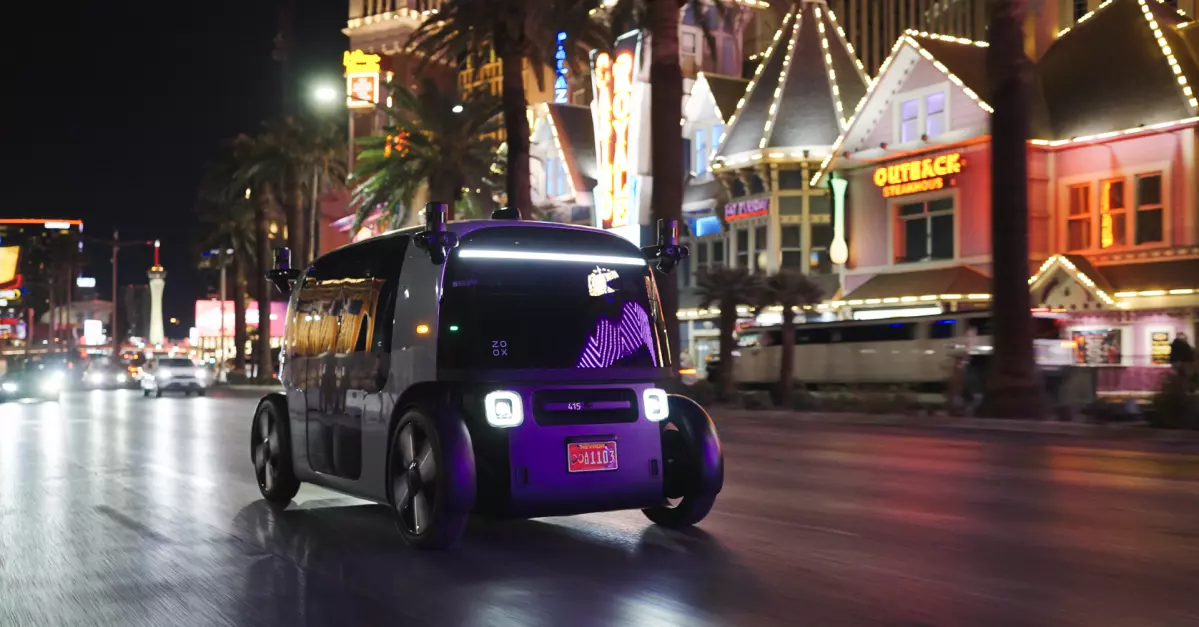

Reinventing Urban Mobility: Zoox’s Purpose-Built Robotaxis Take the Las Vegas Strip
Amazon’s Zoox has quietly rewritten the playbook for autonomous mobility, launching a fleet of steering-wheel-free robotaxis along the Las Vegas Strip—a corridor where spectacle and commerce collide. The debut, though limited in scope and speed, signals a pivotal shift in both the technology and business models underpinning the next wave of urban transportation.
Engineering for Density: The Architecture of Urban Autonomy
Zoox’s vehicles are not retrofitted sedans or SUVs; they are purpose-built, symmetrical carriages that shed the vestiges of traditional driving—no steering wheel, no pedals, no front or back. This design unlocks a social, lounge-like interior, transforming transit from a transactional necessity into an experiential differentiator. For tourists shuttling between neon-lit landmarks, the ride itself becomes part of the Las Vegas experience.
Under the hood, a sophisticated sensor fusion stack—combining 360-degree cameras, lidar, and radar—enables the robotaxi to navigate the Strip’s dense pedestrian flows and unpredictable curb events. By capping speeds below 45 mph, Zoox reduces both risk and computational complexity, allowing the autonomy software to mature in a controlled environment before tackling more chaotic arterial roads. This deliberate, geo-fenced rollout mirrors the risk-mitigation strategies of aerospace, rather than the blitz-scaling ethos of early ride-hailing.
The vehicles’ flat floors and modular interiors hint at a future where passenger and logistics applications converge. In off-peak hours, seats could give way to parcel lockers, aligning with Amazon’s broader logistics ambitions and foreshadowing a seamless blend of people and package mobility.
Economic Dynamics: Subsidized Entry and the Cloud-Logistics Flywheel
Zoox’s initial offering is free—a calculated move to accelerate adoption, gather live operational data, and build brand equity among a transient, high-visibility audience. This strategy not only lowers the psychological barrier for first-time riders but also transforms every trip into a data-rich training run, with real-time telemetry offloaded to AWS. Here, Amazon’s cloud infrastructure becomes a competitive moat: each mile driven sharpens the algorithms, deepens the data reservoir, and reinforces Amazon’s dominance in both cloud and mobility.
The economics diverge sharply from labor-based ride-hailing. By eliminating drivers, Zoox addresses mounting labor shortages and wage pressures, but the capital intensity shifts to high-value hardware and compute. Amazon’s deep pockets and existing logistics spend provide insulation that smaller autonomous vehicle (AV) startups lack, setting the stage for accelerated market consolidation and a new era of capital-driven competition.
Competitively, Zoox’s move is a shot across the bow of Waymo, Cruise, and traditional automakers. Where others retrofit, Zoox reimagines; where rivals target urban commuters, Zoox courts the tourist micro-market, sidestepping direct overlap while gathering operational data in an environment rich with edge cases—high pedestrian density, frequent curbside stops, and a constantly shifting rider base.
Policy, Platform, and the Next-Gen Urban Experience
Federal regulators’ green light for Zoox’s unconventional interiors establishes a critical precedent, nudging policymakers toward a future where vehicles without manual controls become the norm. Nevada’s business-friendly regulatory environment may soon serve as a blueprint for other states eager to attract AV investment, reminiscent of Arizona’s early embrace of drones and self-driving pilots. Yet, as Zoox eyes San Francisco—a city still reeling from high-profile AV incidents—the company will need to navigate a labyrinth of municipal agencies, labor unions, and a public increasingly attuned to the risks and rewards of autonomy.
For Amazon, the Las Vegas Strip is more than a testbed—it’s a product showcase. High-footfall venues double as immersive showrooms for Amazon’s hardware, Prime services, and, potentially, in-vehicle commerce. The robotaxi’s interior screens could soon become coveted ad inventory, transforming idle passenger minutes into monetizable engagement. Meanwhile, the vehicle’s modularity and continuous data streams position Amazon to weave its mobility platform into an end-to-end logistics mesh, integrating with warehouse robots, sidewalk bots, and aerial drones.
Strategic Signals for Industry Stakeholders
The implications ripple far beyond ride-hailing:
- Mobility as Experience: Hospitality and retail leaders should prepare for a world where the ride itself becomes a revenue-generating engagement window—think dynamic pricing, loyalty sign-ups, and contextual commerce.
- Capital-Driven Consolidation: As the industry’s gravitational center shifts to capital expenditure and cloud integration, expect a wave of M&A as smaller AV firms seek shelter within larger logistics or technology conglomerates.
- Policy as Strategic Imperative: The regulatory frontier is now a board-level concern, demanding governance structures akin to those for data privacy or ESG.
- Geo-Fenced Rollouts: Adjacent vendors—micromobility, curb management, fleet charging—would do well to focus on dense, high-visibility micro-markets where AV operators can quickly achieve operational mastery.
- Talent and IP Convergence: The fusion of robotics, AI, and automotive supply chains demands a fresh look at build-versus-partner strategies, especially in sensor fusion and in-vehicle user experience.
Zoox’s Las Vegas deployment is less a moonshot than a meticulously staged proof point—one that validates a new paradigm for autonomous mobility, harvests operational data under real-world conditions, and positions Amazon to redefine the intersection of passenger transport, logistics, and digital commerce. Those who view this merely as another ride-hailing experiment risk missing the broader transformation underway: the emergence of mobility platforms as the connective tissue of urban life in the AI era.

 By
By

 By
By
 By
By
 By
By

 By
By
 By
By







