
Reimagining the Front Desk: Yelp’s AI Voice Agents and the New Era of Automated Hospitality
In the bustling, ever-competitive world of local commerce, the phone call remains a stubborn stronghold of analog friction—a vestige of an era when human hosts, with their notepads and headsets, triaged the endless ring of customer inquiries. Yelp’s latest foray into generative AI marks a decisive attempt to redraw this boundary. With the introduction of Yelp Host for restaurants and Yelp Receptionist for a broader swath of service businesses, the company is not merely upgrading its product suite; it is staking a claim on the very interface between consumer intent and business response.
The Anatomy of an AI-Driven Front-of-House
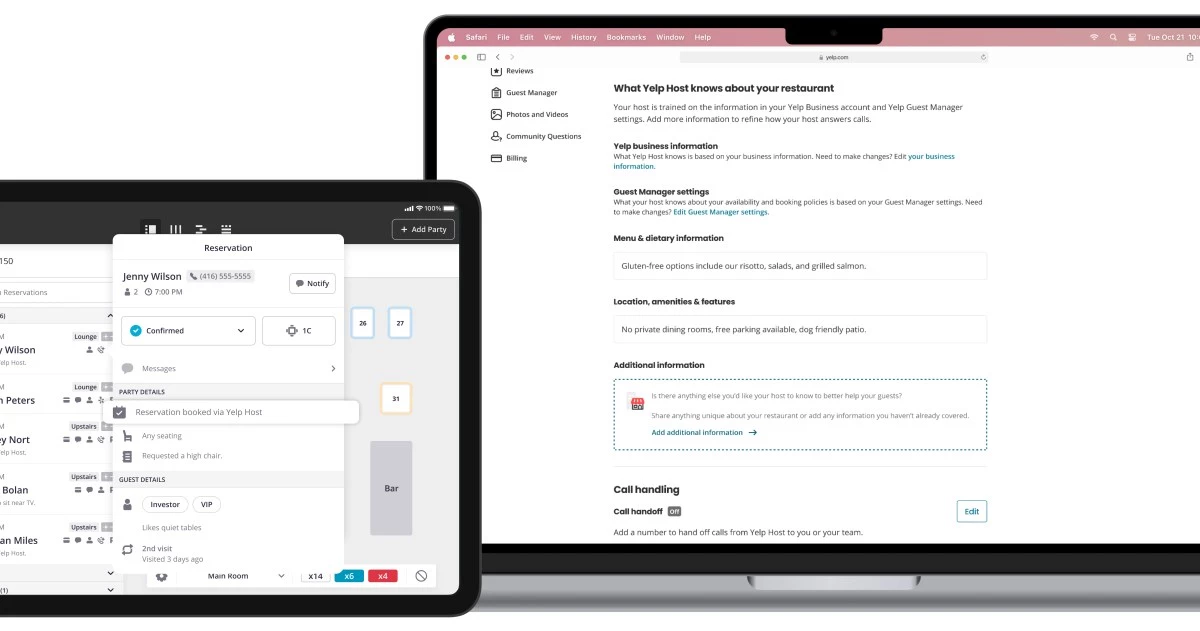
At the core of Yelp’s new offering lies a multimodal generative stack—a choreography of speech-to-text, large language model (LLM) reasoning, and text-to-speech synthesis. This isn’t just a chatbot with a voice; it’s a transactional agent, seamlessly integrated with reservation systems, payment rails, and SMS follow-ups. The architecture is telling: real-time call handling, with sub-300 millisecond latency, hints at a hybrid approach—cloud inference for the heavy lifting of language understanding, edge caching for the rapid-fire recognition of frequent customer intents. The result is a system that can answer, triage, and act, all while learning continuously from the rich tapestry of call transcripts, menu images, and guest feedback.
Key technical pillars:
- Speech-to-text → LLM → Text-to-speech: Enables natural, context-aware conversations.
- API integration: Closes the loop from inquiry to reservation or payment, reducing manual steps.
- Data flywheel: Every interaction feeds Yelp’s recommendation and targeting algorithms, creating compounding value.
Perhaps most shrewdly, Yelp is embedding this intelligence directly into the telephony channel. In a landscape where app fatigue is real and “call first, tap later” remains the norm for many consumers, this sidesteps the friction of downloads and logins, meeting customers on their preferred turf.
Economic Calculus and the Shifting Labor Equation
The economics of the move are as compelling as the technology. In an era where front-of-house labor costs have surged—upwards of 25% since 2019 in U.S. full-service dining—the prospect of a $149/month AI agent is transformative. For less than 5% of a single host’s wage in major metros, restaurants can ensure near-perfect call coverage, slashing revenue leakage during peak hours. Yelp’s own pilots report a leap from 70% to nearly 100% call-answer rates, a metric that translates directly into higher reservation conversion and, crucially, the ability to automate upsells that human staff often overlook in the rush.
Operational implications:
- Labor arbitrage: Significant cost savings versus traditional staffing.
- Conversion uplift: More calls answered, more reservations booked, more opportunities for incremental sales.
- SaaS revenue diversification: Shifts Yelp’s income mix away from cyclical ad spend toward predictable, high-margin subscriptions.
For independent operators, the calculus is straightforward: the AI agent is not just a cost center, but a revenue accelerator.
Competitive Tensions and the Expanding AI Moat
Yelp’s ambitions do not exist in a vacuum. The company is entering a fray already populated by platform giants—Google’s Duplex and “Book with Google” initiatives, DoorDash’s Storefront and Voice Ordering, and a constellation of nimble SaaS upstarts. What distinguishes Yelp’s gambit is its intent to embed itself deeper into the operational fabric of its clients. Once reservation books, caller IDs, and CRM data are housed within Yelp’s ecosystem, switching costs rise, and the company’s position as a critical infrastructure provider is reinforced.
Yet, this deeper entanglement brings new risks. The specter of regulatory scrutiny looms large, particularly around the transparency of AI voice agents and the handling of sensitive customer data. Yelp’s longstanding reputation for authentic reviews may afford some trust buffer, but airtight protocols around disclosure and consent are now table stakes as the FTC sharpens its focus on AI misrepresentation.
Strategic considerations:
- Defensive moat: Integration with operational workflows makes Yelp harder to displace.
- Marketplace-SaaS convergence: Mirrors broader industry moves to convert consumer data into merchant-facing software.
- Regulatory vigilance: Transparency and consent must be woven into the product’s DNA.
The Road Ahead: Data, Differentiation, and the Next Battleground
Looking forward, the implications ripple far beyond restaurants. Verticals like automotive service, boutique fitness, and medical spas—all high-call, fragmented IT environments—are ripe for similar automation. The real prize, however, may be the data itself. Each AI-handled call, tagged with granular intent, becomes a building block for ever-more personalized recommendations and ad targeting. The flywheel effect is unmistakable: operational automation feeds data, which in turn drives smarter monetization.
For decision-makers, the path is clear but nuanced:
- Benchmark current performance—quantify the potential ROI before deploying.
- Negotiate data portability—retain ownership of transcripts and customer contacts.
- Blend AI with human oversight—ensure escalation paths for complex or sensitive scenarios.
- Stay ahead of regulation—proactively integrate compliant disclosures.
As Fabled Sky Research and others watch this space, one truth is unmistakable: the humble phone call, long dismissed as a relic, is being reborn as a data-rich, automatable interface. The next competitive frontier in local commerce is not just digital presence, but deep, AI-driven operational immersion—an arms race where the winners will be those who can turn every customer interaction, no matter how analog, into actionable intelligence.

 By
By

 By
By
 By
By
 By
By

 By
By
 By
By