

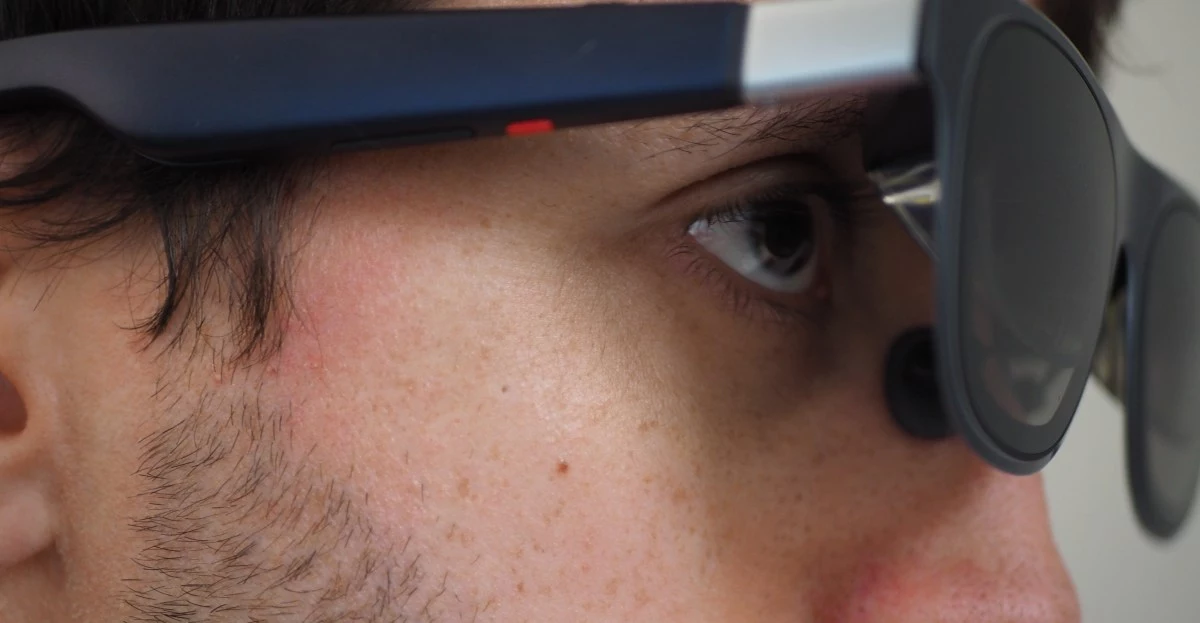

Portable AR glasses for handheld gaming are maturing—unevenly, and at a premium
A new wave of AR display glasses is trying to solve a familiar problem for handheld-console players: how to get a large, stable screen anywhere without hauling a monitor. Xreal’s 1S ($449) and One Pro ($649), alongside Viture’s Beast ($549), position themselves as “virtual TV” companions for devices like Steam Deck-class handheld PCs and modern consoles—yet their differences reveal a category still negotiating what matters most: comfort, optics, audio, and compatibility.
All three products lean on three degrees of freedom (3DoF) stabilization to keep a floating screen from drifting with small head movements. That choice is telling. 3DoF is a pragmatic response to early AR discomfort—wobble, jitter, and the subtle nausea that can come from a screen that doesn’t feel anchored. But it is also an implicit admission that these devices are not aiming for full spatial computing. They are, first and foremost, portable displays—and the market is now debating which trade-offs are acceptable at $450–$650.
3DoF stabilization: a meaningful fix, but not the endgame for XR
The adoption of 3DoF across all three models signals an industry consensus: stabilization is no longer optional if AR glasses are to be used for long gaming sessions, travel, or streaming. For handheld gamers, the value proposition is straightforward—less drift, fewer micro-adjustments, and a screen that feels more “locked” in space.
At the same time, 3DoF remains a transitional technology. It improves viewing comfort, but it does not deliver the natural movement and positional tracking associated with 6DoF systems. That distinction matters strategically:
- For consumers, 3DoF is often “good enough” for a virtual screen, but it sets expectations: these are not VR headsets, and they won’t transform gameplay into room-scale immersion.
- For product teams and investors, 3DoF is a stepping stone toward 6DoF—where inside-out tracking, environmental understanding, and low-latency processing become decisive differentiators.
- For ecosystem players (console OEMs, chip vendors, XR platforms), the real contest is whether AR glasses remain tethered display accessories or evolve into wireless, tracked, platform-grade devices.
In that light, the current generation looks like a bridge: stabilizing the basics while the industry works through the harder problems of optics miniaturization, power efficiency, thermal management, and tracking compute.
Optics, audio, and ergonomics: three products, three philosophies of “immersion”
Where these devices diverge most sharply is in how they define immersion. The reporting highlights a clear segmentation: comfort and sound (Xreal 1S), visual punch (Viture Beast), and a premium middle path (Xreal One Pro).
Xreal 1S emerges as a comfort-first design, anchored by an 85-gram frame and Bose-tuned drivers. That combination reflects a broader shift in XR hardware: audio is moving from “included” to strategic. For gaming, spatial cues, dialogue clarity, and fatigue reduction can matter as much as pixel-level sharpness—especially in portable contexts where users may not want earbuds.
Viture Beast, by contrast, is positioned as the visual maximalist. Its standout is contrast and color saturation described as approaching OLED-TV “punch,” enabled by proprietary micro-display choices. Yet it also illustrates a recurring friction point in AR marketing: “4K-like” claims that stop short of straightforward native-resolution messaging. That gap is not merely semantic; it reflects the engineering and cost constraints of delivering true high-resolution imagery through compact optics at consumer-friendly prices.
Xreal One Pro appears to target buyers who want fewer compromises—better optics and coatings, a more premium finish, and a higher bill of materials that shows up directly in the $649 price. Anti-reflection treatments and precision optics can be the difference between a product that feels futuristic and one that feels like a clever demo, but the economics are unforgiving: every incremental improvement in optical clarity tends to compound cost.
Across the trio, the differentiators that matter most to real-world handheld play are unusually tangible:
- Weight and balance, which determine whether a two-hour session feels effortless or fatiguing
- Audio staging and tuning, which shapes perceived immersion even when visuals are similar
- Build materials, signaling durability and premium positioning (e.g., alloy hinges vs. polymer frames)
- UI and control simplicity, which can either disappear into the experience or become a constant friction point
Pricing, compatibility, and ecosystem leverage: the business story behind the lenses
At $450–$650, these AR glasses sit above the psychological ceiling for many console accessories. That pricing reality narrows the early market to:
- Frequent travelers who value a large screen in tight spaces
- Streamers and creators seeking portable setups
- Tech enthusiasts willing to pay for first- or second-generation convenience
For mass adoption, manufacturers may need to lean on bundling, software value-adds, or subscription tie-ins—not unlike how consoles themselves have historically subsidized hardware through ecosystems. The mention of Xreal’s Real3D conversion engine is notable here: proprietary middleware can justify premium pricing and, crucially, open doors to licensing revenue that doesn’t depend on hardware margins alone.
Compatibility is the other pressure point—and potentially the most consequential. Gaps such as Nintendo Switch 2 USB-C interface behavior create a fragmented experience that can force consumers into docks, adapters, or brand-specific workarounds. Accessory ecosystems (like a dedicated mobile dock) can generate incremental revenue, but they also risk:
- Increasing channel complexity and return rates
- Undermining the “grab-and-go” promise of portable AR displays
- Creating de facto walled gardens that slow category growth
The strategic question for console makers—Nintendo, Valve, and others—is whether to treat AR glasses as a tolerated third-party accessory or a future-facing extension of the platform. The answer will depend on standards (USB-C alt modes, DisplayPort over USB-C), latency targets, and whether developers are incentivized to design AR-friendly UI overlays.
What this product cycle ultimately demonstrates is not a single winner, but a market in active definition: AR glasses for handheld gaming are already useful, not yet universal, and increasingly shaped by ecosystem politics as much as by pixels.

 By
By
 By
By
 By
By
 By
By

 By
By

 By
By







