
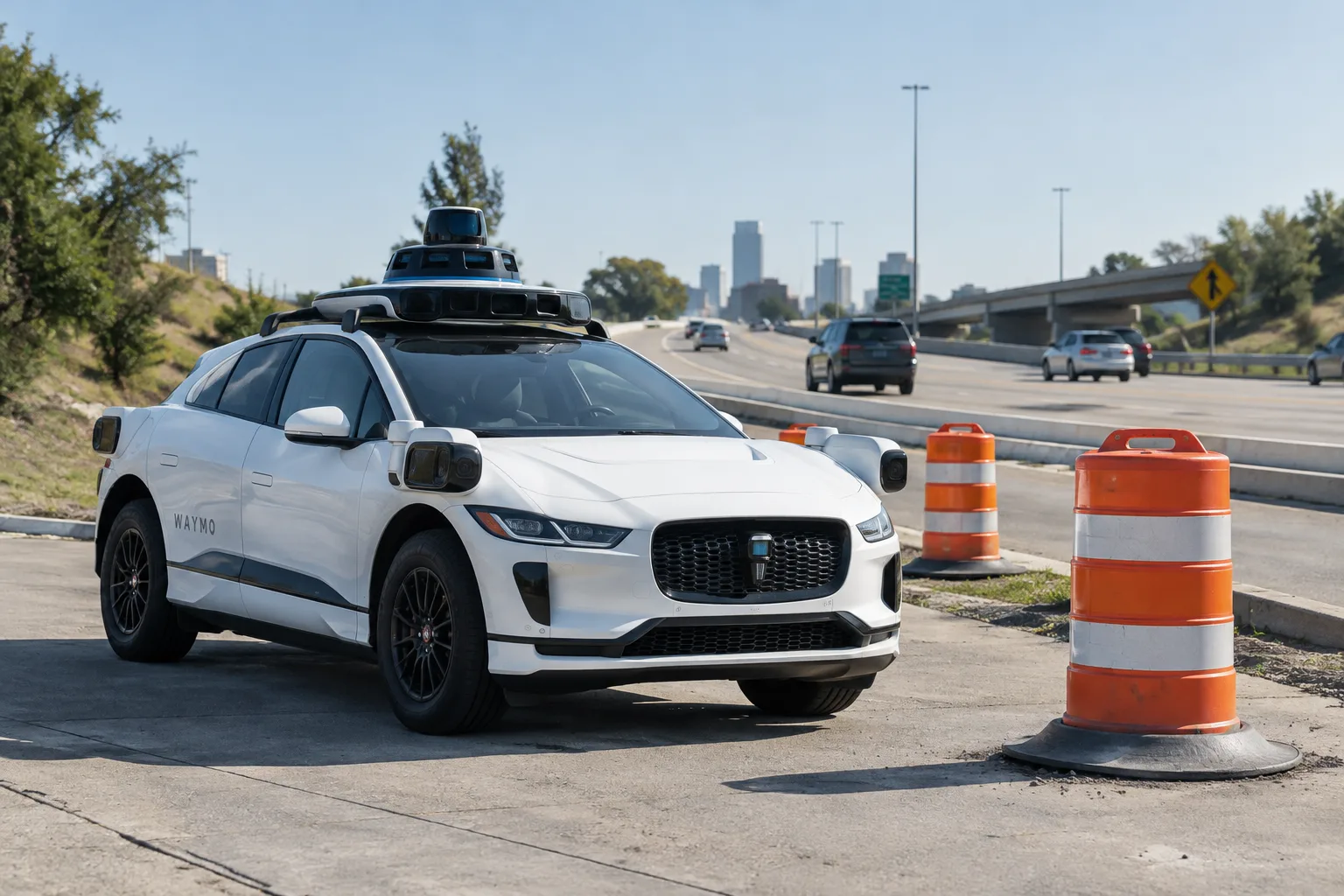

California has restricted Waymo from operating or testing driverless vehicles on all freeways in the state, and Waymo has responded by temporarily stopping commercial driverless freeway rides in every market where it offered that service: the San Francisco Bay Area, Los Angeles, Phoenix, Miami and Austin. The immediate trigger, as first reported by the Associated Press, was a pair of recent California incidents involving an active construction closure and a police traffic break.
The practical importance goes beyond one company’s routing options. Surface-street robotaxi service can keep running, and Waymo says the cited freeway encounters involved no injuries or collisions. But freeway access is part of what makes a robotaxi network commercially compelling: it shortens trips, expands the reachable area and helps a fleet complete more rides in a day. When a regulator shuts that layer down, the real question is not whether every Waymo ride is suddenly suspect. It is whether the industry’s routine mileage totals are less meaningful than they look if a small number of hard, temporary traffic-control scenarios can still force a major operating retreat.
Why California acted
The California Department of Motor Vehicles said the restriction took effect Nov. 11 and disclosed it publicly on Nov. 17. According to the state, three Waymo vehicles entered an active construction closure on U.S. 101 near Burlingame on Nov. 5. The next day, a Waymo vehicle was recorded trying to bypass California Highway Patrol vehicles conducting a traffic break on Highway 280 in San Francisco. The DMV also said similar incidents had occurred on May 18.
That pattern matters more than any single clip. Regulators can tolerate the reality that autonomous systems will encounter unusual situations; what draws intervention is recurrence in a high-consequence setting. The DMV described the freeway operations as an imminent hazard to public safety and said the restriction will remain until Waymo demonstrates effective corrective actions.
This is not a blanket shutdown of Waymo’s public service. The company’s robotaxis continue to operate on surface streets, and it says it will keep testing on freeways with trained autonomous specialists behind the wheel. That makes the state’s action look targeted rather than existential: California is not declaring the entire service unworkable, but it is saying a specific operating domain is not ready for unsupervised use under current conditions.
What the pause does to the business
Waymo operates commercially in 15 U.S. cities, though freeway rides were available in only a subset. Its decision to stop commercial driverless freeway rides outside California was voluntary, not the result of a multistate order. Even so, the national pullback is revealing. It suggests the company does not yet want to argue that what California found is safely contained to one geography while continuing to sell freeway trips elsewhere.
For riders, the most immediate change is straightforward: longer routes, longer trip times and potentially a smaller practical service area even when the app still works. A surface-street-only network can remain useful, especially in dense urban zones. But freeway links are what make distant neighborhoods feel connected to a single service rather than to separate local pockets. In markets like the Bay Area and Los Angeles, that difference can shape whether a robotaxi is a credible substitute for a car trip or just a slower convenience.
For Waymo and its partners, the pause also puts pressure on unit economics without giving the public enough data to quantify it. Freeway access can improve fleet utilization by reducing trip duration and deadhead time between rides. Take that away, and the same number of vehicles may deliver fewer completed trips over the course of a day. The reporting so far does not show how much freeway service contributes to revenue, retention or cost per ride in any market, so sweeping claims about financial damage would be premature. But the direction of the effect is clear: a fleet that cannot use the fastest roads has less flexibility and less throughput.
What Waymo has to prove next
The bottleneck here is more specific than “autonomous driving is hard.” The issue is how a system behaves when the road stops matching the stable, mapped version of itself. Construction closures, cones, barriers, workers, patrol cars and traffic breaks all create temporary rules that can outrank the normal geometry of a freeway. A robotaxi has to detect those cues, choose the right behavior and do so reliably enough that a regulator believes the fix will hold in the next work zone, not just the last one.
Those are three different tests that often get blurred together. Detecting a closure is not the same as understanding that it invalidates the intended route. Choosing not to proceed is not the same as proving the fleet will make the same choice across different lighting, lane configurations, signage patterns and police actions. And even strong internal performance is not the same as satisfying a regulator that unsupervised operation should resume.
What would a credible return look like? Probably not just a software update and a reassurance. The more durable case would include scenario-based testing in live or closely representative construction conditions, repeatable performance metrics, documentation of when remote assistance can and cannot intervene, and a clearer accounting of near misses and restricted-state events. California’s DMV has authority to impose targeted operational restrictions under its autonomous-vehicle framework, and this episode shows how that power can turn edge-case performance into a gating business issue.
There is still a strong case that this is a bounded setback rather than a verdict on the whole model. No injuries or collisions were reported in the cited encounters. Surface-street service continues. Waymo has paused freeway operations before to evaluate construction-zone performance, which suggests a known remediation path rather than a first encounter with the problem. But there is also a strong case that investors, cities and rivals should treat this as strategically important. The incidents were recurring, not isolated; the public video made the failure mode legible; and the company’s own nationwide pause acknowledges that freeway reliability is a shared product question, not just a California paperwork problem.
That is why this episode matters well beyond one regulator’s order. Robotaxi companies may be able to keep expanding on city streets while treating freeway driving as a premium capability that arrives later. If that is the emerging model, deployment could still grow, but more slowly and with more operational segmentation than the industry’s headline mileage figures imply. The next milestone for Waymo is not merely getting back on the freeway. It is showing what kind of evidence is enough when the hard part of autonomy is no longer staying in lane, but safely obeying a road that has temporarily changed its rules.

 By
 By

 By

 By

 By