
Genesis AI has raised a $500 million Series A at a $3.5 billion post-money valuation, a financing large enough to make the two-year-old company one of the best-funded bets in physical AI. The capital matters because Genesis is not pitching another software model. It wants to build a general-purpose robot for factories, warehouses, and labs, then manufacture enough of them to matter. The business question is whether its stack can survive the jump from a controlled dexterity demo to a reliable shift on the floor.
That is the real issue behind the headline. A half-billion-dollar Series A buys time, talent, hardware, and supplier attention. It does not answer the questions customers actually care about: Can the robot finish the task every time, can it be maintained without constant intervention, and does it save money once downtime, replacement parts, integration, and supervision are counted?
Why this round stands out
Genesis said the round was co-led by Premji Invest, Khosla Ventures, and Eclipse, with participation from investors including Durable Capital Partners, T. Rowe Price-advised accounts, Bpifrance, HSG, NVIDIA, AMD Ventures, Zoom, Samsung Next, and Ericsson. Reuters separately confirmed the financing, valuation, investor group, and the plan to increase Eno production and improve manipulation. For a company founded in 2024, after a previously announced $105 million seed round in 2025, that is unusual financial firepower.
The company, founded by Carnegie Mellon lab colleagues Zhou Xian and Théophile Gervet and operating between Paris and San Carlos, California, says the money will expand data acquisition and model training, raise production of its Eno robot, and hire more robotics and AI specialists. Those uses match the core economics of the category: physical AI is expensive because progress requires not just compute, but machines, test environments, field support, safety work, and a supply chain.
The promise of Genesis’s integrated stack
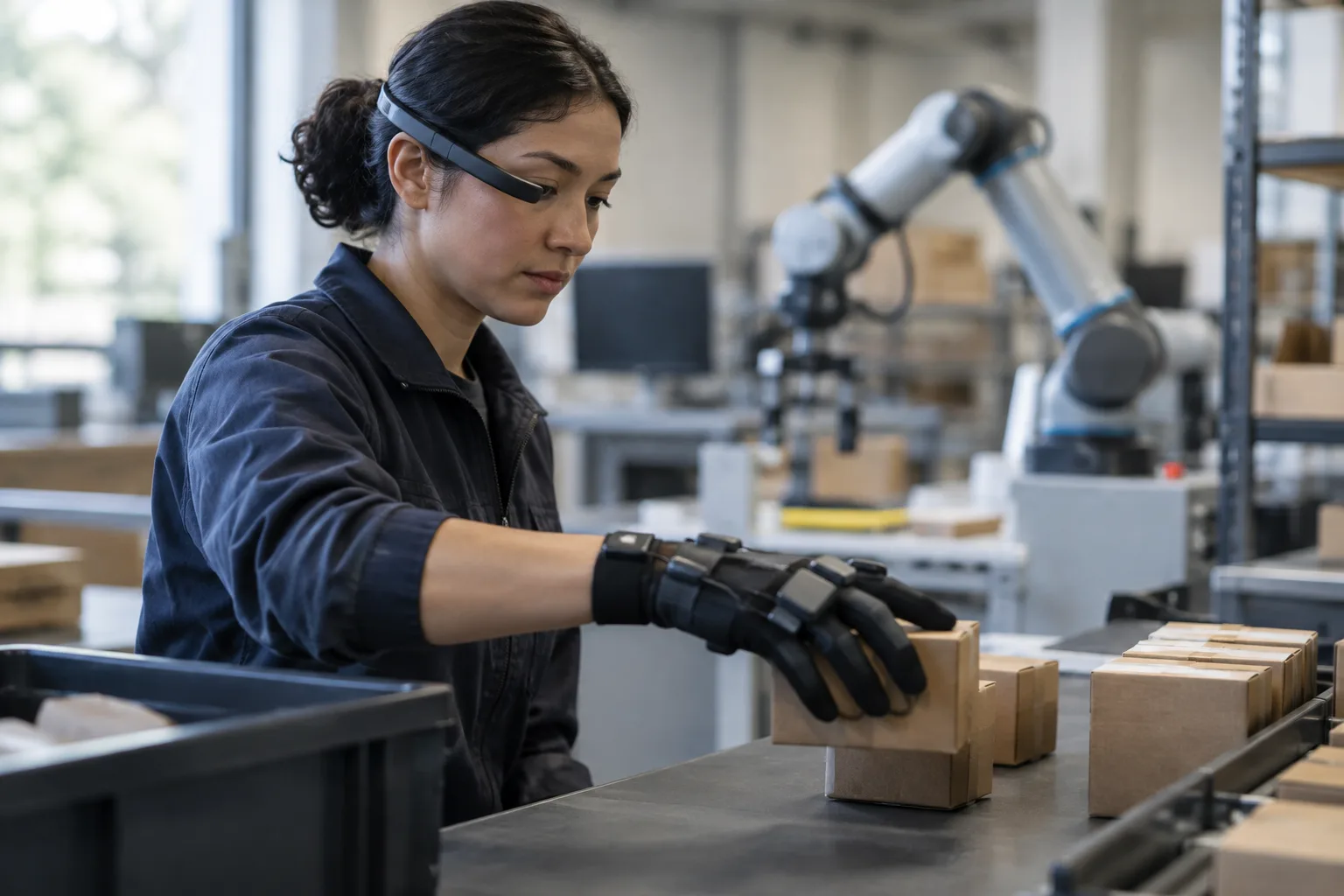
Genesis is making a vertical-integration argument. It is developing GENE, its model for robot control; a dexterous robotic hand; sensor-equipped gloves and headset cameras for recording human movement and force; Genesis World, a simulation environment; and Eno, the robot that runs the resulting policy. The company says more than 100 workers around the world already perform tasks while wearing the gloves and cameras, creating training data meant to transfer human actions to the robot.
If that architecture works, the advantage is obvious. A startup that controls the hand, the data pipeline, the simulator, and the deployed robot can tighten the loop between failure and improvement. A weak grasp can be traced back to hand design, training coverage, or policy behavior without waiting for separate vendors to align road maps. More deployments could also mean more edge-case data, which could improve performance and widen the set of tasks Eno can attempt.
But vertical integration cuts both ways. It can create a moat, or it can concentrate every failure mode inside one young company. Genesis is not only responsible for model quality. It also has to make hands that last, collect consented worker data at scale, validate safety, service hardware in the field, secure remote access, and keep the economics attractive enough to displace either human labor or simpler fixed automation. A proprietary stack can shorten feedback loops for Genesis while increasing dependency risk for customers.
The gap between a dexterity demo and factory work
The best public snapshot of where Genesis stands comes from a TechCrunch observation of its system in action. In the demo, two off-the-shelf robotic arms picked up small cardboard boxes, scanned them, placed them into a larger box, folded and taped the box, and applied a label. That is real progress: multi-step box handling is exactly the kind of manipulation sequence conventional automation often struggles to generalize.
On a repeated run, though, the system fumbled a box and had trouble peeling a small label from its backing. That does not disprove the approach. It does show why robotics buyers are harder to impress than venture investors. In a warehouse or factory, the value is not that a robot can complete the sequence once under supervision. The value is that it can keep doing it when lighting shifts, the tape is slightly misaligned, the label sticks differently, or a worker upstream changes the pace of the line.
That reliability gap matters because Genesis is still early in physical deployment. The company says it has built about 30 to 40 Eno units and selected a mass-manufacturing contractor to begin U.S. production work in 2027. It has piloted the robot with a small number of undisclosed customers, but it has not disclosed customer names, production targets, contract values, uptime, or a date for broad commercial availability. TechCrunch also reported that Eno itself was not ready to demonstrate for the reporter and that Genesis’s dexterous hands currently need replacement after a few weeks of regular work. For any customer running on tight margins, that replacement interval is not a footnote; it is part of the cost model.
What the next proof points need to show
For manufacturers, logistics operators, labs, system integrators, safety teams, and insurers, the next meaningful update from Genesis is not another valuation marker. It is a deployment scorecard. The numbers that matter are cycle time and successful completion rate by task, human interventions per hour, uptime and mean time between failures, hand and end-effector replacement interval, safety and near-miss performance, integration time with existing controls and workflows, and total cost per completed task compared with people and specialized automation.
Many buyers will still choose fixed systems or human-in-the-loop workflows when the cost of a miss is high. Just as important are the governance questions that tend to arrive after the demo. Who owns the data captured from glove-wearing workers? How is consent handled across sites and countries? What are the cybersecurity and remote-access boundaries when a model is updated after deployment? How much of the robot can be serviced in the field instead of swapped out? The public record does not yet answer those questions, and the answers will shape customer willingness to scale.
Genesis’s $500 million round is best read as a market signal that investors believe physical AI is worth funding before the economics are settled. The company has a plausible theory of how to attack manipulation: collect human motion and force data, train a policy, stress it in simulation, deploy it, capture failures, fix hardware, and push updates until the next shift improves. If Genesis turns that loop into dependable operation, the valuation will look like early positioning in a new robotics platform. If not, the round will look more like an expensive subsidy for learning how hard real-world reliability still is.

 By

 By

 By

 By

 By