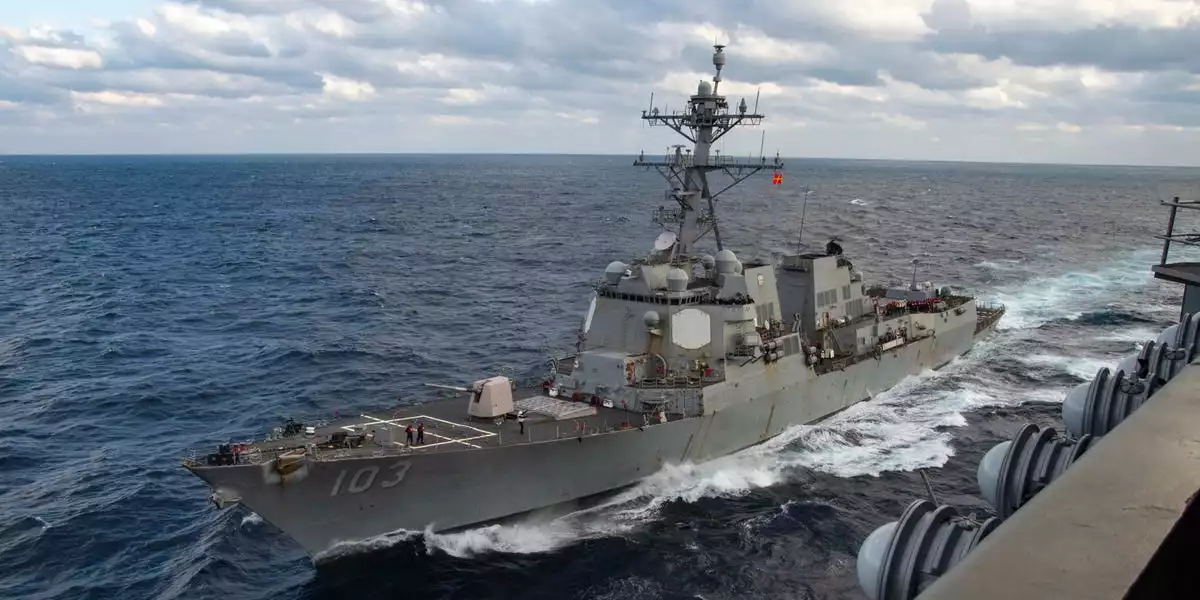

Collision in the Caribbean: Navigating the Edge of Human and Machine Seamanship
In the sunlit expanse of the Caribbean, two titans of the U.S. Navy—the Arleigh Burke–class destroyer USS Truxtun and the Supply-class fast combat support ship USNS Supply—collided during a replenishment-at-sea (RAS) maneuver. The incident, though resulting in only minor injuries and leaving both vessels operational, has sent ripples far beyond the immediate horizon. It occurred as the U.S. Navy intensifies its presence in the region, enforcing sanctions and projecting power in the wake of Venezuela’s ongoing turmoil and the global contest over illicit oil flows.
This episode, following a near-miss earlier in 2024, is more than a maritime mishap. It is a crucible for the evolving relationship between human judgment and machine precision, a stress test for the technologies and doctrines that underpin modern naval operations.
The Limits of Human-Machine Coordination at Sea
Replenishment-at-sea is a ballet of steel and will: two ships, often less than 50 meters apart, maintaining station at 12–16 knots while fuel and supplies arc across taut cables. Despite the arsenal of digital tools—Link-16 tactical data links, ECDIS navigation charts, gyro-stabilized rigs—collision avoidance remains fundamentally a test of human reflex and coordination. This collision exposes the enduring gap between advanced decision-support systems and the unpredictable realities of the ocean.
- Technological Imperatives:
– The event is likely to accelerate the Navy’s pursuit of AI-augmented bridge systems, computer-vision fenders, and LIDAR-based proximity alerts.
– Both ships will undergo rigorous structural integrity scans, fueling the case for digital-twin models that simulate hull fatigue and stress in real time.
– The Navy’s roadmap for surface autonomy, exemplified by initiatives like Ghost Fleet Overlord, may see renewed urgency—pushing unmanned or lightly manned logistic ships and robotic refueling systems from prototype to deployment.
As the Navy’s operational tempo increases, so too does the pressure to automate the most dangerous and routine tasks. The collision is a stark reminder that, for now, the human element remains both the greatest asset and the most unpredictable variable in naval operations.
Economic Reverberations and Industry Realignment
The aftershocks of this incident will be felt across the defense-industrial complex and the global energy supply chain. Each collision, near-miss, or operational hiccup is a data point that shapes procurement cycles, insurance premiums, and commodity flows.
- Defense Procurement Shifts:
– Expect a reallocation of funds within the FY 2026 shipbuilding plan toward advanced navigation sensors, maritime 5G-to-satcom gateways, and immersive crew-training simulators.
– Vendors specializing in radar, EO/IR, and mixed-reality systems will find new opportunities as the Navy seeks to harden its fleet against human error.
- Insurance and Commodity Implications:
– Commercial P&I insurers, ever watchful of naval incidents, may adjust premiums for civilian tankers navigating contested waters, nudging costs upward and indirectly influencing global energy prices.
– Ongoing interdiction operations and the risk of further mishaps keep Venezuelan crude exports volatile, with traders bracing for episodic supply squeezes and wider Brent–WTI spreads.
- Strategic Industry Moves:
– Defense and aerospace executives should anticipate accelerated RFPs for collision-avoidance AI and digital-twin hull modeling.
– Technology investors will note the growing momentum for dual-use navigation and sensor-fusion startups, with pilot contracts poised to mature into Programs of Record.
Geopolitical Undercurrents and the Elasticity of Naval Power
Beyond the steel and circuitry, the collision carries strategic weight. The continued deployment of a dozen U.S. warships in the Caribbean, even after the capture of Nicolás Maduro, signals an enduring commitment to regional stability and a bulwark against great-power encroachment by China or Russia. Yet, every operational mishap is a narrative opportunity for rivals—a chance to question U.S. competence and challenge the rules-based order.
- Force Posture and Readiness:
– The Caribbean flotilla ties up destroyers that might otherwise reinforce Indo-Pacific operations, subtly recalibrating deterrence in other theaters.
– Any degradation in readiness from collisions or stand-downs could ripple across global force posture calculations.
- Information and Influence:
– The Pentagon must manage not only the operational consequences but also the information-space risks, as adversaries seek to exploit perceived lapses in U.S. seamanship.
For energy strategists and supply-chain leaders, the incident is a signal to diversify routing schemes and hedge against late-2024 volatility. For defense technologists, it is a clarion call to accelerate the integration of autonomous systems and predictive analytics.
As the Navy investigates and adapts, the collision becomes more than a headline—it is a catalyst. The drive toward autonomous seamanship, resilient logistics, and strategic agility will only intensify, reshaping the contours of maritime power and the industries that sustain it. Those who anticipate and adapt to this inflection point will find themselves not merely reacting to disruption, but defining the next era of naval and economic security.

 By
By
 By
By
 By
By
 By
By
 By
By


 By
By