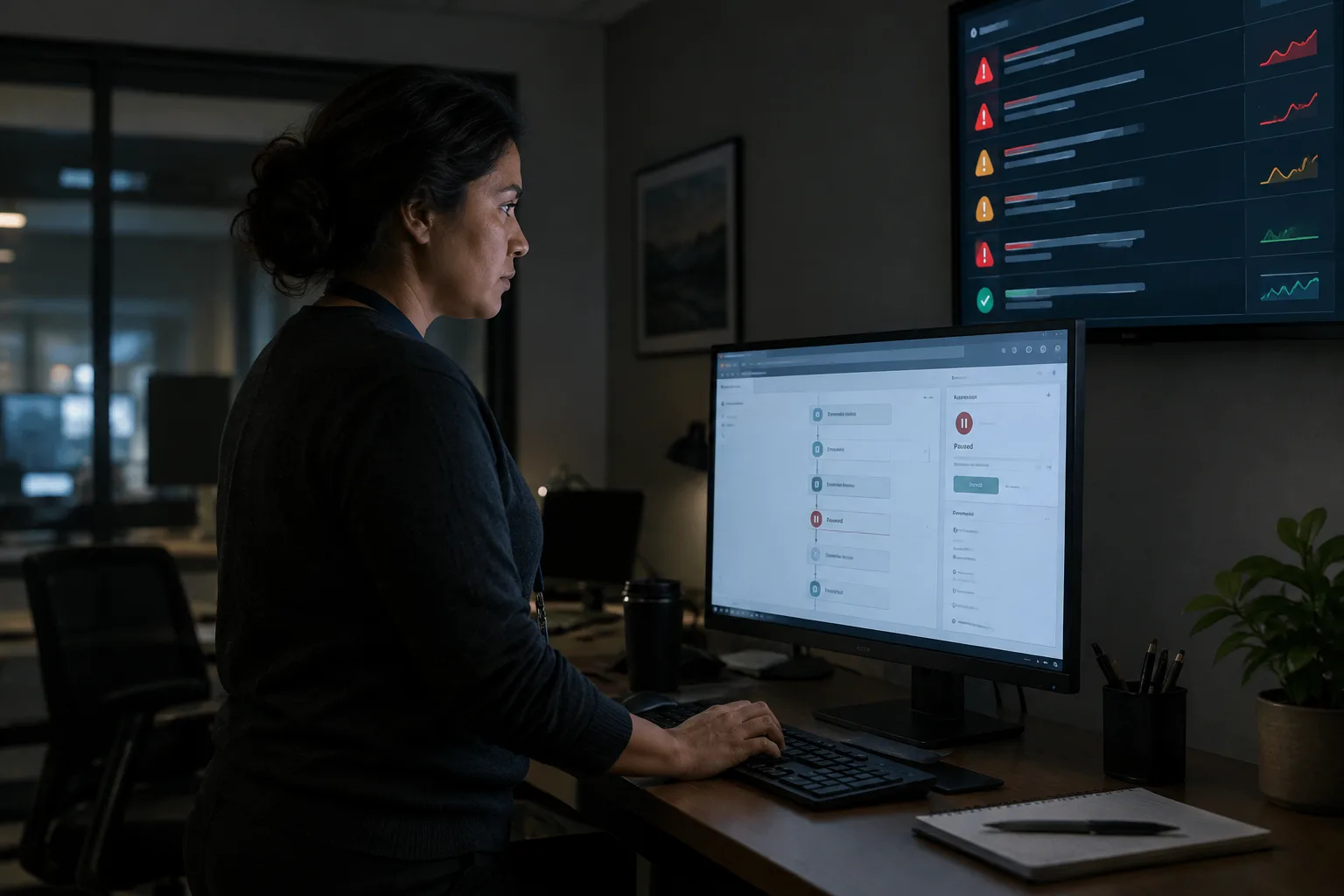

A cross-border care workforce emerges from America’s nursing gap
The U.S. health-care system’s persistent shortage of registered nurses—estimated at nearly 80,000 unfilled positions—is increasingly being addressed not only through domestic recruitment and travel nursing, but through a quieter structural shift: clinical work moving offshore without the patient ever leaving home. Roughly 210,000 full-time Filipino telehealth workers are now supporting U.S. patients remotely, delivering services that range from triage and care navigation to mental-health counseling and substance-abuse follow-up via Zoom and other telehealth platforms.
This is not a simple call-center story. Many of these workers hold medical or nursing credentials, and their work often sits close to the clinical edge—where decisions, documentation, and patient trust intersect. For U.S. providers and payers, the appeal is clear: wages averaging around $5 per hour can translate into up to 70% savings in overhead, particularly for labor-intensive functions such as chart review, patient outreach, and after-visit follow-ups.
Yet the same mechanism that stabilizes U.S. operations can destabilize the Philippines’ own health system. The country has long been a global exporter of nursing labor, but telehealth introduces a new dynamic: skill migration without physical migration. Talent can be absorbed into U.S.-aligned workflows while remaining in-country, potentially deepening domestic staffing shortfalls even as it expands household income opportunities relative to local wage baselines.
Key operational drivers behind the trend include:
- Cost containment amid inflationary pressure and post-pandemic staffing volatility
- Rapid scalability for health systems facing fluctuating patient volumes
- Standardized remote workflows that allow clinical tasks to be modularized and distributed
- A mature English-speaking workforce with deep familiarity with U.S. care norms and documentation styles
The result is a new category of globalization—often described as “clinical process outsourcing”—that is reshaping how health-care labor markets clear, and where the boundaries of “care delivery” are now being renegotiated in real time.
Telehealth platforms become the backbone of offshore clinical operations
This outsourcing wave is inseparable from the maturation of digital health infrastructure. Cross-border care at scale depends on more than video calls; it requires interoperable systems, cloud-native architectures, and reliable tele-EMR access that can support distributed clinical teams while maintaining continuity of care.
The technological implications extend beyond convenience:
- Interoperability as an enabler of labor mobility: When documentation, scheduling, and patient messaging are standardized, tasks can be routed to remote clinicians with minimal friction.
- A runway for remote monitoring and IoMT: As health systems expand home-based care, offshore teams can increasingly support device-driven workflows—flagging abnormal readings, escalating alerts, and coordinating follow-up.
- Operational data exhaust that feeds automation: Documentation, coding, and clinical note-taking—common responsibilities for offshore staff—generate structured and semi-structured datasets that are highly valuable for analytics and AI development.
That last point is strategically significant. The outsourced workforce is not only delivering services; it is also producing high-volume annotated clinical artifacts—notes, triage decisions, patient engagement logs—that can influence the direction of AI diagnostic support, patient engagement models, and workflow automation. If governance is weak, the incentives to scale documentation throughput can collide with the need to protect patient privacy, ensure clinical accuracy, and avoid creating datasets that overfit to U.S. care patterns while underrepresenting broader populations.
Data governance, cybersecurity, and liability move to the center of the risk equation
Cross-border telehealth introduces a complex compliance landscape where health data traverses jurisdictions, expanding attack surfaces and complicating accountability. Even when U.S. providers remain the covered entities responsible for HIPAA compliance, offshore operations can create practical challenges around access controls, auditability, subcontractor management, and incident response.
The risk profile typically clusters into three categories:
- Data protection and cybersecurity: International access to patient records increases exposure to credential theft, endpoint compromise, and third-party vulnerabilities—pushing providers toward end-to-end encryption, zero-trust architectures, and rigorous vendor audits.
- Clinical quality assurance: Remote teams can deliver high-quality care, but consistency depends on training, supervision, escalation protocols, and measurable outcomes—especially for sensitive domains like behavioral health and substance-use follow-up.
- Cross-border liability and reputational exposure: Malpractice questions, dispute resolution, and patient consent can become murky across borders. Separately, brand risk can rise if patients perceive the model as opaque or exploitative, even when care quality is strong.
For executives, the strategic challenge is that the most visible benefit—labor savings—can mask downstream liabilities. A low hourly wage may look efficient on a spreadsheet, but it can become costly if it triggers regulatory scrutiny, patient dissatisfaction, or ESG criticism. In an era where trust is a competitive asset in health care, transparency about who is delivering care, under what standards, and with what protections is moving from a compliance detail to a board-level concern.
The next phase: from labor arbitrage to sustainable, ethical clinical globalization
The outsourcing of telehealth labor sits at the intersection of two national vulnerabilities: U.S. staffing scarcity and Philippine domestic health-care capacity constraints. The strategic question is whether this model remains a short-term pressure valve—or evolves into a more durable, ethically defensible system of global clinical collaboration.
Several forward-looking moves are emerging as differentiators for health systems and digital health vendors:
- Multilayered governance: Cross-functional oversight spanning clinical leadership, legal, IT security, and compliance—paired with routine quality audits and patient satisfaction metrics that are disaggregated by care location.
- Ethical sourcing embedded in ESG: Compensation frameworks aligned to living-wage standards in local markets, plus structured upskilling pathways (tele-ICU support, informatics, advanced triage) that build careers rather than merely extracting labor.
- Hybrid staffing models: Combining onshore clinicians with offshore support to create redundancy, preserve cultural competence, and reduce single-point-of-failure dependency on any one labor market.
- Regulatory anticipation: Preparing for tighter data-sovereignty rules and evolving bilateral labor policies by designing adaptable data-flow architectures and clear contractual accountability.
The most resilient version of offshore telehealth will not be the one that simply finds the lowest cost per hour. It will be the one that treats remote clinicians as a strategic extension of care delivery, invests in security and quality as first principles, and acknowledges that global efficiency cannot be separated from global responsibility—especially when the commodity being traded is clinical capacity itself.

 By
By
 By
By
 By
By



 By
By
 By
By