

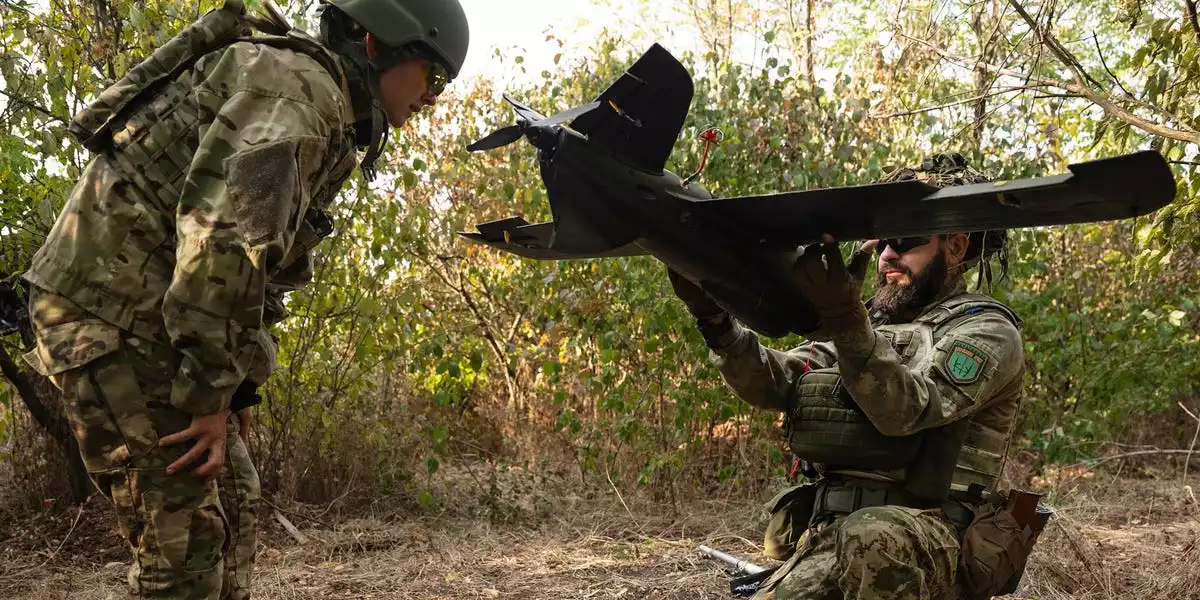

The Front Lines of Innovation: How Ukraine’s Drone Schools Are Rewriting the Rules of Military R&D
In the battered fields of eastern Ukraine, a quiet revolution is underway—a revolution not of steel and firepower, but of relentless iteration and learning. Ukraine’s front-line drone schools, facing the existential urgency of Russian countermeasures, have institutionalized a tempo of adaptation that would make Silicon Valley blush. Every one to two weeks, these centers update not only their tactics and training modules but also the very hardware configurations of their unmanned aerial vehicles. This cadence, reminiscent of the agile release cycles in software engineering, is redefining the tempo and structure of military innovation.
Continuous Integration on the Battlefield: The New R&D Paradigm
The analogy to software’s “continuous integration/continuous deployment” (CI/CD) is not accidental. At these drone schools, firmware updates, sensor swaps, and new electronic warfare (EW) countermeasures are deployed with a frequency that would be familiar to any developer pushing nightly builds. The result? The classic “observe-orient-decide-act” loop is compressed to near-real-time, with training centers doubling as R&D hubs.
- Consumer and Defense Tech Convergence: Off-the-shelf flight controllers and open-source autopilots are being fused with custom AI modules and hardened EW shielding. The line between hobbyist and military-grade technology has blurred to the point of irrelevance, upending traditional export-control regimes and challenging assumptions about dual-use technology.
- Data Network Effects: Each drone sortie generates torrents of telemetry, which feed directly back into both tactical doctrine and algorithmic refinement. Ukraine’s decentralized operator network is, in effect, generating the world’s largest live dataset for small-UAV combat—a resource whose value compounds exponentially with scale and speed.
This ecosystem, where operators, trainers, and manufacturers co-evolve solutions in days rather than decades, is a stark departure from the glacial pace of Western defense procurement. Firms like DroneShield and Granta Autonomy are already pivoting to sprint-based product management, accepting that “good enough” and field-upgradeable trumps perfection delivered too late.
Economic Disruption: Agile Supply Chains and the Democratization of Lethal Autonomy
The industrial implications are profound. Capex-light manufacturing—anchored by 3-D printing and modular design—lowers the barriers to entry, inviting venture capital into a sector long dominated by government-funded giants. The result is a wave of M&A activity, as incumbents race to acquire nimble robotics startups, not just for their intellectual property, but for their culture of iterative velocity.
- Funding Asymmetry: Despite the strategic value of their output, Ukrainian drone schools operate under persistent cash-flow fragility. Philanthropic and diaspora capital have bridged the gap, but this is an unstable foundation for a capability now central to national defense. The moment calls for new public-private financing vehicles—perhaps a digital-age echo of the war bond.
- Procurement Doctrine Lag: NATO’s procurement cycles, measured in years, are at risk of irrelevance. The UK defense establishment’s recent warnings underscore the need for rolling requirements, modular certification, and pre-approved upgrade pathways—a regulatory challenge, but an inevitable one if parity is to be maintained.
Perhaps most striking is the democratization of precision strike. Ukraine’s model demonstrates that lethal autonomy can be scaled by mid-tier economies with modest budgets, eroding the monopoly once held by the world’s top militaries. This diffusion of capability could reshape regional power balances far beyond Eastern Europe.
Strategic Imperatives: Learning Velocity as a Weapon
The new arms race is not about who spends most, but who learns fastest. Tactical innovation is now inseparable from technological agility. The most forward-leaning defense ministries and contractors are absorbing several key lessons:
- Adopt “Release 0.9” Mindsets: Treat initial fielding as the beginning of product development, not its endpoint. Budget 20–30% of lifecycle costs for continuous upgrades, mirroring SaaS economics.
- Real-Time Feedback Corridors: Embed engineers with combat units to capture telemetry and failure modes in situ, closing the loop between the field and the lab.
- Modular Certification: Shift from platform-level to module-level certification, enabling rapid upgrades without bureaucratic drag.
- Synthetic Environments: Parallel real-world training with digital-twin ranges, allowing overnight A/B testing of tactics and instant deployment of best practices.
Even the resilience of these training centers—forced into mobility, dispersion, and online instruction by their high-value status—offers a preview of future command-and-control doctrine in contested domains.
As the world watches Ukraine’s drone schools, a new maxim emerges: military advantage accrues not to the biggest spender, but to the ecosystem that learns and adapts with the greatest velocity. For executives in defense, technology, and beyond, the lesson is clear—iterative speed, powered by tight operator-developer feedback loops, has become a strategic weapon in its own right. In this new era, the future belongs to those who update, adapt, and outpace the adversary—week after week, sortie after sortie.

 By
By
 By
By
 By
By
 By
By



 By
By







