
A shutdown-driven security bottleneck meets peak travel reality
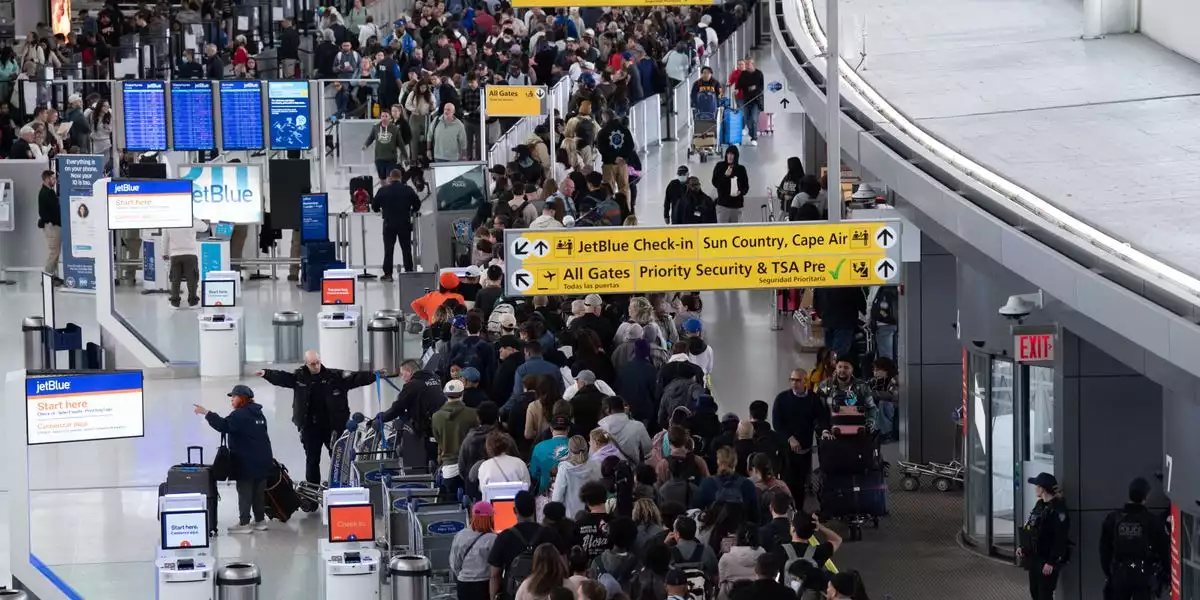
The emerging strain on U.S. aviation security is less about a single political event than what that event reveals: critical travel infrastructure is being run with just enough slack to function—until it doesn’t. With federal funding for the Department of Homeland Security stalled during a protracted government shutdown, the Transportation Security Administration (TSA) is absorbing a shock at the exact moment passenger volumes are rebounding and global attention is turning toward a major near-term demand surge, with the World Cup less than three months away.
The headline number—more than 480 TSA officers resigning, roughly 1% of a 50,000-person workforce—is not, on its own, a collapse. But aviation operations rarely fail in dramatic single points; they degrade through compounding constraints. Screening throughput is a system of systems: staffing levels, training pipelines, checkpoint configuration, airport layout, passenger arrival patterns, and airline schedule banks. When one variable tightens, the rest must overperform to compensate.
Two operational realities sharpen the risk:
- Training lead times of four to six months mean staffing cannot be “turned on” quickly, even if funding is restored tomorrow.
- Demand surges are lumpy, not linear—major events and seasonal peaks create concentrated pressure at specific airports and time windows, where queue growth can become nonlinear and reputational damage immediate.
For airlines, airports, and corporate travel managers, the shutdown is not merely a Washington story; it is a capacity planning problem with direct implications for on-time performance, missed connections, customer satisfaction, and downstream costs across hospitality and ground transportation.
Jet fuel at $197 per barrel: the cost shock that reshapes networks and fares
If staffing constraints threaten the front door of air travel, energy prices are pressurizing the entire aircraft operating model. Jet fuel near $197 per barrel—almost double its long-run average—is not just an expense line item; it is a strategic stress test for route economics, pricing power, and network resilience.
Several forces are converging:
- Supply constraints and geopolitical volatility are tightening availability and increasing price swings.
- Insufficient refining capacity for high-grade aviation kerosene highlights a structural bottleneck: even when crude supply exists, the ability to convert it into jet fuel at scale is not guaranteed.
- Airspace restrictions and congestion force flight-path adjustments, adding block hours, increasing burn, and reducing aircraft utilization—an efficiency hit that compounds the fuel shock.
Airlines can and do pass costs through, but the mechanism matters. Fuel-driven fare increases are rarely uniform; they can be route-specific, time-specific, and aircraft-specific, producing a patchwork of price volatility that complicates consumer planning and corporate travel budgeting. Meanwhile, longer routings and schedule padding can erode the very product airlines sell—reliability—at the moment customers are most sensitive to disruption.
This is also where technology strategy becomes inseparable from operations. Energy volatility rewards carriers that can deploy:
- Advanced forecasting and scenario modeling to anticipate price and availability swings
- Machine-learning-driven procurement and hedging strategies (where appropriate)
- Dynamic network planning that treats airspace constraints as a first-class variable, not an exception case
- Sustainable aviation fuel (SAF) partnerships and scaling pathways, not as branding exercises, but as long-term supply diversification
The jet fuel spike is a reminder that decarbonization and resilience can align: diversifying fuel inputs and improving efficiency reduces exposure to single-commodity shocks, even before emissions benefits are counted.
Consumers feel the squeeze: travel demand, delivery economics, and the end of “cheap and fast”
The consumer experience is being pinched from multiple directions. Rising gasoline prices dampen road-trip demand just as air travel becomes more expensive and less predictable. That substitution effect—drive instead of fly, fly instead of drive—weakens when both modes inflate simultaneously.
The same energy-labor nexus is playing out in last-mile logistics. Delivery platforms face a familiar but intensifying equation: when fuel costs rise, driver take-home pay falls unless pricing adjusts. Platforms then confront a choice that is strategically uncomfortable in a competitive market:
- Absorb costs, compressing margins and potentially reducing service coverage
- Raise fees, risking demand softness and customer churn
- Offer retention bonuses, which can stabilize supply but raise unit costs further
This is not merely a consumer inconvenience; it is a signal that the “instant economy” depends on a delicate balance of labor availability and energy affordability. When either breaks, expectations around speed and price must reset—or technology must step in to restore the economics.
Operators exploring resilience are likely to accelerate:
- Electrified fleet deployment where charging infrastructure and route density support it
- Dynamic routing using real-time traffic, weather, and demand signals to reduce wasted miles
- Micro-fulfillment and inventory repositioning to shorten delivery distances
- Autonomous pilots (ground robots, drones in constrained corridors) where regulation and safety cases can be met
The common thread is decoupling unit economics from petroleum prices—reducing the direct linkage between fuel volatility and service viability.
The next inflection point: digitized security, predictive staffing, and volatility-aware planning
The most consequential outcome of the current moment may be institutional learning: lean, just-in-time operating models are efficient until politics, labor markets, or commodity shocks intervene. Aviation security, airline operations, and delivery logistics are all discovering the same constraint—resilience requires optionality, and optionality costs money unless technology reduces the cost of preparedness.
Three strategic moves stand out as both practical and scalable:
- Digitize and decentralize identity and screening workflows: prolonged queues and staffing attrition will accelerate investment in biometric kiosks, contactless identity verification, and pre-travel digital credentialing. Done well, these tools reduce on-premises labor intensity while improving throughput consistency.
- Deploy predictive workforce analytics: agencies and operators can use historical throughput, demand forecasts, and disruption simulations to identify attrition hotspots and pre-stage hiring, overtime, or reassignments before bottlenecks become visible to the public.
- Embed volatility into procurement and travel systems: corporate travel platforms and airline revenue systems alike will need tighter integration of carrier APIs, fuel-price indexing, and real-time traveler notifications to manage cost variability and operational changes without manual intervention.
What looks like a set of disconnected headlines—shutdown politics, TSA resignations, jet fuel spikes, delivery fee increases—is better understood as a single narrative about modern infrastructure under stress. The organizations that emerge strongest will be those that treat disruption not as an anomaly to endure, but as a design requirement to engineer around.

 By
By
 By
By

 By
By
 By
By

 By
By