


A security system under fiscal strain: what the TSA assault spike signals
Testimony from Acting TSA Administrator Ha Nguyen McNeill to the House Homeland Security Committee frames the partial government shutdown not merely as a political standoff, but as an operational stress test for the nation’s aviation security apparatus. The most arresting metric—a 500% surge in assaults on TSA officers since February 14—is best understood as a downstream indicator of system overload: longer queues, frayed tempers, and frontline staff asked to enforce high-stakes rules while working without pay.
The shutdown’s human impact is translating quickly into measurable capacity loss. Roughly half of TSA’s frontline staff at major U.S. airports have reportedly called out sick, nearly 480 officers have resigned, and the agency faces a four-to-six-month training backlog that limits how fast it can replace attrition. Those figures matter because TSA checkpoint operations are still fundamentally human-centric, relying on trained judgment, repetition, and procedural compliance—attributes that degrade under fatigue, financial stress, and staffing volatility.
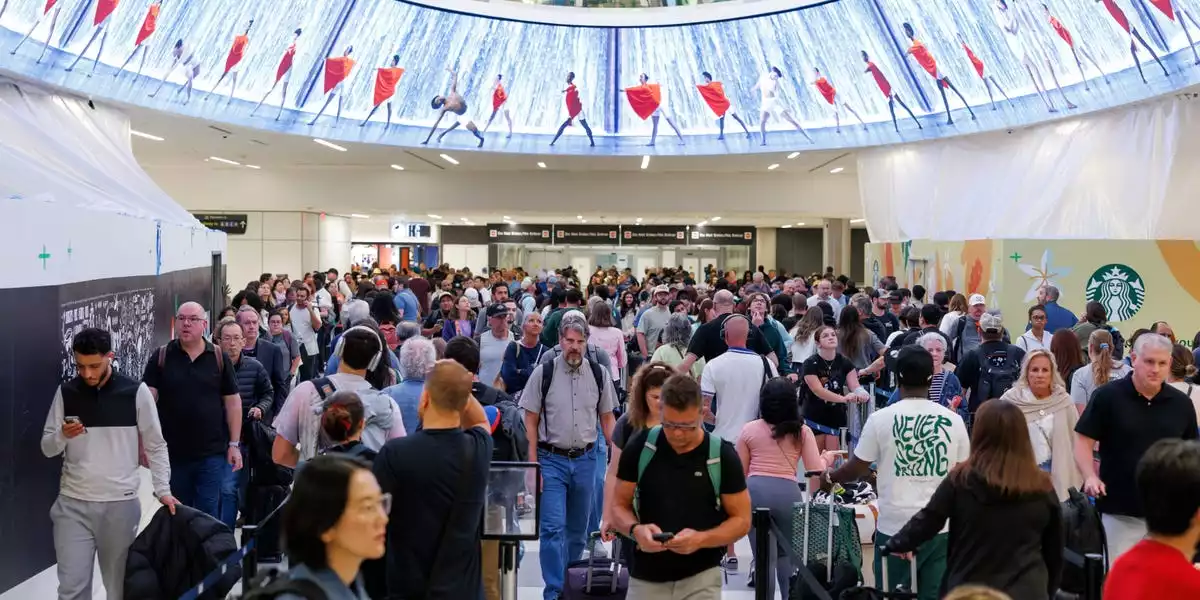
For passengers, the immediate manifestation is time: waits exceeding four and a half hours at some hubs, with airports from Houston to Los Angeles urging travelers to “pack patience” and treat staff with courtesy. For policymakers and industry leaders, the assault spike is a warning light that security performance and passenger experience are becoming tightly coupled to budget stability—an uncomfortable dependency for a function designed to be resilient under pressure.
Checkpoint throughput, security accuracy, and the hidden costs of burnout
Aviation security is often discussed as a binary—safe or unsafe—but real-world checkpoint performance is a continuum shaped by throughput, error rates, and the quality of human decision-making. When staffing drops abruptly, the system doesn’t simply slow down; it becomes more brittle.
Key operational dynamics now in play include:
- Throughput degradation: Fewer officers means fewer open lanes, slower bag resolution, and longer secondary screening cycles. Queue management becomes a bottleneck, and small disruptions cascade into hours-long delays.
- Elevated error risk: High stress and extended shifts can increase the likelihood of missed cues, inconsistent application of procedures, and reduced attentiveness—especially in repetitive tasks like image interpretation and bag checks.
- More passenger friction: Longer waits and tighter staffing can lead to more frequent “hard stops” (additional pat-downs, bag searches, and manual resolution), which can intensify confrontations and contribute to the reported rise in assaults.
- Training pipeline constraints: With conventional training timelines cited at 120–180 days, the agency cannot quickly “hire its way out” of the problem. A four-to-six-month backlog effectively turns attrition into a semi-permanent capacity reduction during peak travel periods.
The economic implications extend beyond inconvenience. Extended dwell times reduce airport throughput and can depress ancillary revenue—retail, food and beverage, and parking—while also eroding airport brand equity. Airlines face knock-on effects through missed connections, rebooking costs, and potential compensation obligations, which can ripple into insurance premiums and operational buffers.
This is why the shutdown functions like a supply-chain shock: the checkpoint is a critical node, and when it constricts, the entire travel ecosystem absorbs the cost.
Technology acceleration: CT scanners, AI threat detection, and remote screening as resilience tools
The current disruption is sharpening the business case for automation and AI-enabled screening, not as a replacement for officers, but as a force multiplier that stabilizes performance when staffing is volatile.
Several technology pathways stand out:
- Computed Tomography (CT) scanners: CT improves bag imaging fidelity and can reduce the need for manual bag checks, which are labor-intensive and often a flashpoint for passenger frustration.
- Automated Threat Detection (ATD) algorithms: AI-assisted detection can standardize certain screening judgments, potentially reducing variability under stress and helping officers focus on exceptions rather than routine flow.
- Remote screening centers using computer vision: Decoupling image review from the physical checkpoint can enable flexible staffing models, centralized expertise, and better surge capacity—particularly valuable during political disruptions or localized staffing shortages.
- Digital twins for checkpoint operations: Real-time simulation models can optimize lane allocation, staffing distribution, and queue interventions dynamically, improving throughput without compromising security protocols.
Technology alone, however, cannot resolve the training bottleneck. The more strategic shift is to modernize workforce development:
- VR simulation for scenario-based training to accelerate pattern recognition and procedural fluency.
- Modular micro-credentialing that certifies discrete competencies faster, enabling earlier supervised deployment.
- Cross-agency fellowships and mentorship models that redeploy experienced officers into training and quality assurance roles, increasing training throughput without diluting standards.
If TSA can compress onboarding to 60–90 days through competency-based pathways—while maintaining rigorous evaluation—it would materially improve resilience during future funding disruptions.
World Cup readiness, labor-market competition, and the policy choices ahead
The timing is particularly sensitive. With global travel demand rebounding and major events such as the FIFA World Cup on the horizon, checkpoint capacity becomes a national competitiveness issue: the traveler experience is part of the country’s soft infrastructure, shaping perceptions for tourists, business travelers, and international partners.
Meanwhile, the labor market is not standing still. A shutdown-induced pay freeze strains morale and increases the attractiveness of private-sector alternatives, raising the long-term cost of attrition. It also introduces legal and reputational risk, including the prospect of class-action litigation and sustained recruitment challenges.
This environment may revive debate over public-private staffing models—from outsourcing non-core functions to exploring premium or managed-service lanes—ideas that collide with TSA’s statutory role and the equity concerns of tiered access. Yet the pressure is real: when federal hiring constraints meet peak travel demand, stakeholders will look for any mechanism that restores flow.
A Senate-approved funding deal and indications of expedited back-pay orders could provide near-term relief if enacted by the House. But the deeper lesson is structural: political risk is becoming an operational variable for aviation security, and corporate travel risk frameworks will increasingly treat budget brinkmanship as a predictable disruption factor.
The path forward is less about choosing between people and machines than designing hybrid screening architectures—where human judgment is preserved for high-risk decisions, AI reduces routine friction, and training systems are built for speed without sacrificing rigor. That is how a security agency moves from crisis response to durable resilience, even when the fiscal ground beneath it remains unstable.

 By
By
 By
By
 By
By
 By
By
 By
By


 By
By







