


A U.S.-Only Ebola Quarantine Facility in Kenya Signals a Hard Turn in Health Security Policy
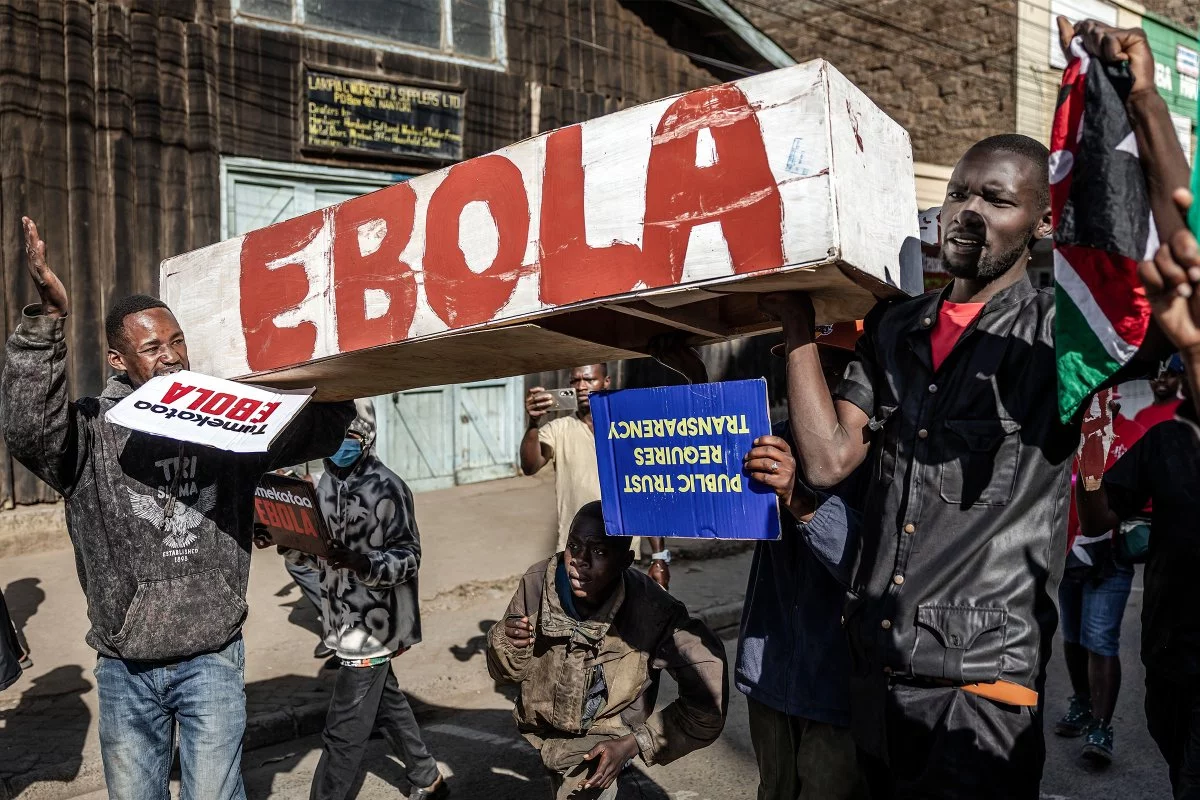
The reported negotiations between the Trump administration and Kenya to establish a U.S.-only Ebola quarantine facility in Nanyuki mark a consequential shift in how epidemic preparedness is being framed—and operationalized. Where global health has historically leaned on multilateral coordination, shared surveillance, and host-country integration, this model reads as biosecurity by perimeter control: a facility designed primarily around U.S. risk containment rather than regional public-health capacity.
The political irony is difficult to miss. In 2014, Donald Trump—then a private citizen—criticized the evacuation of Ebola-infected Americans from West Africa, arguing they should remain there. Now, the U.S. is reportedly pursuing an offshore quarantine architecture, but with a crucial difference: exclusive operational control, limited local consent, and a security-backed negotiating posture.
Even more destabilizing is the context: no confirmed Ebola cases in Kenya. That absence does not eliminate the rationale for preparedness, but it raises the bar for legitimacy. When a high-consequence facility is advanced without transparent epidemiological triggers, it can be interpreted less as public health infrastructure and more as a geopolitical instrument—one that relocates perceived U.S. vulnerability onto a partner state’s territory.
Sovereignty, Aid Leverage, and the Precedent of Bypassing Local Governance
Kenya’s reported acquiescence—despite a court injunction and local opposition—spotlights a recurring tension in aid-dependent environments: the collision between national sovereignty and conditional support. If military aid and security funding are tied, explicitly or implicitly, to acceptance of the project, the facility becomes a case study in how health initiatives can be bundled into strategic bargaining.
Several dynamics stand out for policymakers and investors tracking U.S.–Africa relations:
- Security-first health diplomacy: Epidemic response is treated as an extension of national security, with military logistics and restricted access shaping the operational model.
- Institutional fragility under external pressure: Ignoring judicial constraints signals that executive priorities—especially those linked to security funding—can override domestic checks and balances.
- Strategic competition subtext: The approach lands in an Africa policy environment already shaped by rivalry narratives, particularly against China’s Belt and Road infrastructure footprint. A U.S.-only facility can be read as a counterweight—yet one that risks alienating the very communities whose stability underpins long-term influence.
For Kenya, the political calculus may be immediate: secure funding, deepen bilateral ties, and signal alignment with Washington. For local communities, the calculus is existential: land use, safety, dignity, and voice. That asymmetry is where legitimacy erodes—and where unrest can metastasize.
Business, Investment, and ESG Exposure as Protests Turn Violent
The reported escalation of protests—culminating in state police opening fire and at least one death—changes the risk profile from reputational discomfort to material exposure. For multinational firms operating in Kenya across agriculture, logistics, fintech, and infrastructure, the concern is not limited to the quarantine facility itself. It is the broader contagion of distrust: when a community perceives that decisions are imposed through external leverage, any adjacent project can become a proxy target.
Key implications for business and capital markets include:
- Erosion of “social license to operate”: Exclusion of local stakeholders from planning can trigger boycotts, sabotage, or persistent disruption—especially if the facility becomes a symbol of neo-imperial overreach.
- Misaligned aid signals: Reports that U.S. budget cuts have worsened a domestic hunger crisis in Kenya amplify the perception that Washington is funding security-linked projects while basic humanitarian needs go unmet. That gap can harden anti-U.S. sentiment and raise political risk premiums.
- ESG and human-rights scrutiny: Viral footage and NGO documentation—such as material attributed to groups like Vocal Africa—can rapidly attach reputational liability to any entity perceived as complicit, including contractors, logistics providers, and financial intermediaries. Boards and compliance teams increasingly treat such events as foreseeable governance risk, not unforeseeable volatility.
For investors, the lesson is structural: geopolitical alignment does not substitute for community consent. Where those diverge, the market often pays twice—first through disruption, then through the cost of rebuilding trust.
Data Sovereignty, Health-Tech Interoperability, and the Hidden Architecture of Biosecurity
A U.S.-only quarantine facility is not merely a physical site; it is also a data-generating node—capturing diagnostics, movement logs, clinical records, and potentially genomic information. If the facility operates as a closed loop, it risks undermining the very thing epidemic response requires: interoperable surveillance and trusted information-sharing across local and regional systems.
From a technology and health-infrastructure perspective, several fault lines emerge:
- Data sovereignty and digital trust: Exclusive control can create suspicion about who owns health data, who accesses it, and whether it feeds national systems or bypasses them. Trust, once lost, degrades compliance in future outbreaks—when speed and cooperation matter most.
- Missed capacity-building opportunities: A model that imports “off-the-shelf” solutions rather than co-developing with Kenyan universities, labs, and health-tech startups can entrench dependency and weaken local innovation ecosystems in diagnostics, telemedicine, and AI-assisted triage.
- Supply-chain opacity: Military-controlled logistics may accelerate deployment, but they can also reduce civilian visibility into medical supply flows—creating bottlenecks and accountability gaps if a real outbreak demands rapid scaling of vaccines, PPE, and therapeutics.
The most durable epidemic preparedness is not a fortress; it is a network—technical, institutional, and social. If the Nanyuki facility is perceived as an enclave rather than an integrated asset, it may deliver short-term containment optics while degrading long-term resilience.
What unfolds next will hinge less on concrete and aircraft movements than on governance: whether Kenya’s leadership, including President William Ruto’s public support, can reconcile national strategy with local legitimacy—and whether the United States recalibrates from unilateral biosecurity toward partnership-based public health. In a region where trust is a strategic currency, the cost of spending it carelessly can outlast any facility’s operational lifespan.

 By
By
 By
By
 By
By
 By
By
 By
By
 By
By









