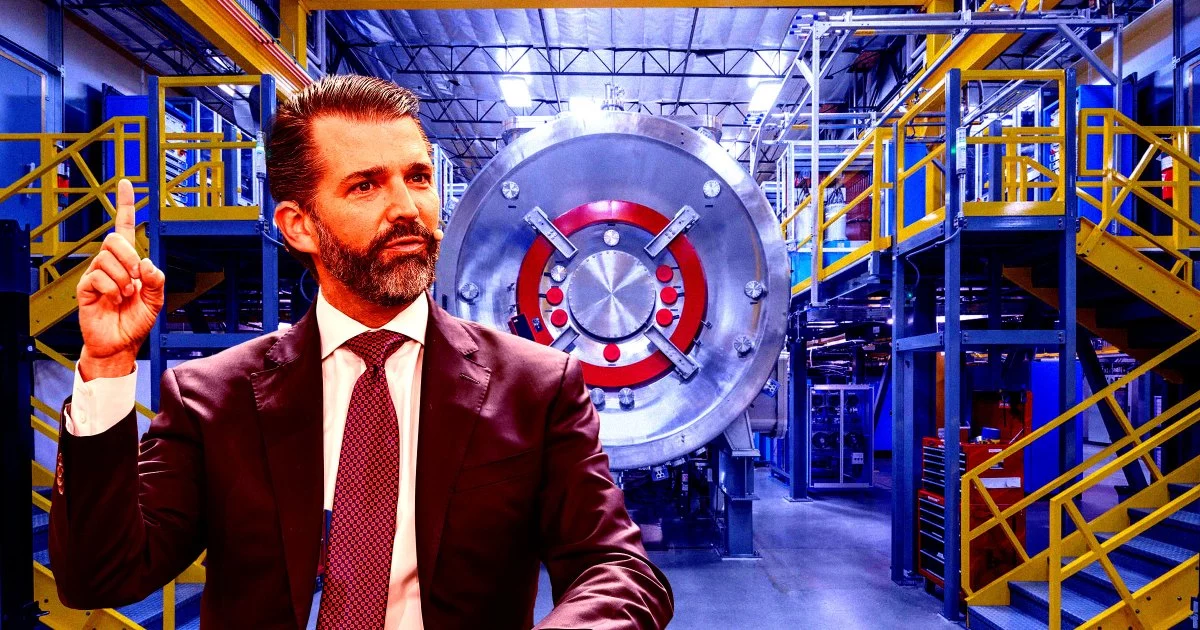

The Alchemy of Narrative and Nuclear Ambition: TMTG’s High-Stakes Leap into Fusion
In a move that defies both sectoral logic and Wall Street orthodoxy, Trump Media & Technology Group (TMTG)—the company behind Truth Social—has announced a definitive merger with TAE, a private fusion-power developer. The deal, which instantly inflated TMTG’s market capitalization by nearly a third, is less a routine acquisition than a radical act of narrative arbitrage. For a firm that has bled $54.8 million in operating losses this year and whose social-media business faces stagnant growth, the pivot into fusion energy is an audacious attempt to recast itself from a political-media outpost into a protagonist of the energy transition.
Narrative Arbitrage Meets Deep-Tech Moonshot
At the heart of this transaction lies a shrewd exploitation of market psychology. TMTG’s retail-heavy shareholder base, cultivated through meme-stock volatility and political brand loyalty, provides a rare public-market vehicle for a capital-starved fusion asset. In today’s high-interest-rate environment, late-stage private funding for fusion is elusive; TAE, by merging with TMTG, gains not just a ticker (DJT), but also access to a retail investor base that could support secondary offerings without the punitive dilution typical of venture rounds.
For TMTG, the deal is a narrative sleight of hand: it transforms the company’s story from “alt-Twitter” to “energy transition,” monetizing political capital in the public markets while acquiring a call option on a technological moon-shot. The merger also introduces political optionality—should federal energy or defense appropriations arise, a company with close ties to a possible future administration could be uniquely positioned to benefit.
Fusion’s Technical Frontier and the Promise of Clean Energy
TAE’s technological approach stands apart from the mainstream. While most fusion efforts—like the ITER project or Commonwealth Fusion Systems—focus on massive, tokamak-based reactors, TAE’s compact field-reversed configuration (FRC) promises a smaller footprint and lower material costs. If its proprietary boron-proton fuel cycle succeeds, the by-products would be dramatically cleaner, sidestepping the long-lived neutron waste that plagues traditional fusion concepts. This aligns with the environmental, social, and governance (ESG) incentives embedded in the U.S. Inflation Reduction Act and the EU’s Green Taxonomy.
Yet, the technical risks are formidable. TAE’s plasma confinement times have yet to be proven at scale, and the leap from laboratory demonstration to commercial deployment is measured in decades, not quarters. Still, the potential prize is transformative: dispatchable, low-cost fusion energy could reshape the economics of AI compute, hyperscale data centers, and green hydrogen—domains where TMTG currently has no operational presence but now holds a speculative ticket.
Capital Markets, Competitive Dynamics, and the New Strategic Playbook
The market’s exuberant response to TMTG’s pivot—despite a lack of immediate revenue synergies—signals that, in certain retail-driven floats, liquidity and narrative can outweigh traditional discounted cash flow logic. Fusion equities, typically relegated to private markets or venture-style multiples, may find new life if TAE’s public listing via DJT succeeds, potentially reopening the IPO window for other climate-hardware ventures stalled since late 2021.
The competitive landscape is fierce. Rivals like Helion (backed by Sam Altman) and Commonwealth Fusion Systems (with Jeff Bezos in its corner) are racing toward first-plasma milestones, supported by deep-pocketed strategics capable of vertically integrating energy offtake. TAE’s new access to political capital could help compensate for its thinner cash reserves, especially in securing Department of Energy loan guarantees or defense contracts for mobile reactor concepts.
Yet, skepticism abounds. Elon Musk’s public doubts about fusion’s near-term viability resonate with institutional investors wary of hype cycles. Regulatory hurdles loom large: the Nuclear Regulatory Commission’s evolving frameworks could impose fission-level scrutiny, delaying returns. And the cultural gulf between a media company and a physics R&D shop introduces governance risks that could threaten talent retention and execution.
Strategic Implications for Industry and Investors
The implications ripple far beyond the parties involved. Energy-intensive sectors—semiconductors, hyperscale cloud, advanced manufacturing—should begin scenario-planning for the possibility of sub-$10/MWh baseload power by 2035. Early offtake agreements or strategic equity positions in credible fusion ventures could yield durable cost advantages. For investors, fusion remains a venture-style option; position sizing and close monitoring of policy signals are paramount, particularly as energy-dominance agendas could reprice fusion assets overnight.
The deal also highlights a broader trend: unconventional SPACs and meme-equity vehicles targeting deep-tech assets overlooked by traditional capital. Boardrooms and M&A frameworks must adapt to a new reality where political branding and retail enthusiasm can unlock funding for technologies once deemed too risky or remote.
TMTG’s foray into fusion is a case study in the convergence of capital-market storytelling, geopolitical maneuvering, and technological ambition. The outcome remains uncertain, but the message is clear: in an era where narrative can move markets and policy can shape fortunes, even the most improbable mergers can become catalysts for the next wave of industrial transformation.

 By
By
 By
By
 By
By


 By
By

 By
By
 By
By
 By
By