

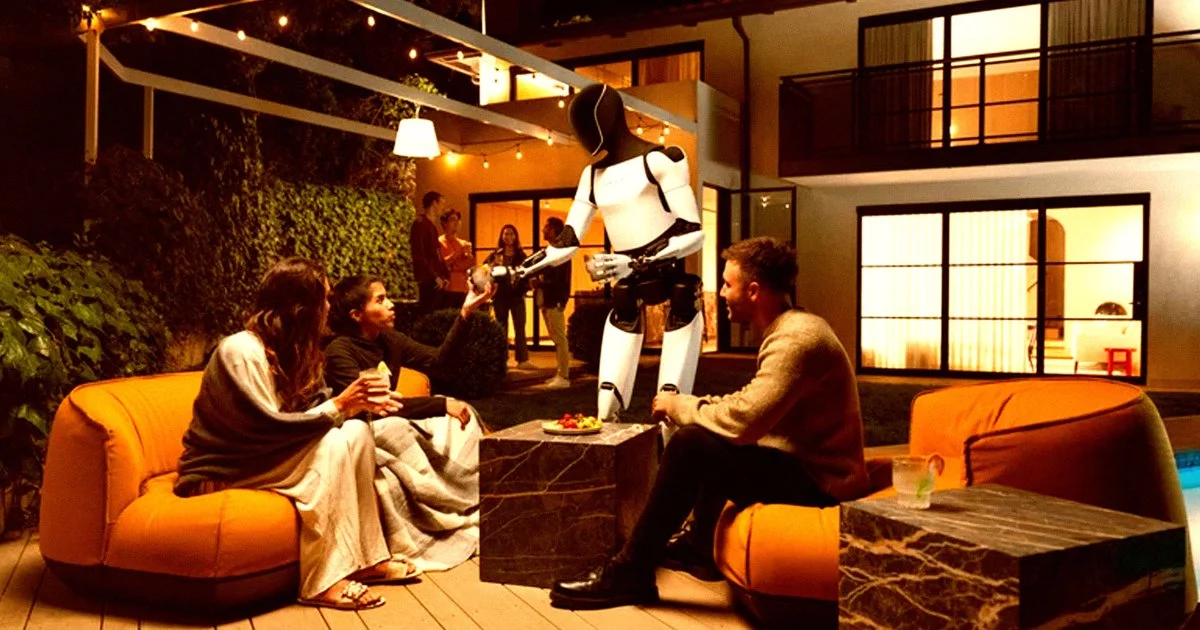

Tesla’s Strategic Metamorphosis: From Electric Vehicles to Embodied Intelligence
Tesla, long the lodestar of the electric vehicle (EV) revolution, now stands at a crossroads. Amidst waning EV demand, regulatory friction over its driver-assistance software, and a rare production miss on its Model Y, the company is orchestrating a dramatic narrative pivot. Elon Musk, never one to shy from audacious forecasts, has begun to recast Tesla as a robotics powerhouse—placing the humanoid Optimus robot at the center of its future value proposition. The ambition is staggering: one million units by 2030, a $25 trillion market cap, and a transformation of the company’s DNA from automotive disruptor to AI-and-robotics juggernaut.
Yet, beneath this bold vision lies a tension between aspiration and execution, between the intoxicating promise of embodied AI and the sobering realities of manufacturing, supply chains, and capital markets.
—
The Technological Frontier: Repurposing Autonomy for Humanoid Robotics
Tesla’s technological play hinges on a radical act of reuse: leveraging the AI architecture developed for Autopilot and Full Self-Driving (FSD) as the cognitive backbone for Optimus. On paper, the synergy is elegant. Both self-driving cars and bipedal robots must perceive, localize, and plan in dynamic environments. Tesla’s Dojo supercomputer, designed to drive down the cost of AI training, could—if it achieves its promised economics—become a moat around high-volume embodied intelligence.
But the devil is in the details. The leap from four wheels to two legs is non-trivial:
- Manipulation and Balance: Unlike vehicles, humanoids must master dexterity, variable contact forces, and the subtle art of balance—domains where research is nascent and the path to robustness is uncertain.
- Mechatronics Bottleneck: Boston Dynamics spent over a decade and millions per unit to achieve Atlas’s agility. For Tesla, the challenge is to collapse the bill of materials below $20,000 while maintaining durability—a feat that remains theoretical.
- Supply Chain Strains: Robots demand a far higher actuator-to-battery ratio than EVs, amplifying pressure on lithium and rare-earth magnet supply chains already stretched by the energy transition.
Tesla’s manufacturing philosophy—epitomized by its “unboxed” EV assembly and giga-pressings—has yet to find its analog in robotics. The vision of modular, in-situ printed limbs remains speculative, a tantalizing glimpse of scale yet to be realized.
—
Market Valuation: Narrative Premiums and the Economics of Optionality
Despite missing its 2023 pilot production target for Optimus and relying heavily on tele-operation in demonstrations, Tesla’s equity story remains buoyant. Investors are not pricing the company on its current automotive fundamentals, but on the optionality embedded in robotics—a call option on a future where humanoid labor is as ubiquitous as the smartphone.
- Valuation Disconnect: At current levels, Tesla trades at a multiple that dwarfs the combined valuations of legacy automakers. The market is underwriting a robotics narrative worth hundreds of billions, even as the path to scale is unproven.
- Profitability Math: Even optimistic assumptions—one million robots sold at $25,000 each with a 25% margin—yield incremental profits insufficient to justify a $25 trillion valuation. The implied expectation is a vast, yet-to-be-articulated service or recurring revenue layer, perhaps in robot-as-a-service (RaaS) models.
- Labor Economics: The demographic swell of aging populations in OECD countries and China creates a structural tailwind for automation. As unit labor costs rise, the ROI on general-purpose robots strengthens, but elasticity of demand at scale remains an open question.
The competitive landscape is equally dynamic. Startups like Figure, Agility Robotics, and Sanctuary are flush with venture capital but lack Tesla’s cash flow and sensor data pipeline. Meanwhile, industrial stalwarts—Fanuc, ABB, KUKA—are quietly advancing humanoid research, leveraging entrenched supply chains and service networks.
—
Strategic Horizons: Platform Convergence and Regulatory Maneuvering
Tesla’s pivot is not merely a hedge against EV commoditization; it is an attempt to orchestrate a convergence of autonomy, energy storage, and robotics under a unified AI and powertrain architecture. If successful, this could yield formidable ecosystem efficiencies:
- Shared Software and Silicon: A common AI stack and hardware platform could enable rapid iteration, over-the-air updates, and internal deployment in Tesla’s own factories—accelerating the learning curve.
- Regulatory Arbitrage: While FSD faces formidable regulatory hurdles on public roads, humanoid robots, operating within private premises, encounter lighter oversight. This regulatory asymmetry could allow Tesla to commercialize embodied AI faster than Level-4 autonomy.
For executives and capital allocators, the implications are profound. High burn rates and continued capital raises are likely as Tesla funds its robotics ambitions. Suppliers and partners would be wise to hedge their exposure—through structured agreements or options—while talent wars for embodied AI engineers intensify, driving median compensation ever higher.
—
Tesla’s Optimus initiative is a high-variance bet—one that mirrors the broader question of how quickly embodied AI can make the leap from research labs to balance sheets. For now, the prudent posture is one of strategic flexibility: option-like investments, modular technology roadmaps, and supply-chain hedges. The promise of a robotic future is vivid, but the journey from narrative to numbers is only just beginning.

 By
By
 By
By

 By
By
 By
By

 By
By
 By
By







