

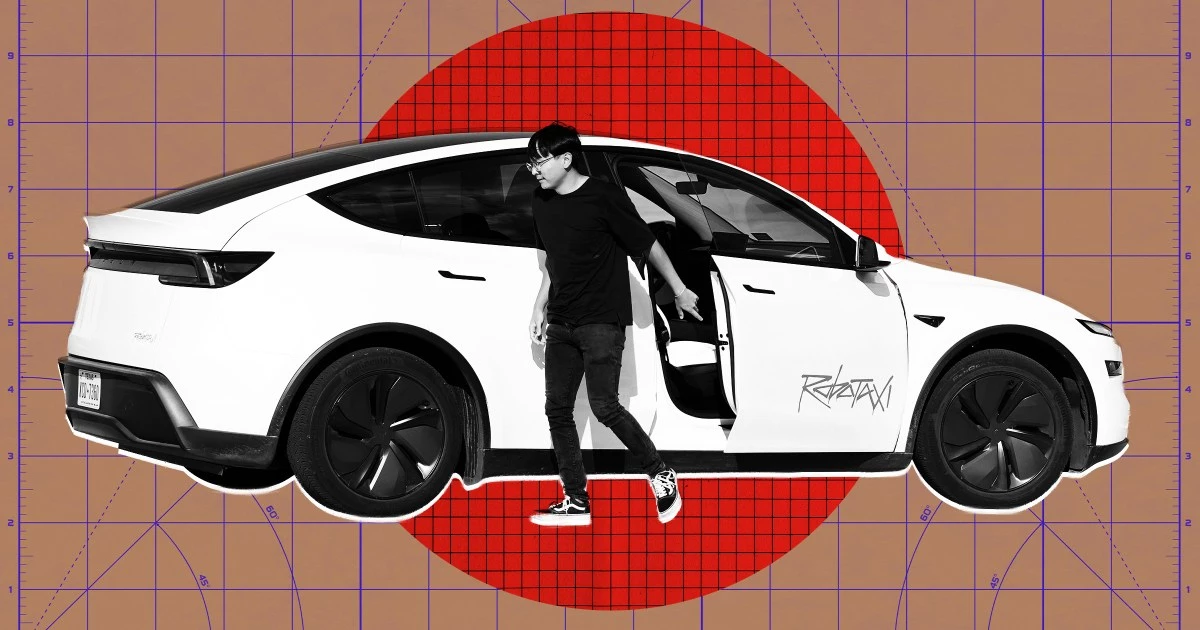

Austin’s Streets as a Crucible: Tesla’s Driverless Robotaxi Gambit
On the sunbaked boulevards of Austin, Texas, a new chapter in autonomous mobility is quietly unfolding. Tesla, under the restless vision of Elon Musk, has begun live-road testing its fully driverless “Robotaxi” vehicles—without the once-mandatory in-car safety monitors. The move, confirmed by Musk after a flurry of social-media videos, signals not just a technical milestone but a philosophical wager: that software, scale, and silicon can outpace the cautious, sensor-laden approach of rivals like Alphabet’s Waymo. The implications ripple far beyond the city limits, touching capital markets, regulatory frameworks, and the very economics of urban mobility.
Vision-Only Autonomy: The High-Wire Act of Algorithmic Confidence
Tesla’s decision to strip away human fallback is more than a cost-saving maneuver; it is a public test of the company’s faith in its “vision-only” Full Self-Driving (FSD) stack. Unlike Waymo’s fortress of lidar arrays and sensor redundancy, Tesla is betting that vast troves of fleet data and ever-evolving neural networks can shoulder the entire safety envelope—even in the unpredictable theater of city streets.
- Edge-Case Mastery: With no safety driver to intervene, Tesla’s algorithms must now detect, interpret, and respond to rare, high-stakes scenarios with near-perfect precision. This forces a relentless feedback loop: every anomaly becomes training data, every over-the-air update a test of the system’s statistical confidence.
- Scaling Bottlenecks Removed: The absence of human monitors is a tacit admission that people were becoming the limiting reagent in Tesla’s autonomy experiment. Now, the company’s in-house Dojo supercomputer and custom inference chips are thrust into the spotlight, tasked with processing petabytes of real-world scenarios at hyperspeed.
Yet, Tesla’s approach is not without controversy. Unlike Waymo, which publishes detailed disengagement data, Tesla’s data transparency remains opaque. As regulators worldwide pivot toward data-driven oversight, the company’s reticence could either expedite or stall new rules, depending on how real-world incidents unfold.
Rewriting the Economics of Urban Mobility
The removal of safety drivers is more than a technological flex—it is a seismic shift in the cost structure of ride-hailing and urban transit.
- Labor Cost Disruption: By eliminating the $6–$8 per mile labor premium, Tesla’s Robotaxi model transforms previously unprofitable routes into net-positive ventures. This underpins the company’s audacious projection of up to 70% gross margins for its autonomous fleet—a figure that, if realized, would upend the economics of mobility-as-a-service.
- Market Reverberations: Investors responded with characteristic zeal, sending Tesla’s share price upward on the news. The equity market’s reaction underscores a broader truth: autonomy milestones remain the primary source of option value in Tesla’s valuation, with ripple effects for AI-compute suppliers and lidar manufacturers alike.
But the path is fraught with risk. A single high-profile incident could trigger a cascade of insurance repricing and regulatory scrutiny, resetting the industry’s assumptions about capital allocation and risk tolerance.
Regulatory Chess and the Battle for Social License
Tesla’s high-velocity approach stands in stark contrast to Waymo’s incremental, city-by-city regulatory diplomacy. By moving rapidly—and publicly—Tesla accelerates technical learning but also amplifies the probability of policy backlash.
- Legal and ESG Frontiers: With no human fallback, accident liability shifts squarely onto Tesla’s shoulders, moving the debate from driver negligence to product liability. This is uncharted legal territory, where a lack of precedent could inflate balance-sheet risk and invite new forms of regulatory intervention.
- Transparency as Currency: As ESG investors sharpen their focus on data transparency, Tesla’s opaque crash reporting could restrict access to sustainability-linked capital pools. The social license to operate, once an afterthought, is fast becoming a strategic asset.
- Labor Market Shockwaves: The elimination of safety drivers is likely to fuel broader debates about automation and workforce displacement, raising the specter of regulatory offset requirements such as training funds or reskilling mandates.
The Road Ahead: Strategic Inflection Points for Stakeholders
For multinational automakers, Tesla’s gambit is a clarion call to reassess sensor strategies, balancing the allure of low-cost vision stacks with the regulatory comfort of redundancy. Mobility platform operators must brace for insurance volatility, while city and state regulators face mounting pressure to establish data-sharing compacts and common telemetry standards.
Enterprise fleet buyers, meanwhile, will be watching total cost of ownership curves with newfound urgency. The moment driverless cost per mile undercuts traditional fleets—even before factoring in fuel savings—will trigger boardroom debates and capital reallocation on a global scale. Technology investors, too, are eyeing the second-order beneficiaries: connectivity providers, edge AI firms, and simulation vendors poised to ride the next wave of autonomy testing.
As the dust settles in Austin, the stakes are clear. Tesla’s removal of in-car safety monitors marks a bold acceleration toward unsupervised autonomy—one that could either cement the company’s lead or expose it to existential risk. For industry incumbents, regulators, and investors alike, the coming months will be a crucible, testing not just the limits of technology, but the frameworks of trust, governance, and value creation that will define the next era of mobility.

 By
By
 By
By

 By
By
 By
By
 By
By

 By
By







