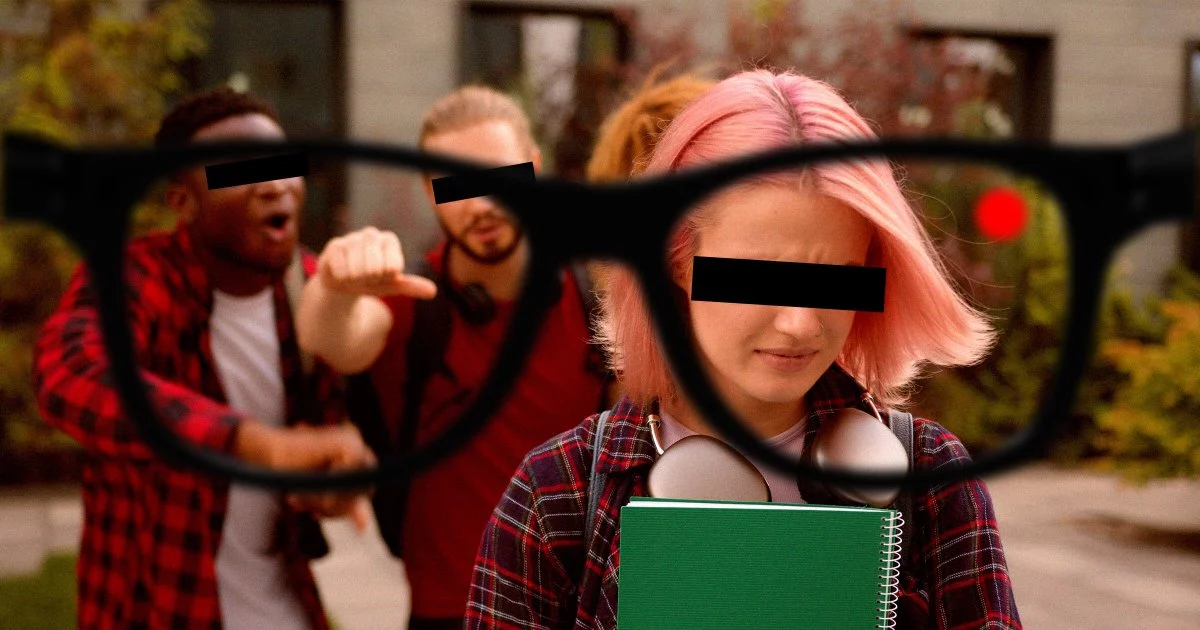

When AI smart glasses enter the school hallway: a new front in teen privacy and harassment
A viral TikTok clip—now echoed by a broader pattern documented by *Futurism*—has pushed Meta’s AI-enabled smart glasses into an uncomfortable spotlight: U.S. high school students using discreet, point-of-view wearable cameras to record female peers without consent, sometimes escalating into harassment, humiliation, or intimidation. The setting is mundane—corridors, cafeterias, classrooms—but the dynamic is novel. Unlike smartphones, which are visible and socially legible when raised to record, smart glasses normalize capture as posture: looking becomes filming, and filming becomes plausibly deniable.
What makes this moment particularly consequential is not only the misconduct itself, but the way the technology compresses the distance between intent and distribution. A wearable camera paired with AI features and cloud-connected sharing can turn a fleeting encounter into a permanent artifact—searchable, remixable, and socially amplified—before a teacher or administrator even realizes recording occurred. For the targets, the harm is not limited to the moment of confrontation; it extends into the uncertainty of not knowing what was captured, where it went, and how long it will circulate.
School districts moving to ban smart glasses are responding to a convergence of risks: student privacy, minor safety, classroom distraction, and cheating. Yet enforcement is inherently difficult because the devices are designed to be worn continuously and appear ordinary. This is the core tension: the same form factor that makes wearables compelling as consumer tech also makes them uniquely challenging as a governance problem.
The technology shift: from visible cameras to ambient, AI-assisted recording
Wearable cameras have existed for years, from GoPros to body cams, but the current wave of AI smart glasses represents a step-change in both usability and social impact. The trajectory is clear: devices are getting smaller, more connected, and more capable—while becoming less noticeable.
Key technological dynamics shaping this issue include:
- Point-of-view capture with minimal friction: recording can be initiated quickly and discreetly, often without the conspicuous “phone up” signal that alerts others.
- AI-enabled features and cloud connectivity: even when the AI is not directly used for identification, the ecosystem encourages rapid posting, editing, and sharing—accelerating virality and reducing opportunities for intervention.
- Ambiguity by design: many bystanders cannot easily tell whether glasses are recording, which undermines social norms that typically regulate filming in shared spaces.
- Institutional lag: teachers and administrators may not recognize the devices, understand their capabilities, or have clear procedures for addressing misuse—especially when policies were written for smartphones, not wearables.
This is a familiar pattern in consumer technology: capability outpaces etiquette, and etiquette outpaces policy. The difference here is that the affected environment—schools—contains minors, heightened duty-of-care expectations, and a daily density of interactions that can be exploited for content.
Market and brand stakes: wearables adoption meets reputational gravity
For Meta and the broader AR/wearables sector, the emerging narrative is not simply “kids misbehave.” It is that hands-free, always-available cameras can become tools for coercion and social dominance—particularly in adolescent settings where status incentives are strong and empathy can be underdeveloped.
From a business and technology perspective, several implications stand out:
- Brand risk and consumer trust: high-visibility misuse can chill mainstream adoption of smart glasses, especially among parents, educators, and privacy-conscious consumers. Wearables succeed when they feel safe and socially acceptable; harassment content makes them feel neither.
- Regulatory and procurement headwinds: schools and public institutions are influential norm-setters. If districts broadly restrict smart glasses, that can ripple into workplace policies, venue bans, and insurance requirements.
- A parallel market for compliance and controls: as organizations confront wearable recording, demand may rise for:
– device-management and policy enforcement tools
– geofencing or location-based recording restrictions
– incident-response workflows and evidence handling
– privacy and liability advisory services for schools and districts
Investors tracking AR and consumer wearables may increasingly price in policy friction as a real adoption constraint—akin to how drones, facial recognition, and social platforms encountered regulatory ceilings after early growth.
Governance, law, and “privacy by design”: what stakeholders can do next
The policy challenge is not merely whether smart glasses should be allowed in schools, but how to define consent, notice, and accountability in environments where recording can be invisible. U.S. recording laws vary widely, including two-party consent standards in some states, and the presence of minors raises the stakes further. Schools also operate under distinct expectations around student protection, yet many codes of conduct were not written with wearable cameras in mind.
A workable path forward likely requires coordinated action across education, industry, and policymakers:
For school districts and administrators
- Update student conduct codes to explicitly address wearable cameras and undisclosed recording.
- Establish clear, fast incident-response protocols that include student support, evidence preservation, and parent/guardian notification where appropriate.
- Treat non-consensual recording as both a disciplinary and student-wellbeing issue, integrating counseling resources when harm occurs.
For Meta and wearable manufacturers
- Implement privacy-by-design safeguards that are difficult to bypass, such as:
– highly visible recording indicators
– stronger default restrictions in sensitive locations (schools, locker rooms, clinics)
– clearer user education and friction for sharing content featuring minors
- Provide optional institutional device-management modes that support schools and workplaces with enforceable policies and auditability.
For policymakers and regulators
- Clarify how existing consent and privacy frameworks apply to wearable cameras, especially involving minors and educational settings.
- Encourage standards that make recording legible to bystanders, reducing ambiguity that erodes social trust.
The immediate controversy is about smart glasses in high schools, but the underlying question is larger: whether society will accept a future where any glance can be a recording—and whether the companies building that future will treat consent as a feature, not an afterthought. The next school year may become an early proving ground for how quickly institutions can adapt when surveillance capability becomes wearable, ambient, and socially invisible.


 By
By
 By
By
 By
By

 By
By
 By
By