
A bracket final that doubles as a boardroom stress test
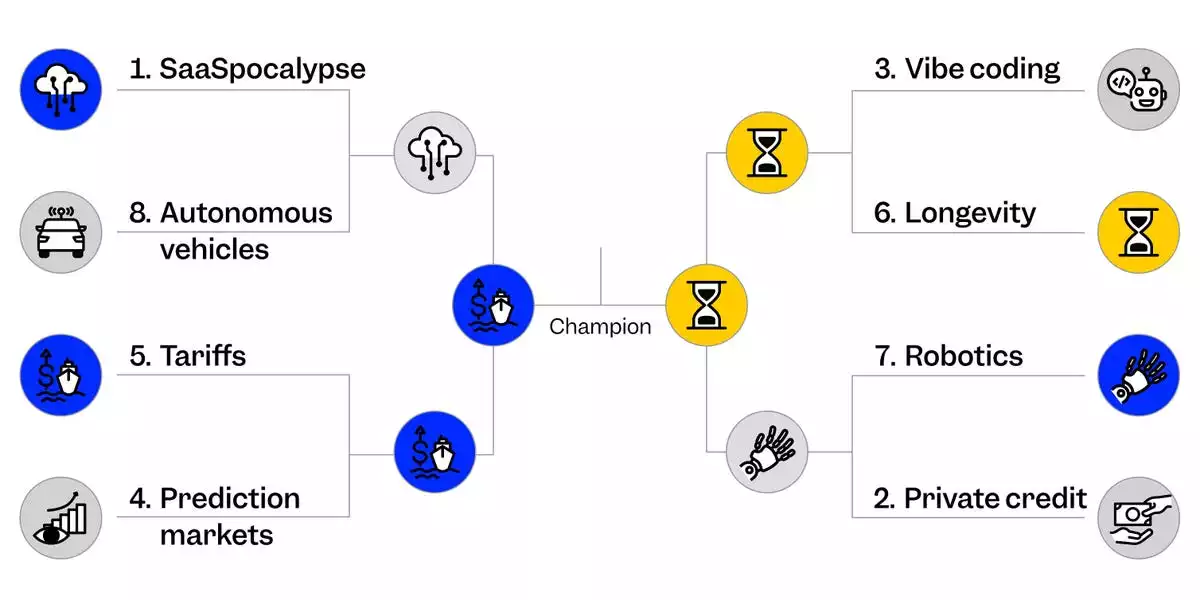
Business Insider’s bracket-style vote—nearly 300 participants narrowing a field of business-impact themes to a head-to-head final—lands on a telling matchup: tariffs versus longevity. On the surface, it reads like a contest between a near-term policy shock and a long-arc technological and demographic shift. In practice, it captures how executives are being forced to manage two different clocks at once: the quarterly cadence of pricing, sourcing, and compliance, and the multi-decade reconfiguration of healthcare, work, and retirement.
Tariffs advanced decisively after an upset over “SaaSpocalypse,” taking 61.6% of the vote—an outcome aligned with what consumers and CFOs feel most viscerally: higher shelf prices, margin compression, and the persistent uncertainty of trade policy. Meanwhile, longevity—which beat robotics with 60.4%—reflects a more aspirational, universal pull: the promise that advances in biotechnology, AI-driven drug discovery, diagnostics, and personalized nutrition can extend healthspan, not just lifespan.
This is not merely a popularity contest. It is a snapshot of where business anxiety and business ambition are concentrating—and where capital allocation debates are likely to intensify.
Tariffs: from temporary tool to “managed protectionism” baseline
Tariffs have evolved from a tactical lever into a structural feature of planning. Their most immediate effect is inflationary: duties raise the landed cost of goods, forcing companies to choose among price increases, margin sacrifice, or product redesign. The downstream consequence is behavioral as much as financial—when essentials and staples rise, discretionary spending often shifts away from services and innovation-led purchases, subtly reshaping demand across categories.
Key dynamics now defining tariff risk include:
- Price signal distortion and margin pressure: Persistent duties can mask underlying competitiveness, complicating decisions on product mix, promotions, and long-term supplier commitments.
- Supply-chain realignment as a permanent program: Near-shoring, dual-sourcing, and “inventory-on-hand” strategies are increasingly treated as resilience investments rather than temporary hedges—especially in electronics, precision machinery, and specialty chemicals.
- The judiciary as a commercial policy actor: Recent Supreme Court ripple effects—potentially enabling refunds for goods affected by former President Trump’s duties—highlight how legal precedent can move balance sheets. For importers, this is not abstract: it can influence cash flow timing, reserve policy, and even earnings guidance.
Yet the political trajectory matters as much as the legal one. Despite periodic hopes for relief, the current administration has shown limited appetite for broad reversals. The result is a “new normal” of managed protectionism—a world where trade friction is not an exception but an operating condition. For business leaders, that shifts tariffs from a procurement issue into an enterprise-wide discipline spanning pricing strategy, treasury, compliance, and geopolitical intelligence.
Longevity: the healthspan economy arrives—with new markets and new liabilities
If tariffs are a constraint, longevity is a frontier. The longevity theme resonates because it is simultaneously personal and macroeconomic: people want more healthy years, and societies are being reshaped by aging demographics. The commercial implication is the emergence of a healthspan economy—a broad ecosystem spanning biotech, digital health, alternative proteins, diagnostics, lifestyle brands, and preventive-care platforms.
The most consequential shift is not simply that people may live longer, but that they may remain healthier—and productive—later into life. That possibility reorders multiple markets at once:
- Real estate and urban planning: Demand may rise for multi-generational housing, retrofitted accessibility, and communities designed around prevention, mobility, and social connection.
- Labor markets and workforce design: Longer working lives imply career ladders spanning decades, requiring continuous re-skilling and workplace design that supports multiple generations simultaneously.
- Insurance and pensions: Longer lifespans force actuarial recalibration. Insurers and pension funds must revisit liabilities, pricing, and product design—fueling experimentation with annuity innovations and early signals of longevity-linked instruments.
Capital is already responding. Longevity start-ups—ranging from senolytic biotech to AI-powered diagnostics—are attracting crossover investment from tech venture and healthcare private equity. That convergence brings speed and scale, but also intensifies competition for talent and raises the premium on regulatory strategy, clinical validation, and data governance.
Where the two forces collide: cost of innovation, capital strategy, and the multi-generational firm
The most underappreciated insight in the tariffs-versus-longevity framing is that these forces are not independent. They intersect in ways that can either compound risk or create defensible advantage.
Consider three pressure points now emerging:
- Trade policy as an R&D variable: Tariff regimes can raise costs for critical longevity inputs—cell-culture media, specialty reagents, high-precision lab instruments—potentially slowing timelines and narrowing the set of viable experiments. For life-sciences and health-tech leaders, trade-policy scenario planning is becoming part of the R&D roadmap, not an afterthought.
- CFO reengineering under dual stress: Tariff-driven margin pressure pushes more sophisticated hedging, supplier financing, and working-capital tactics. Longevity-driven benefit liabilities push the other way—toward reserving for longer pension outflows and revisiting actuarial assumptions. The combined effect is a more complex balance-sheet narrative for investors.
- The multi-generational workforce as strategy, not HR: As employees live and work longer, organizations will need policies that support multi-decade careers, continuous up-skilling, and inter-generational mentorship—while shifting health programs from episodic care to lifelong prevention.
For policymakers and corporate leaders alike, the combined weight of protectionism and demographic change will test public finances and corporate operating models. The companies that navigate this era best are likely to be those that treat tariffs as a permanent resilience discipline—while investing early in the longevity economy’s platforms, partnerships, and prevention-first business models—because the next decade will reward firms that can absorb policy shocks without surrendering the compounding returns of long-horizon innovation.


 By
By


 By
By
 By
By
 By
By