

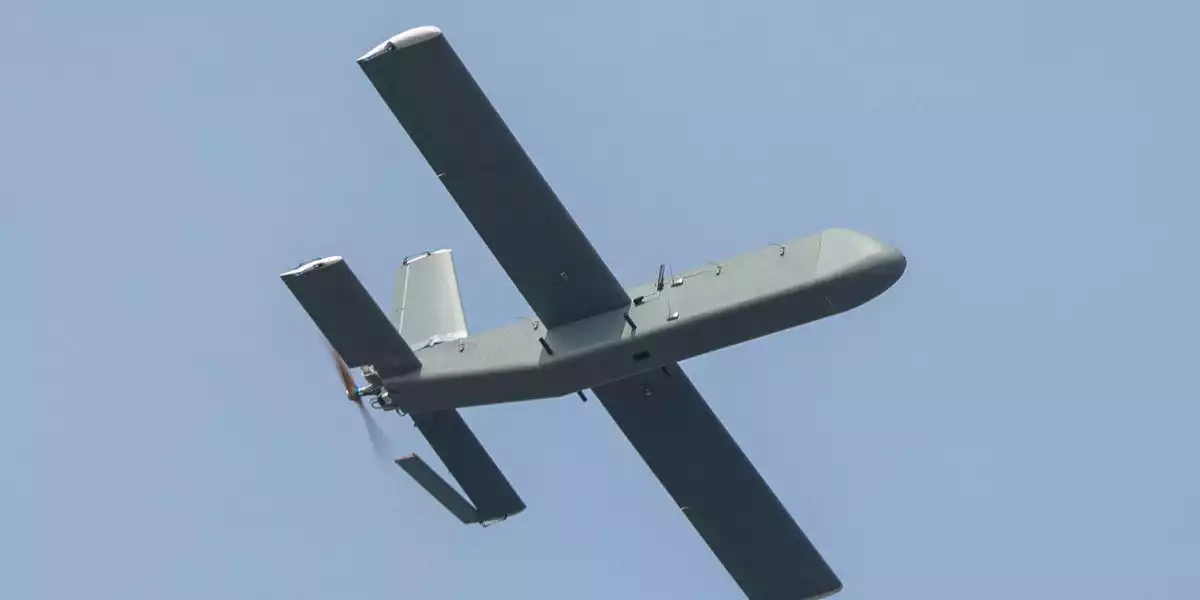

A public debut that signals Taiwan’s next phase of unmanned coastal defense
Taiwan’s latest Han Kuang military exercises offered a carefully staged but strategically resonant first: the public display of two domestically developed medium-class “suicide” strike drones (loitering munitions) during a simulated littoral attack near Zuoying, a naval hub that anchors Taiwan’s maritime posture. The unveiling—observed by President Lai Ching-te—was not accompanied by extensive technical specifications, yet the choreography of the drills spoke clearly. Taiwan is moving to normalize unmanned strike systems as a visible component of its defense messaging, not merely a classified capability kept in reserve.
The drones’ reported 40–60 km range places them in a tactically consequential middle tier: far beyond short-range quadcopters used for immediate reconnaissance, but below long-endurance UAVs designed for persistent surveillance. In practical terms, that range bracket maps neatly onto the geography of Taiwan’s coastal approaches, where fast-moving engagements, cluttered sea lanes, and compressed decision timelines define the operational problem.
The broader exercise package reinforced the same theme of distributed denial. Alongside the drone appearance, Taiwan integrated:
- Special-forces amphibious operations
- Rapid missile-boat sorties designed for quick strike-and-disperse cycles
- Combined-arms responses to “gray-zone” pressure, reflecting the reality of coercion below the threshold of open conflict
Taken together, the message is less about a single platform and more about a doctrine: Taiwan is rehearsing a defense architecture that is mobile, networked, and difficult to preempt.
What the medium-range loitering munition implies for design, endurance, and targeting
The most revealing detail is not the airframe silhouette but the category choice. Medium-range loitering munitions fill a gap that many militaries now treat as decisive: the ability to search, wait, and strike within a window of 30–60 minutes—long enough to exploit fleeting targets such as slow-moving vessels, landing craft, logistics boats, or patrol assets operating in the littorals.
Analysts have drawn parallels to Ukrainian “kamikaze” drone employment against Russian logistics and rear-area nodes. The comparison is instructive, not because Taiwan’s environment is identical, but because Ukraine has demonstrated how relatively low-cost unmanned strike systems can impose outsized operational friction—forcing adversaries to disperse, harden, and spend scarce air-defense capacity on small, numerous threats.
Taiwan’s limited disclosure also invites attention to what must exist behind the scenes for these drones to matter at scale:
- Guidance and navigation resilience: In contested environments, reliance on satellite navigation alone is fragile. A plausible architecture would blend inertial navigation with GPS and other satellite fallbacks, plus terminal guidance tuned for maritime targets.
- Electronic warfare (EW) survivability: The absence of a live-fire demonstration may reflect ongoing work to validate performance under jamming, spoofing, and datalink disruption—conditions expected in any high-end cross-strait contingency.
- C4ISR integration: A loitering munition is only as effective as the targeting chain feeding it. Coastal defense use cases demand real-time target acquisition, cueing from coastal radar, and networked fire control that can function even when communications are degraded.
In other words, the drone is the visible tip of a larger system-of-systems investment: sensors, datalinks, mobile launch concepts, and battle management processes that can compress the “detect-to-engage” timeline.
Industrial scale as strategy: the 2030 production target and the NT$200 billion bet
The most consequential element may be economic rather than aerodynamic. Taiwan’s stated ambition to reach 100,000 drones per month by 2030, supported by a proposed NT$200 billion (US$6.6 billion) procurement plan for more than 210,000 domestically produced drones, is a declaration of intent to build industrial depth—not just boutique capability.
If pursued seriously, that scale target reshapes several business and technology realities:
- Manufacturing throughput and automation: High-volume drone output requires standardized designs, modular subsystems, and automated assembly—approaches familiar to consumer electronics, but harder when systems must meet defense reliability and security requirements.
- Supply-chain resilience: Motors, batteries, composite materials, and EO/IR sensors become strategic inputs. The global market for these components is exposed to commodity volatility and export controls, making redundancy and stockpiling more than prudent—they become operational necessities.
- Semiconductors as both advantage and constraint: Taiwan’s chip ecosystem is a natural enabler for avionics, communications, and onboard compute. Yet prioritizing defense-grade components could create allocation pressures and force difficult choices around capacity, certification, and export commitments.
For Taiwan’s domestic economy, the procurement plan could catalyze a broader drone supply ecosystem, pulling in SMEs and creating spillovers into civilian domains such as infrastructure inspection, disaster response, precision agriculture, and logistics. For global firms, it raises immediate questions about supplier qualification, dual-use compliance, and capacity planning in a market where defense demand may become structurally larger.
Deterrence logic and the regional technology race now taking shape
Strategically, Taiwan’s drone emphasis aligns with an asymmetric deterrence posture often described as making an aggressor’s operation costly, complex, and uncertain. A credible inventory of sea-denial drones—especially if paired with mobile launchers and resilient targeting—could compel the PLA to invest more heavily in screening, point defense, and electronic countermeasures, diluting offensive concentration.
This is where the “swarm” concept becomes more than a buzzword. Even without science-fiction autonomy, massed unmanned systems can create:
- Saturation pressure on air defenses and shipboard interceptors
- Persistent reconnaissance-strike loops that punish predictable movement
- Operational ambiguity, forcing adversaries to treat many contacts as lethal
The regional context matters. Japan, South Korea, and Australia are also accelerating UAV and counter-UAV programs, and Taiwan’s scale ambitions could influence Indo-Pacific economies of scale—potentially lowering unit costs and speeding iteration cycles across the theater. Predictably, it will also accelerate countermeasures: directed-energy systems, kinetic interceptors, advanced EW, and hardened command-and-control designed to blunt the drone advantage.
For business and technology leaders, the Han Kuang unveiling reads as a market signal: Taiwan is not merely buying drones; it is attempting to industrialize unmanned defense. The winners will be those who can deliver resilient components, secure communications, and scalable manufacturing—because in the emerging security environment, deterrence is increasingly measured not only by exquisite platforms, but by how fast a nation can produce, replace, and adapt the systems that fight first and in the greatest numbers.

 By
By
 By
By

 By
By
 By
By

 By
By
 By
By







