

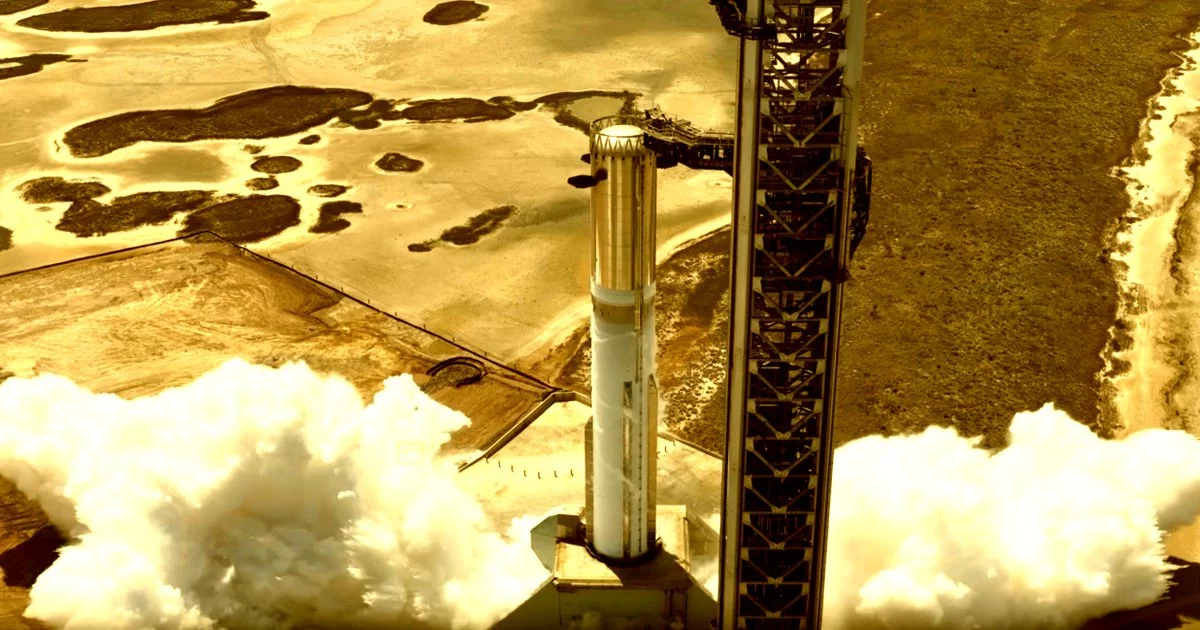

When the launch pad becomes the critical path for Starship
SpaceX’s Starship program has always been framed as a vehicle story—stainless-steel structures, Raptor engines, and full-stack reusability. Yet the most consequential recent signals are coming from the ground. The first integrated Starship launch in late 2023 exposed a foundational vulnerability: the absence of adequate pad reinforcement. The result was not merely a rough test outcome but a systems-level failure that cratered the launch site, damaged surrounding infrastructure, and lofted debris beyond the immediate perimeter—an outcome that sharpened scrutiny around environmental impact, community safety, and operational readiness.
SpaceX responded with a clear pivot toward ground-system hardening, notably:
- A reinforced steel launch plate designed to absorb and distribute extreme acoustic and thermal loads
- An automated water-deluge flame suppression system intended to reduce plume impingement, heat flux, and particulate ejection
This mitigation package signaled maturation: a recognition that rapid iteration cannot rely solely on vehicle redesign when the launch mount, flame trench alternatives, and suppression plumbing are effectively part of the propulsion system at liftoff. But the latest anomaly—a localized explosive event during a deluge-system test—reopens the question of whether the pad has truly moved from experimental to dependable. Even if structural damage was minimal, the incident matters because it challenges the reliability of the very subsystem meant to prevent a repeat of the 2023 pad failure.
For a program marching toward a 12th integrated flight test and a “Version 3” prototype campaign on a newly constructed pad and test facility, the message is direct: ground infrastructure is now a gating technology, not an accessory.
Engineering reality check: integration is where “solved” subsystems fail
SpaceX’s engineering identity—iterative development, aggressive test cadence, and learning through failure—has delivered historic gains in launch economics and operational tempo. The Starship program extends that ethos to an unprecedented scale. The trade, however, is that the most difficult problems often emerge not within individual components but at their interfaces.
The recent pattern illustrates this integration risk:
- A deluge-system test anomaly that produced an explosive event, raising questions about pressure transients, ignition sources, or mechanical failure modes in high-flow plumbing
- Two static-fire attempts of the B19 Super Heavy booster that auto-aborted, reportedly due to interactions between the steel plate and the deluge system
- A growing emphasis on automated abort logic, which—while essential for safety—can become a program bottleneck if sensor thresholds and control tolerances are overly sensitive to novel dynamics
From a technical standpoint, the likely culprits are not exotic; they are the classic hazards of high-energy ground operations at scale:
- Fluid-hammer effects in deluge piping and valves, where rapid changes in flow create shock loads and pressure spikes
- Mechanical resonances induced by high-volume water flow interacting with structural elements (steel plate, mount, plumbing supports)
- Sensor fusion and interlock tuning, where real-time diagnostics must distinguish between benign transient behavior and true precursor signals of catastrophic failure
The key insight for aerospace and industrial engineering leaders is that pad systems are not passive. A steel plate changes acoustic reflection and thermal distribution. A deluge system changes plume behavior, pressure fields, and vibration signatures. When recombined, these “fixes” can create emergent conditions that were not present in isolated tests. In other words, Starship’s current challenge looks less like a single broken part and more like a coupled system seeking a stable operating envelope.
The business implications: schedule risk, unit economics, and market spillovers
Every additional test cycle carries a dual cost structure: direct rework and time-based opportunity cost. For SpaceX, the opportunity cost is unusually high because Starship is positioned not just as a new rocket, but as a platform intended to reshape launch pricing, payload mass economics, and mission architectures—including NASA’s Artemis program.
Several economic and strategic pressures converge here:
- NASA milestones and credibility: NASA’s plan includes a low-Earth-orbit Starship demonstration targeted for next year and a crewed lunar landing mission in 2028. Any slip introduces reputational risk for both NASA leadership and SpaceX, and can complicate downstream program dependencies (training, payload integration, mission sequencing).
- Commercial launch market ripple effects: SpaceX’s dominance means schedule perturbations influence satellite operators’ deployment calendars. Even if Falcon 9 and Falcon Heavy remain available, Starship’s promised capacity and cost profile have shaped expectations. Delays can prompt customers to hedge with ULA, Arianespace, or Blue Origin, or to restructure constellation rollouts around smaller-lift alternatives and rideshare strategies.
- Unit economics under pressure: Repeated pad iterations, abort-driven stand-downs, and infrastructure retrofits can raise the marginal cost per attempt. That doesn’t negate Starship’s long-run potential, but it does complicate simplistic narratives around ultra-low per-flight costs until operational stability is proven.
This is also a capital-markets story. SpaceX’s ability to fund parallel development tracks—vehicle, engines, pads, and facilities—remains a strategic advantage. Yet investors and institutional stakeholders tend to reward predictable throughput once a program transitions from experimental to operational. The closer Starship gets to being embedded in national mission timelines, the more the market expects disciplined reliability engineering alongside bold iteration.
What strategic leaders should watch next in the Starship program
For executives, policymakers, and aerospace partners, the near-term signal is not whether anomalies occur—complex test programs generate anomalies—but how quickly root causes are isolated and whether fixes reduce recurrence. The most decision-relevant indicators over the next test window include:
- Stability of the steel plate + deluge configuration: whether the combined system can support repeatable static fires without triggering abort logic
- Refinement of automated safety interlocks: whether abort thresholds evolve from conservative tripwires into robust, context-aware controls supported by high-fidelity diagnostics
- Supply-chain and retrofit readiness: specialty steels, high-pressure valves, and large-scale plumbing components are not immune to inflation and lead-time constraints, especially if redesigns cascade
- Regulatory and stakeholder posture: FAA licensing pace, environmental scrutiny, and community impact management can become schedule multipliers if confidence erodes
Starship’s promise remains structurally intact: a fully reusable heavy-lift system would reorder the economics of orbit and beyond. The current friction point is that industrial-scale reusability demands industrial-scale ground reliability—and the launch pad, once treated as supporting infrastructure, is now proving to be one of the program’s most consequential technologies.

 By
By
 By
By
 By
By
 By
By

 By
By
 By
By







