


A roller-coaster “remote meeting” that doubles as a modern media playbook
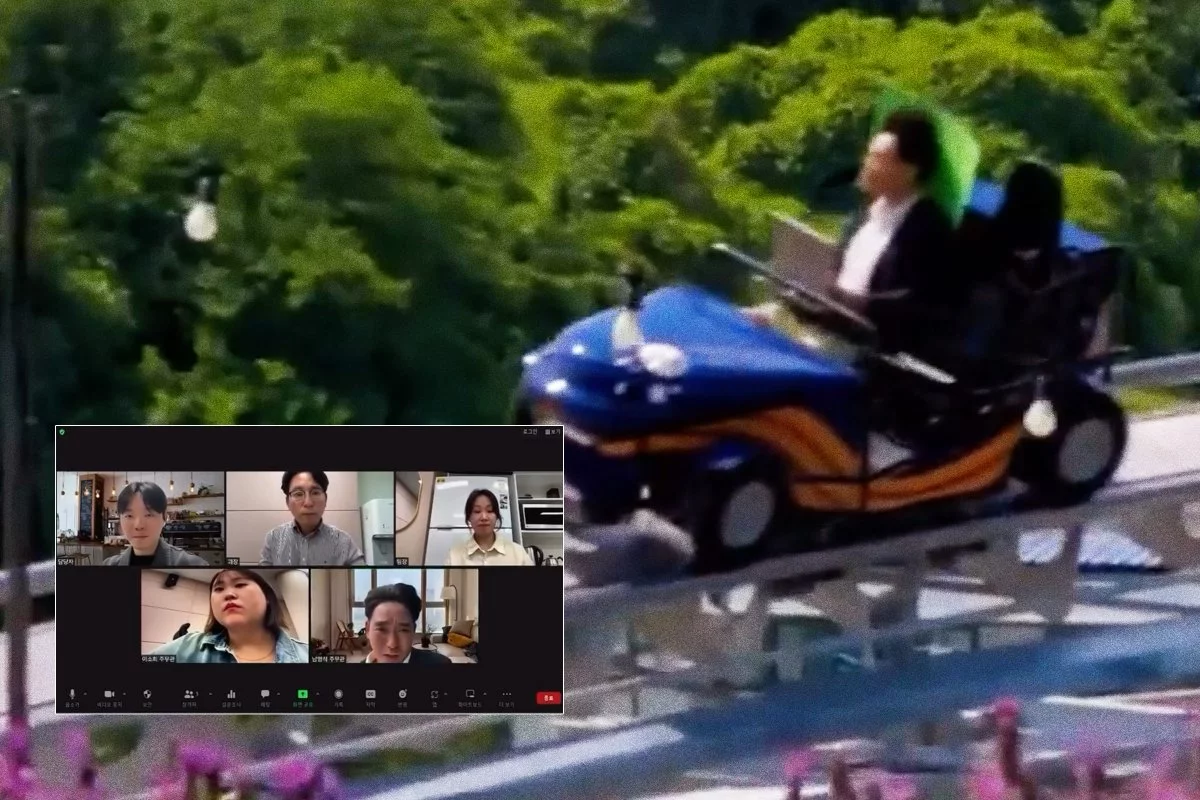
A South Korean municipal broadcaster has delivered an unlikely viral moment: a livestreamed, minute-long “work-from-home” vignette in which an employee joins a video conference while riding a whale-themed roller coaster at the Jangsaengpo Whale Culture Special Zone in Ulsan’s Nam-gu district. The worker—laptop balanced on his lap—props up a cardboard green screen to simulate a tidy home-office background, while a supervisor’s incredulous questions punctuate the ride’s jolts and drops.
On the surface, it’s slapstick. Underneath, it’s a compact case study in how public-sector and local tourism stakeholders now compete in the attention economy: not by outspending national brands, but by out-designing them for shareability. The clip’s power lies in its tight alignment with today’s digital reflexes—short-form pacing, instantly legible visual comedy, and a premise that travels across languages because it targets a near-universal workplace artifact: the video call.
For business and technology leaders, the more interesting story is not the prank itself, but what it reveals about the evolving mechanics of earned media, the shifting norms of remote-work culture, and the growing sophistication of lean, viral-first marketing.
The technology stack is mundane—and that’s precisely the point
The stunt works because it is built on tools that have become infrastructural: Zoom, Microsoft Teams, Google Meet, and the broader grammar of webcam etiquette. Video conferencing is no longer “tech”; it is workplace plumbing. That ubiquity lowers the creative barrier for everyone—from global enterprises to municipal broadcasters—to remix professional conventions into entertainment.
Three technology dynamics stand out:
- Standardized interfaces enable instant comprehension. Viewers don’t need context to understand the joke; they recognize the meeting format immediately. This is the same reason “screen share fails” and “hot mic moments” travel so well online—platform conventions have become cultural conventions.
- Production value has been democratized. A consumer laptop, a DIY green screen, and a roller coaster deliver a result that competes with higher-budget campaigns because distribution—not cinematography—is the scarce resource. In 2026’s media environment, *concept density* often beats polish.
- Authenticity is being engineered, not discovered. The cardboard backdrop is intentionally flimsy, signaling “we know you know this is staged.” That wink matters. Audiences increasingly reward content that feels candid—even when it’s meticulously planned—because it contrasts with overly optimized brand messaging.
For marketers and communications teams, the takeaway is pragmatic: virality is less about tools and more about format fluency. Understanding the visual language of remote work—grid views, background filters, awkward interruptions—creates a ready-made canvas for storytelling.
Tourism, budgets, and the new economics of attention
The clip is also a pointed example of how destinations are selling experiences in a post-pandemic rebound. Tourism boards and local governments are competing not just for foot traffic, but for social proof—the photos, clips, and memes that turn a physical attraction into a digital asset.
This is where the whale-themed coaster becomes more than a ride. It becomes a content engine.
Key economic and strategic implications:
- Experience-economy positioning: Attractions now compete on “shareability” as much as thrill. A coaster that can be summarized in one sentence—“the whale ride”—and one visual—“a meeting on a roller coaster”—has an advantage in crowded feeds.
- Cost-effective earned media vs. traditional spend: Municipal entities often operate under constrained budgets. A stunt that generates global circulation can outperform paid placements on a cost-per-impression basis, especially when amplified by reposts, reaction videos, and press pickup.
- ROI expands beyond ticket sales: The return is measured in brand lift for the district, increased search interest, and long-tail discoverability. In modern destination marketing, attention is a form of infrastructure: it reduces future customer acquisition costs.
This is not merely “going viral.” It is strategic compression—packing a destination narrative into a clip short enough to be frictionlessly shared, yet distinctive enough to be remembered.
Remote-work culture as both punchline and pressure point
The humor lands because it exaggerates a real tension: the blurred boundary between work and life. Remote and hybrid work normalized the idea that professional presence can be performed anywhere—kitchens, cafés, cars, airports. The roller-coaster meeting is absurd, but it is also a mirror held up to a culture that sometimes treats constant availability as flexibility.
For employers and HR leaders, the clip surfaces several cultural signals worth noting:
- Presence is increasingly theatrical. Backgrounds, lighting, and “camera-ready” behavior are now part of workplace performance. The prank literalizes that performance with a cardboard set.
- Micro-influencers can be accidental—and powerful. The employee becomes a protagonist, demonstrating how ordinary staff can carry a narrative more credibly than polished spokespeople. This has implications for employer branding and civic promotion alike.
- Humor is a high-trust communication channel. When institutions use comedy effectively, they can feel more human—without abandoning professionalism—provided the joke doesn’t trivialize safety, labor norms, or public accountability.
The broader lesson is that remote-work conventions have become a shared global language, and shared languages are fertile ground for marketing, storytelling, and community identity-building.
What this signals for marketing strategy, civic branding, and the next wave of experiential media
This roller-coaster video conference is a small artifact with outsized implications: it shows how quickly a local initiative can achieve global reach when it aligns with platform-native storytelling and a universally understood workplace trope.
Organizations looking to learn from it—whether tourism boards, SMEs, or enterprise brands—can extract a few durable principles:
- Design for “one-glance understanding”: a premise that reads instantly in a thumbnail and pays off within seconds.
- Fuse digital and physical touchpoints: use online spectacle to drive real-world visitation, then encourage user-generated content to sustain momentum.
- Institutionalize creative risk with guardrails: empower small teams to test unconventional ideas quickly, while maintaining safety, ethics, and brand fit.
- Extend the concept into immersive formats: 360° video, VR previews, behind-the-scenes shorts, and interactive maps can turn a single viral clip into a longer campaign arc.
In a world where attention is scarce and budgets are scrutinized, the most competitive organizations—public and private—will be those that treat creativity as operational capability. This municipal prank, staged on a whale-themed coaster, is a reminder that the next global marketing moment may not come from a major studio or a multinational brand, but from a local team that understands exactly how the internet watches.

 By
By
 By
By


 By
By
 By
By
 By
By







