

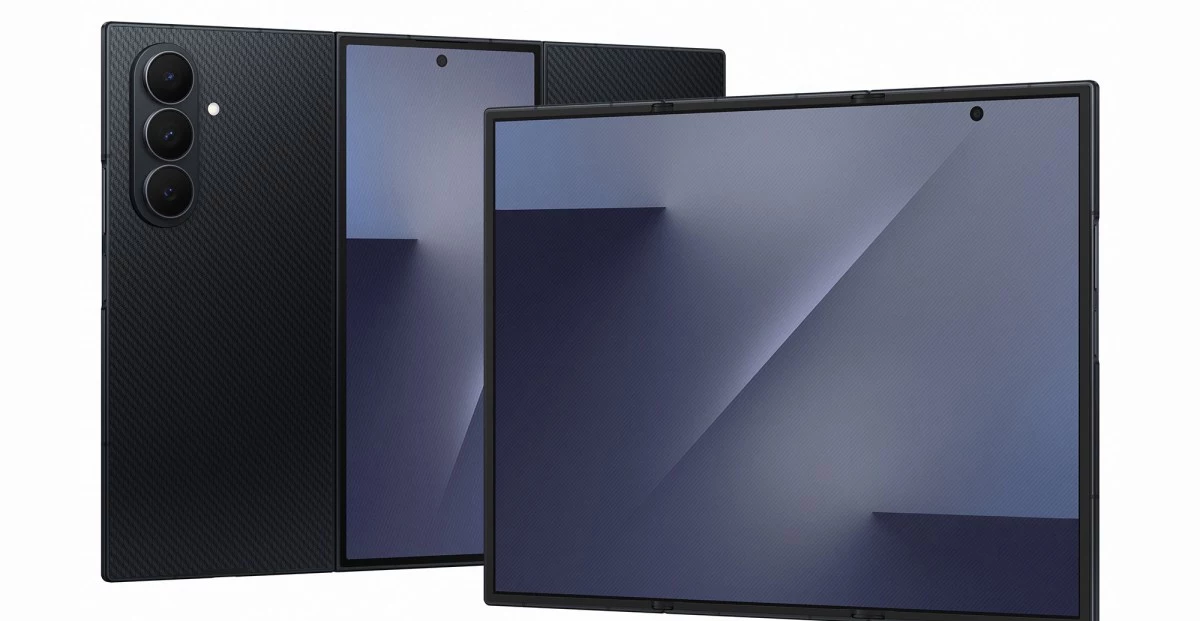

The Galaxy Z TriFold: Redefining the Foldable Frontier
Samsung’s introduction of the Galaxy Z TriFold is not merely a new product launch—it is a declaration of intent in the rapidly evolving world of mobile hardware. The device, with its dual-hinge, tri-panel architecture, signals a bold leap beyond the incrementalism that has defined recent foldable releases. At a projected price point of $2,500, the TriFold is positioned as a premium, productivity-focused slate, poised to challenge the boundaries of what mobile devices can be.
Engineering Marvels: Dual-Hinge Dynamics and Material Science
At the heart of the TriFold is a sophisticated engineering solution: a dual-hinge system that distributes mechanical stress across two axes, rather than concentrating it on a single fold. This innovation is more than a technical flourish—it directly addresses the Achilles’ heel of foldables: long-term durability. The central 4.2 mm panel, which houses the device’s I/O, acts as a structural backbone, reducing torsional fatigue and allowing for a remarkably slim 12.9 mm folded profile. This achievement places Samsung shoulder-to-shoulder with competitors like Huawei, demonstrating that hinge miniaturization and panel stacking tolerances have reached a new level of commercial viability.
Material innovation is equally central to the TriFold’s proposition. The use of a ceramic-glass fiber-reinforced polymer shell in lieu of traditional aluminum offers a superior flexural strength-to-weight ratio, absorbing the micro-impacts that plague foldable hinges. Titanium-reinforced dual-rail hinges further extend the mechanical lifespan, resisting wear without adding significant mass. These choices are not just about performance—they are about signaling a new era of reliability and premium tactility in mobile design.
Productivity, Performance, and the New Multitasking Paradigm
The TriFold’s 2160 × 1584 OLED display, refreshing at 120 Hz, is more than a canvas—it’s a platform for a new kind of mobile multitasking. With support for tri-app concurrency, the device nudges the user experience closer to desktop-grade window management, inviting enterprise users and power consumers to rethink their workflows. The absence of S Pen support, while notable, is a calculated trade-off: integrating a digitizer across three folding radii remains a yield and reliability challenge. Samsung is betting that mechanical robustness will matter more to early adopters than stylus input—a wager that may well pay off as the tri-fold form factor matures.
Under the hood, the Snapdragon 8 “Elite for Galaxy” SoC, paired with 16 GB of RAM and a 5,600 mAh battery, is engineered for both performance and longevity. The inclusion of on-device AI acceleration (with an NPU exceeding 45 TOPS) hints at a future where multimodal agents and local compute become central to the mobile experience, reducing dependence on cloud infrastructure and sidestepping the thicket of regional data-sovereignty regulations.
Market Dynamics and Strategic Calculus
The TriFold’s $2,500 price tag is a bold experiment in price elasticity, setting a new high-water mark for mobile ASPs. This is not about incremental upgrades in camera or processor specs, but about testing the market’s appetite for radically expanded screen real estate. Samsung’s staggered launch—debuting in South Korea this December, with a U.S. rollout delayed until Q1 2026—reflects a careful calibration of supply chain realities and channel readiness. By controlling initial volume ramp-up, the company can amortize high bill-of-materials costs domestically before negotiating broader carrier subsidies.
In a market where Chinese OEMs command approximately 60% of global foldable shipments, Samsung’s tri-panel architecture is both a defensive moat and an offensive thrust. The move resets the competitive conversation, shifting focus from price-per-inch metrics to the qualitative leap of multi-axis hinge technology. For operators and channel partners, the high upfront cost will necessitate creative financing—enterprise leasing, trade-in escalators, and device-as-a-service bundles will become essential tools for driving adoption.
Enterprise and ISV ecosystems stand to benefit as well. The tri-window multitasking paradigm is fertile ground for industry-specific applications—think electronic health records, field diagnostics, and trading dashboards—optimized for the unique 3:4:3 aspect ratio. With Samsung DeX and hardware-level Knox security, the TriFold could even cannibalize a portion of the corporate laptop refresh cycle, offering a secure, on-the-go workstation for hybrid professionals.
The Road Ahead: Platform Convergence and Competitive Tensions
The Galaxy Z TriFold is more than a product—it is a harbinger of platform convergence. As generative AI front-ends and multimodal assistants proliferate, the demand for expansive yet portable canvases will only intensify. Yet, the device’s reliance on exotic materials such as titanium and ultra-thin glass brings sustainability and regulatory questions to the fore. European directives on rare-metal reclamation may soon shape the material palette of future tri-folds, forcing manufacturers to innovate not just for performance, but for circularity.
Competitively, Samsung’s two-year U.S. delay offers rivals a window of opportunity. Apple’s patent activity suggests a possible foldable debut by 2027–2028, potentially leapfrogging current designs with more mature panels or a mixed reality pivot. Meanwhile, mid-tier OEMs may seek to bypass the dual-hinge era entirely, betting on rollable display breakthroughs from suppliers like LG and BOE. For now, however, the TriFold stands as a testament to the possibilities at the intersection of engineering audacity and market ambition—a device that dares to redraw the boundaries of mobile productivity.

 By
By
 By
By

 By
By



 By
By







