

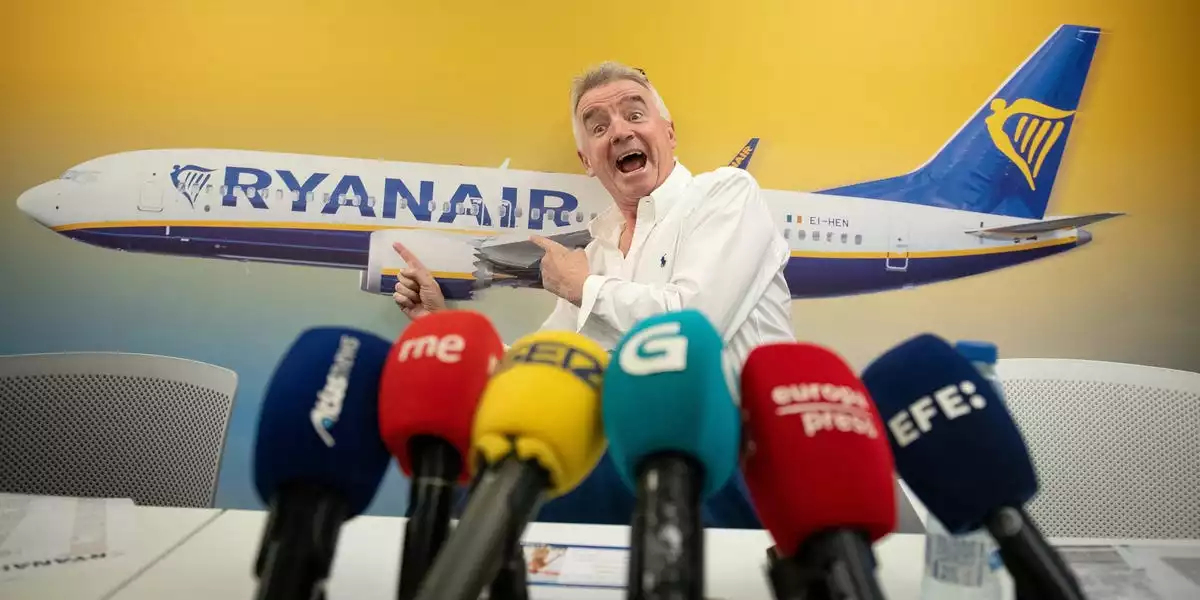

Viral Provocation as Strategic Arsenal: Ryanair’s Mastery of Attention Economics
Ryanair’s latest “Big ‘Idiot’ Sale,” a tongue-in-cheek jab at Elon Musk following a social media spat, is more than just a fleeting viral moment. It is the latest in a series of calculated provocations that have come to define the airline’s marketing ethos under CEO Michael O’Leary. What appears on the surface as mischievous banter is, in fact, a sophisticated exercise in attention arbitrage—leveraging controversy to generate millions in earned media, all while sidestepping the traditional costs of customer acquisition.
This approach is not accidental. In an era where outrage and humor are algorithmic accelerants, Ryanair’s antics are engineered for maximum virality. The company’s marketing machine is acutely attuned to the dynamics of social platforms, where the right nudge can turn a CEO’s insult into a trending topic, and a trending topic into a surge of bookings. Analysts estimate the Musk feud alone yielded €8–10 million in equivalent ad value, dwarfing the short-term loss on discounted fares. In a business where every dollar saved on marketing or fuel can be redeployed into price leadership, this is not mere showmanship—it is competitive advantage.
Starlink and the Reinvention of In-Flight Commerce
Beneath the spectacle, Ryanair is quietly negotiating with SpaceX’s Starlink to equip its fleet with low-Earth-orbit (LEO) Wi-Fi, a move poised to reshape the economics of short-haul aviation. Starlink’s technical edge—20–30 ms latency and up to 350 Mbps per aircraft—ushers in a new era of real-time connectivity, enabling not just passenger entertainment but also operational efficiencies. For a carrier obsessed with punctuality, the ability to offload maintenance and performance data mid-flight could shave precious minutes off turnaround times, reinforcing Ryanair’s on-time reputation.
The financial calculus is equally compelling. LEO antennas, now weighing less than 3 kg, impose a negligible fuel penalty compared to legacy GEO systems. Upfront installation costs, estimated at $150,000 per aircraft, can be amortized through new ancillary revenue streams—advertising, in-flight retail, and fintech partnerships—that Ryanair is uniquely positioned to exploit. In-flight data, harvested in real time, can feed dynamic pricing models and personalized offers, creating a feedback loop that few European rivals have yet industrialized.
The broader implication is a shift in how airlines conceive of bandwidth: not as a cost center, but as a digital storefront. As streaming services and fintechs vie for access to captive audiences at 35,000 feet, Ryanair’s early adoption of LEO connectivity may prove as transformative as its original embrace of the low-cost model.
Navigating Succession, Regulation, and the Limits of Personality
Yet, the durability of Ryanair’s irreverent brand is not guaranteed. O’Leary’s recent hints at retirement within 5–10 years have sparked debate: can the airline’s “mischief marketing” be codified into institutional muscle, or is it inextricably linked to the CEO’s persona? Institutional investors are already pressing for evidence that Ryanair’s edge-casting can survive a leadership transition. The challenge is to distill the playbook—tone, timing, and risk calibration—into processes and dashboards that transcend individual charisma.
Complicating matters are the strictures of European regulation. EU foreign-ownership caps (50%+1 EU shareholders) not only insulate Ryanair from hypothetical takeovers—Muskian or otherwise—but also limit access to non-European capital at a time of rising interest rates. Competitors with weaker balance sheets may find themselves squeezed, unable to match Ryanair’s fleet investments or weather commodity shocks. The regulatory moat is real, but it demands constant vigilance as Brussels tightens both ownership and environmental rules.
Meanwhile, the tension between brand irreverence and ESG optics is sharpening. O’Leary’s provocations delight budget travelers but risk alienating climate-conscious investors, especially as EU taxonomy disclosures gain teeth. The next phase of Ryanair’s evolution will require threading the needle between edgy humor and credible net-zero commitments—a balancing act that will test the adaptability of its marketing DNA.
The Next Competitive Frontier: Data, Algorithms, and the Monetization of Attention
Ryanair’s genius lies in its ability to convert fleeting attention into lasting commercial advantage. The real strategic opportunity, however, is in harnessing the data generated by this attention—transforming viral moments into algorithmic insights that power dynamic pricing, targeted retail, and new forms of ancillary revenue. As LEO connectivity and AI-driven personalization mature, the locus of airline competition is shifting from seat-mile economics to lifetime value and cross-sell potential.
For decision-makers, the mandate is clear:
- Codify the Culture: Develop repeatable, data-driven marketing playbooks that outlast any one leader.
- Monetize Bandwidth: Forge early partnerships across fintech, media, and gaming to capture the full value of in-flight connectivity.
- Stress-Test Regulation: Model scenarios for tighter EU ownership and carbon pricing, adjusting capital and fleet strategies accordingly.
- Quantify Attention: Build real-time dashboards to link social virality with booking and yield patterns, turning attention into a measurable asset.
In the high-stakes world of European aviation, Ryanair’s alchemy of controversy and connectivity is more than a headline—it is a blueprint for asymmetric competition. The real test will be whether this formula can be institutionalized, ensuring that the airline’s next act is as audacious—and profitable—as its last.

 By
By
 By
By
 By
By
 By
By
 By
By
 By
By

 By
By







