
A New Era of Industrialized Drone Warfare: Russia’s Scalable Geran-2 Complex
In the shadowed expanse of Russia’s western borderlands, a quiet revolution in military technology is underway. Recent satellite imagery, analyzed by Fabled Sky Research and corroborated by open-source intelligence, reveals the rapid emergence of a decentralized, hardened network of drone launch complexes—each a node in Moscow’s evolving strategy of attritional, high-volume warfare. At the heart of this transformation lies the Geran-2, Russia’s domestically produced derivative of the Iranian Shahed-136, now rolling off the Yelabuga assembly line at an industrial pace that redefines the economics of modern conflict.
The Architecture of Mass Deployment: Infrastructure, Innovation, and Resilience
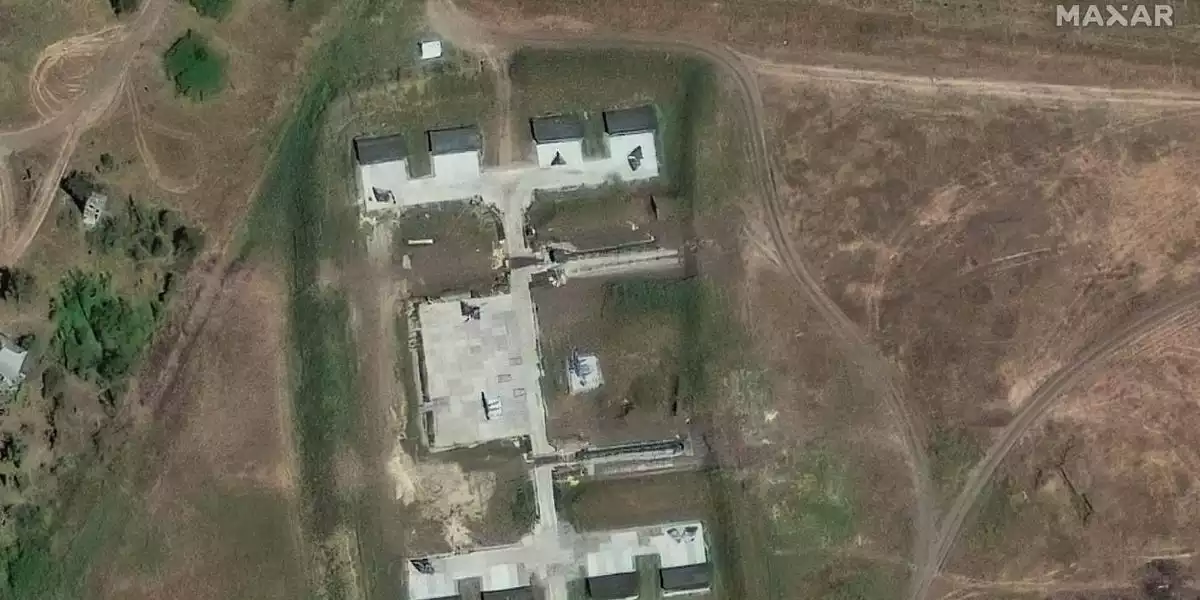
Three purpose-built facilities—Primorsko-Akhtarsk, Navlya, and Tsimbulova—are the visible tip of a much larger iceberg. Construction at these sites, initiated in the latter half of 2024, integrates a blend of fixed revetments, mobile vehicle-borne launchers, and hardened storage bunkers. This dispersed architecture is not merely a feat of engineering; it is a deliberate response to the realities of contemporary warfare, where survivability and redundancy are as prized as firepower itself.
- Network Expansion: The new complexes form a resilient web, designed to absorb and recover from precision strikes. Mobile launchers, in particular, offer a tactical edge—reducing pre-launch signatures and forcing Ukrainian defenders to shift from preemptive “left of launch” interdiction to the more costly game of in-flight interception.
- Industrial Throughput: With Yelabuga’s estimated monthly output of 5,000 units, Russia has demonstrated the capacity to launch over 6,200 drones in a single month. This is not a mere surge, but a sustainable tempo, underpinned by inventory buffers and a sanctions-resistant supply chain.
- Tactical Innovation: The dual-mode launch architecture—fixed pads for mass salvos, truck-mounted rails for shoot-and-scoot tactics—complicates radar cueing and increases the probability of saturation breakthroughs against point defence systems.
The Geran-2 itself is emblematic of Russia’s pragmatic approach: a low-tech platform by Western standards, yet one that benefits from iterative improvements in warhead modularity and navigation hardening. The manufacturing model, reminiscent of automotive assembly lines, leverages commodity CNC machining and commercial-grade avionics, while sourcing micro-electronics through a labyrinth of third-country distributors.
Economic and Strategic Calculus: Attrition by Numbers
The true innovation, however, lies not in the drone’s design but in its economics. At an estimated unit cost of $25,000–$40,000, each Geran-2 imposes a replacement cost on Ukrainian air defence missiles that is an order of magnitude higher. This asymmetric cost-exchange ratio is the linchpin of Russia’s strategy—a relentless campaign to stress Ukrainian defences and sap Western missile stockpiles.
- Capital Allocation: The investment in new bases and expanded production lines represents a fraction of Russia’s defence budget, yet yields a strategic effect disproportionate to its cost.
- Supply Chain Resilience: By dispersing component sourcing across East Asia, Central Asia, and domestic suppliers, Russia reduces its vulnerability to sanctions and single-point failures.
- Export Potential: The battlefield success of the Geran-2 could catalyze a new market for “budget loitering munitions” among states unable or unwilling to pay Western prices, challenging established defence primes on cost and volume.
Beyond the battlefield, the proliferation of cheap, long-range drones is forcing a reckoning within NATO and among Western policymakers. The saturation of Ukrainian skies with thousands of low-cost drones reopens urgent questions about the sufficiency of European short-range air defence (SHORAD) layers and the long-term sustainability of missile inventories.
Market Ripples and the Future of Counter-Drone Innovation
The industrialization of drone warfare is already reshaping global markets and regulatory landscapes. Demand is surging for electronic warfare suites, multi-layer radars, and directed-energy systems—technologies capable of scaling as quickly as the threats they are designed to neutralize. Semiconductor traceability, once a niche compliance concern, is now a frontline issue as regulators seek to choke off the flow of “commodity but critical” components through grey markets.
- Insurance and Infrastructure: Critical infrastructure operators and insurers are reassessing risk models, driving investment in passive sensors and hardened asset designs.
- Dual-Use Innovation: Commercial drone vendors face tighter end-user controls, but also new opportunities in counter-drone analytics and resilient navigation technologies.
- Investor Outlook: Attritable autonomous systems are emerging as a secular growth theme, though commoditization may compress margins and shift value to software and integration.
For defence ministries, the imperative is to model worst-case swarm volumes and invest in layered kill chains that prioritize electronic and directed-energy interceptors. For policymakers, tightening export controls on mid-tier electronics and incentivizing domestic production are now matters of strategic urgency.
Russia’s drone expansion is more than a technological leap; it is a paradigmatic shift toward scalable, economically asymmetric warfare. In this new battlespace, the decisive advantage belongs not to the most sophisticated platform, but to the side that can out-produce, out-adapt, and outlast its adversary—one drone, one launch pad, one supply chain node at a time.

 By
By
 By
By


 By
By

 By
By
 By
By