

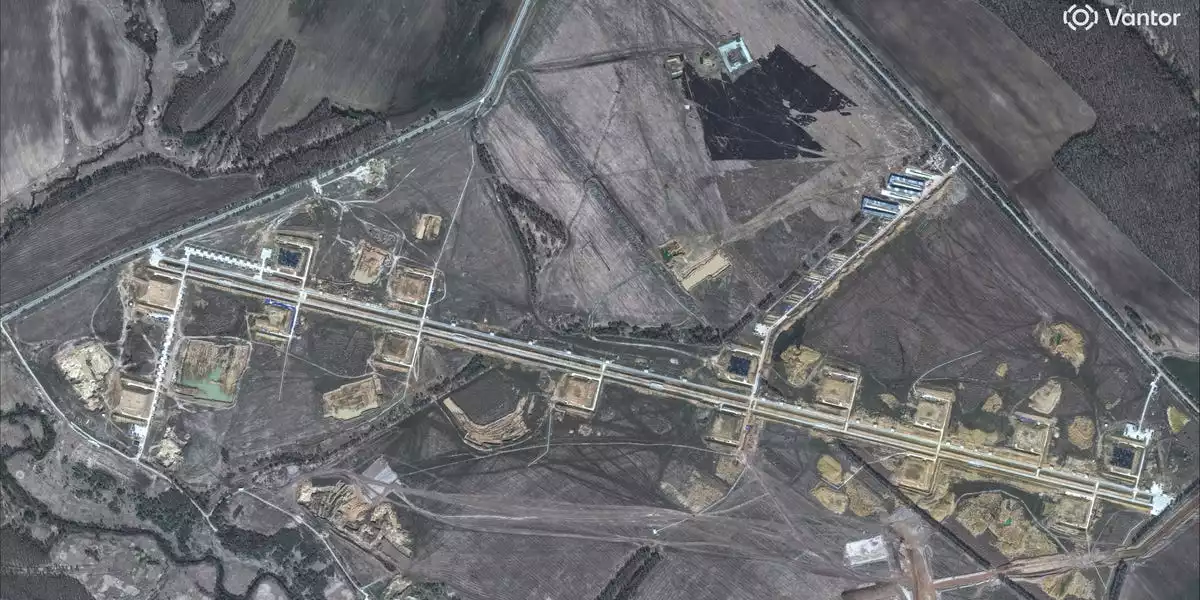

Satellite intelligence and the industrialization of Russia’s jet-drone campaign
High-resolution satellite imagery obtained by US spatial intelligence firm Vantor points to a consequential shift in Russia’s unmanned strike posture: the upgrade of the Tsimbulova drone base in Oryol, roughly 100 miles from the Ukrainian border, to support jet-powered Geran variants. The imagery indicates four new launch rails under construction—two approximately 85 meters long designed for the Geran-5 (described as a cruise-missile-style drone), and two shorter rails intended for the Geran-3 and Geran-4 legacy systems. Construction timelines—beginning December 2025 for the longer rails and April 2026 for the shorter—suggest a phased build that aligns infrastructure with evolving inventory.
This matters because fixed, purpose-built launch infrastructure signals institutionalization, not improvisation. Compared with truck-mounted catapults and ad hoc launch points, permanent rails can improve:
- Sortie generation rate through repeatable, standardized launch cycles
- Operational resilience, including dispersal planning and faster reconstitution after strikes
- System integration, enabling tighter coupling between launch operations, mission planning, and command-and-control
Tsimbulova is also notable for its exclusivity. The reporting frames it as one of only two Russian sites capable of launching these higher-speed, longer-range platforms, alongside an expanded facility in occupied Donetsk. If accurate, that concentration creates both a capability boost and a strategic vulnerability: fewer nodes can mean easier targeting and intelligence focus, but also stronger defenses and higher operational discipline at each node.
From loitering munitions to cruise-missile analogues: what the Geran-5 implies
The reported move toward small turbojet propulsion in the Geran-5 reflects a broader technological trajectory: one-way attack drones evolving into cruise-missile analogues. Jet propulsion can materially change the engagement problem for defenders, particularly if paired with improved guidance, navigation resilience, and signature management. The cited performance envelope—400–600 km/h cruise speeds, lower observability, and greater standoff range—compresses decision timelines and can stress radar coverage, interceptor availability, and command latency.
The infrastructure itself is a tell. Longer rails are not merely construction details; they imply design choices around launch energy requirements, airframe weight, and repeatable deployment at scale. In practical terms, this can enable:
- Higher tempo mass launches, increasing the probability of saturation
- More consistent launch conditions, improving reliability and mission success rates
- A clearer pathway to iterative upgrades, where new variants can be fielded without reinventing the launch concept
For business and technology observers, the key insight is that the drone “product” is no longer just the airframe. It is an integrated system-of-systems: propulsion supply chains, electronics sourcing, software updates, launch infrastructure, and operational data loops. That integration is what turns a tactical tool into a strategic instrument.
Ukraine’s interceptor drone surge and the economics of cost-exchange warfare
Running in parallel to Russia’s base upgrades is a sharp increase in operational volume. The reporting cites nearly 16,000 Russian drone sorties in Q1 2026, up from 10,000 in the same period a year earlier. That scale is not simply a battlefield statistic; it is evidence of industrial throughput and supply-chain durability despite sanctions pressure.
Ukraine’s response—fielding at least 2,000 domestically produced interceptor drones per month—highlights an emerging market-defining contest: cost-exchange ratios. Russia’s mass-launch approach seeks to overwhelm defenses by volume and force expensive intercept decisions. Ukraine’s interceptor strategy aims to invert that equation by using comparatively low-cost kinetic solutions to defeat incoming threats without burning through high-end surface-to-air missiles.
The export dimension is equally consequential. The plan to allocate roughly half of interceptor production for export to NATO partners and Middle Eastern allies positions Ukraine as a potential supplier in a fast-forming global category: affordable counter-swarm air defense. For procurement communities facing fiscal constraints, interceptor drones can offer an attractive alternative or complement to capital-intensive systems—especially for point defense of infrastructure, bases, and urban nodes.
This dynamic also raises compliance and governance questions that will matter to Western technology firms and investors:
- Dual-use component leakage risks, especially in semiconductors, navigation modules, radios, and sensors
- End-use verification and provenance tracing as exports scale
- Standardization pressures, as NATO-aligned buyers seek interoperable command-and-control and open architectures
The wider strategic signal: drone ecosystems, tech transfer, and the next autonomy race
The Tsimbulova build-out and Ukraine’s interceptor ramp are best understood as early indicators of a broader transformation: the maturation of drone ecosystems where manufacturing scale, software iteration, and operational learning cycles converge. The Geran lineage’s association with Iranian Shahed designs underscores the likelihood of continued cross-border technology diffusion, whether through direct transfer, co-development, or parallel innovation. Policymakers will be watching for advances in propulsion, guidance hardening, electronic counter-countermeasures, and modular payloads.
Forward-looking, the competitive frontier is drifting toward greater autonomy and cooperative behaviors—the building blocks of AI-enabled swarms. That trajectory increases the premium on:
- Sensor fusion and networked command-and-control to shorten detect-to-defeat timelines
- Layered counter-swarm defenses, including electronic warfare, rapid radar networking, and potentially directed-energy options
- Industrial base resilience, particularly for microturbines, MEMS inertial sensors, high-density batteries, and secure datalinks
What emerges from this week’s satellite imagery and production figures is a clear strategic message: unmanned warfare is no longer a niche capability—it is becoming a scalable, infrastructure-backed, exportable industry. The actors that master not just the drone, but the supply chain, software cadence, and interoperability standards, will shape the next phase of air defense economics and battlefield advantage.

 By
By
 By
By

 By
By
 By
By

 By
By
 By
By







