


When a Humanoid Learns to Drum: The Quiet Revolution in Embodied AI
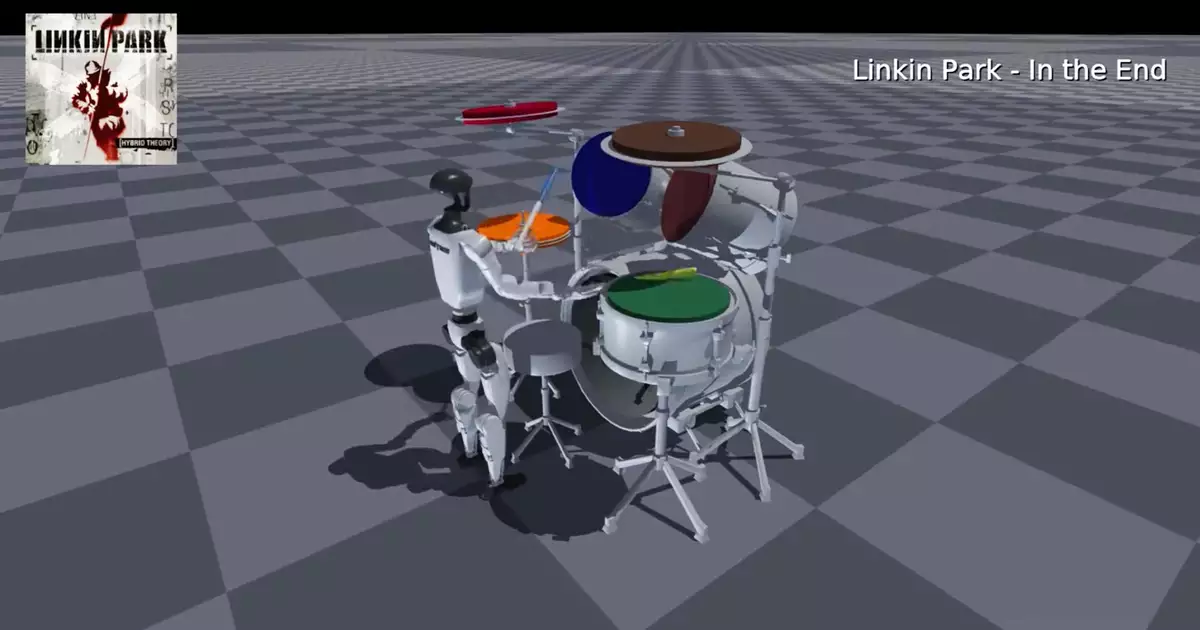
Beneath the viral snickers and meme-laden dismissals of the so-called “Robot Drummer”—a simulated Unitree G1 humanoid, trained by researchers at the Dalle Molle Institute for Artificial Intelligence to bash out Linkin Park’s “In the End”—something more profound is at play. While the internet derided the performance as mechanical and unmusical, the underlying achievement signals a transformative leap for embodied AI: a machine, built from consumer-grade parts, now executes rock drumming with 90 percent strike accuracy and emergent, distinctly human techniques like cross-arm hits. The spectacle may be rough around the edges, but the implications for robotics, creative automation, and the future of human-machine collaboration are anything but trivial.
Sim-to-Real Mastery: Precision, Timing, and the New Benchmarks
What sets this experiment apart is not the novelty of a robot wielding drumsticks, but the confluence of technical breakthroughs that made it possible. Historically, drumming—requiring millisecond-level synchronization between vision, proprioception, and actuation—has been a task reserved for the most expensive, industrial-grade robotic arms. Here, a sub-$20,000 humanoid achieves comparable precision, thanks to advances in:
- Sim-to-Real Transfer: The model’s 100 hours of virtual training migrated to hardware with minimal retuning, a testament to the maturation of domain-randomized physics engines and high-fidelity audio models.
- Micro-Latency Control: Drumming’s demand for split-second feedback loops pushes the envelope for closed-loop control systems. These advances ripple outward, promising improvements in fields as disparate as autonomous vehicle navigation, surgical robotics, and smart manufacturing.
- Embodied Generative AI: By combining large-action-space reinforcement learning with symbolic music notation, researchers are inching toward systems that don’t just mimic, but interpret and perform—a harbinger of multimodal, on-device AI capable of real-time improvisation.
The project’s success is not merely technical; it’s symbolic. It demonstrates that embodied AI is ready to tackle latency-intolerant, creative tasks once thought uniquely human. The next phase—porting these models from simulation to physical hardware—will test the limits of both machine dexterity and our collective imagination.
The Business of Robotic Creativity: Economics, IP, and Competitive Stakes
The economic resonance of this breakthrough is already reverberating across industries. As live events rebound post-pandemic and skilled labor shortages persist, robotic performers offer a tantalizing solution:
- Experience-Economy Robotics: Humanoids on stage could unlock new revenue streams, from hybrid live shows to merchandising and IP licensing. Early adopters—concert venues, cruise lines, theme parks—stand to amortize the cost of these robots across marketing, guest engagement, and data analytics.
- Hardware Supply-Chain Synergies: Components like high-torque actuators and MEMS microphones, originally scaled for smartphones, now find lucrative secondary markets in entertainment robotics, reinforcing the cycle of innovation and cost reduction.
- Data and IP Battles: As music labels, gaming studios, and robotics manufacturers vie for proprietary “motion-style” datasets, the competitive landscape is shifting. The platform owners who control these datasets may soon monetize performances much as Dolby did with audio codecs—licensing every robotic rendition.
Yet, the rise of creative robots brings knotty questions: Who owns the rights to a robotic performance? How are royalties distributed when a machine covers a song? The legal ambiguities around AI-generated interpretation are fertile ground for both new revenue models and regulatory headaches.
Leadership Imperatives: Strategy, Security, and the Human Factor
For executives and innovators, the emergence of expressive, time-critical robotics demands a recalibration of priorities:
- Brand Differentiation: Early adoption signals tech-forward, human-complementary values—attributes increasingly prized by Gen-Z consumers.
- IP and Rights Management: Proactive engagement with rights holders and legal counsel is essential to navigate the evolving landscape of AI-mediated performances.
- Workforce Evolution: As robots encroach on non-routine manual tasks, reskilling must extend beyond coding to encompass sensorimotor programming and human-robot stagecraft.
- Cyber-Physical Security: With humanoids capable of swinging drumsticks at speeds up to 5 m/s, robust safety protocols and real-time monitoring are not optional—they are board-level imperatives.
The forward trajectory is clear. In the next 12 to 36 months, expect proof-of-concept gigs, richer simulation platforms, and cross-industry spillovers—from fulfillment centers optimizing pick-pack rhythms to rehabilitation robotics tuned to patient gait. Fabled Sky Research and its peers will find themselves navigating not just technical frontiers, but also the cultural and commercial redefinition of creativity itself.
Robot Drummer’s shaky debut is less a punchline than a prologue. The convergence of embodied AI, real-time control, and experiential commerce is set to redraw the boundaries of what machines—and the organizations that deploy them—can achieve. Those who see only novelty risk missing the deeper signal: a new era of expressive automation is at hand, and the tempo is accelerating.

 By
By
 By
By
 By
By

 By
By
 By
By
 By
By
 By
By







