

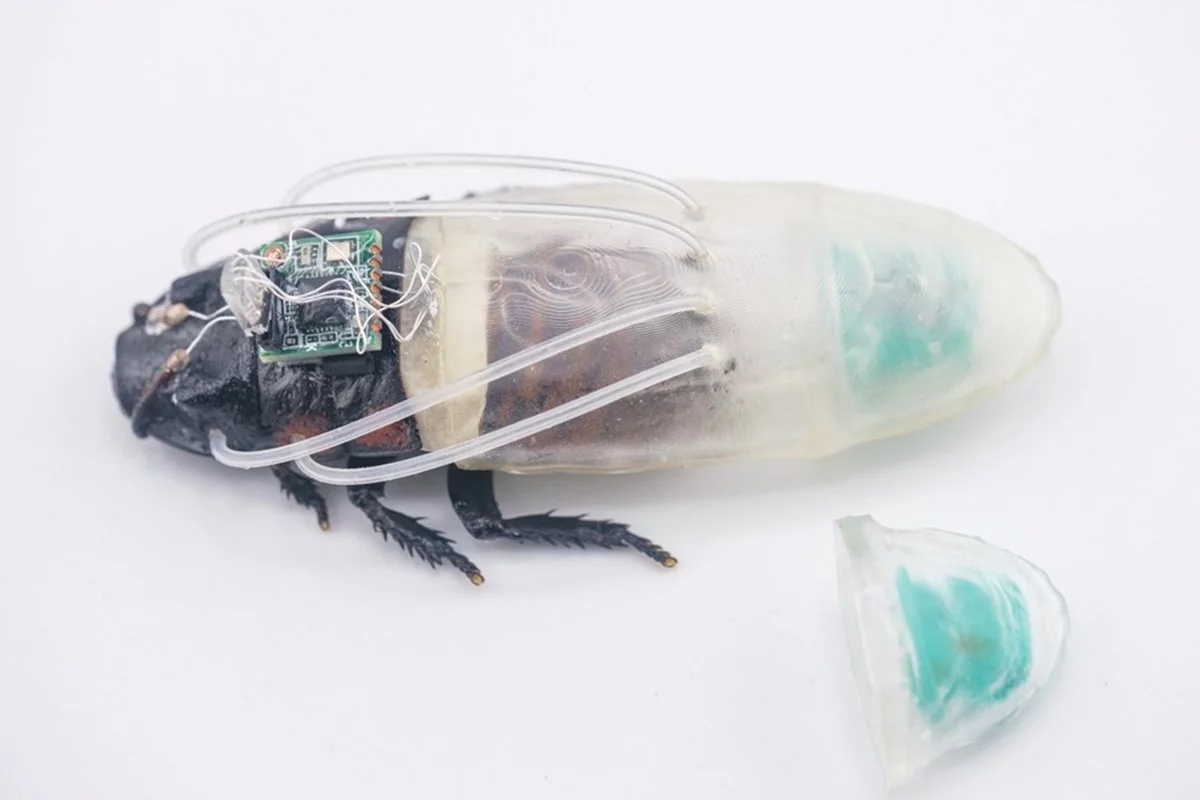

A biohybrid leap: turning a resilient insect into an amphibious robotic platform
The latest advance in biologically integrated robotics arrives in an unlikely form factor: the Madagascar cockroach, engineered into a remote-controlled “cyborg” capable of sustained underwater movement. Reported in *Nature Communications*, the research pairs an implanted control system with a custom 3D-printed “scuba suit” that enables the insect to operate in flooded environments for up to three hours, at speeds approaching its land locomotion. Notably, the work also reports no observable adverse health effects under the tested conditions—an important claim given the ethical and regulatory scrutiny that biohybrid systems inevitably attract.
From a technology and business perspective, the significance is less about novelty for novelty’s sake and more about what this platform demonstrates: a new engineering pathway for micro-scale mobility in environments that defeat conventional robots. Floodwater, debris, narrow voids, and unstable terrain are precisely where many small mechanical drones struggle—especially when waterproofing, buoyancy control, and battery mass collide with tight size constraints. In contrast, the cockroach brings a pre-optimized chassis: distributed actuation (legs), robust balance, and a metabolism that already solves many “power-to-weight” problems that engineers typically address with heavier batteries and motors.
This is the deeper pivot the study signals: rather than building ever-smaller waterproof robots and accepting steep performance trade-offs, researchers are exploring biohybrid architectures where the organism supplies locomotion and adaptability, while electronics provide control, sensing, and mission logic.
—
The engineering core: microfluidic oxygen generation meets rapid 3D-printed design
At the heart of the breakthrough is a pragmatic solution to an old constraint: oxygen supply. Insects can survive in harsh conditions, but sustained underwater operation requires a reliable source of oxygen. The researchers’ “scuba suit” addresses this with a compact chemical system: hydrogen peroxide decomposed via a manganese dioxide catalyst, producing oxygen that can be delivered through a microfluidic pathway. This approach avoids bulky tanks and reduces payload mass—an essential requirement when the “vehicle” is a living organism with strict weight and comfort tolerances.
Several technical elements stand out for their broader implications in robotics and advanced manufacturing:
- Oxygen-delivery microfluidics as a modular subsystem: The catalytic oxygen generator is more than a clever hack; it suggests a reusable design pattern for miniaturized life-support and gas-management modules in micro-vehicles, including non-biological platforms that need intermittent oxygenation or controlled gas release.
- 3D-printed architecture enabling bespoke biointerfaces: The suit’s fabrication highlights how rapid prototyping can be used to create organism-specific housings that balance rigidity (for mounting components) with soft interfaces (to reduce stress and injury). This is a manufacturing playbook: iterate quickly, customize cheaply, and tailor to anatomy.
- Embedded electronics and power: The implanted control chip and onboard power source underscore a central biohybrid trade: pushing capability into the organism reduces external hardware mass, but increases demands for biocompatibility, thermal management, and long-term stability.
- Control today, autonomy tomorrow: The current system is remote-controlled, but the trajectory is clear. Adding onboard processing, lightweight sensors, and edge AI would shift these platforms from “teleoperated curiosities” to semi-autonomous swarms capable of mapping, target detection, and adaptive navigation.
For industry watchers, the key question is not whether insect cyborgs will replace drones wholesale—they won’t—but whether this work opens a credible lane for micro-scale reconnaissance where traditional robotics remains cost-prohibitive or physically constrained.
—
Market logic and operational value: disaster response, infrastructure, and defense pull the demand forward
The most immediate commercial and public-sector relevance lies in disaster-zone reconnaissance, especially as climate-driven flooding becomes more frequent and more severe. In flooded buildings, collapsed infrastructure, and debris-filled waterways, responders need fast situational awareness without risking human entry. A low-cost, distributed fleet of biohybrid units could provide first-look intelligence where wheeled robots stall, propellers foul, and waterproof drones run out of endurance.
From an economic standpoint, the proposition is compelling because biohybrid systems may be:
- Cost-efficient at scale: If unit costs remain low, agencies could deploy many devices at once, improving coverage and redundancy—an advantage in chaotic environments where losses are expected.
- Energy-lean by design: By leveraging an organism’s locomotion and reducing dependence on high-density batteries, biohybrids may deliver longer mission time per gram of carried energy, a metric that matters in micro-robotics and aligns with sustainability narratives in field operations.
- Supply-chain catalytic: Adoption would create demand for specialized components—biocompatible polymers, microcontrollers, catalysis modules, microfluidic parts, and miniature sensor arrays—potentially forming a new supplier ecosystem at the intersection of biotech and advanced manufacturing.
Strategically, the pull from defense and security is difficult to ignore. Insect-scale reconnaissance has long been a research interest; the underwater dimension adds stealth and access in littoral and flooded urban environments, potentially accelerating pilot programs and procurement interest. Meanwhile, the study’s nod to extraterrestrial missions—where subsurface ice, brines, or enclosed habitats could benefit from small, adaptable explorers—signals a longer-term horizon where space agencies and private space firms may consider biohybrid payloads alongside conventional rovers.
—
Governance, ethics, and the next competitive frontier in bio-robotics
The same attributes that make biohybrid robots attractive—low cost, stealth, scalability—also create dual-use risk. Regulators and ethics boards will likely focus on animal welfare standards, permissible modification thresholds, containment protocols, and transparency requirements. For companies exploring commercialization, the reputational and compliance stakes are high: the sector will need clear norms around humane treatment, mission boundaries, and auditability of deployments.
The competitive frontier now shifts to execution: who can standardize the “bio-integration stack” and make it reliable. The most credible near-term roadmap points toward:
- Modular platforms for implantable control, oxygen delivery, and sensor payloads
- Cross-industry consortia to define safety and ethics standards before regulation hardens
- Field trials in controlled flood and marine settings to validate ROI and operational logistics
- Data-services models that monetize mapping and analytics rather than hardware alone
What this research ultimately puts on the table is a new category of machine—not fully robotic, not purely biological—designed for the messy, waterlogged, infrastructure-dense realities that increasingly define modern risk. The organizations that treat biohybrid robotics as a disciplined engineering and governance challenge, rather than a spectacle, will be the ones positioned to turn this amphibious cyborg milestone into deployable capability.

 By
By
 By
By

 By
By
 By
By

 By
By
 By
By







