

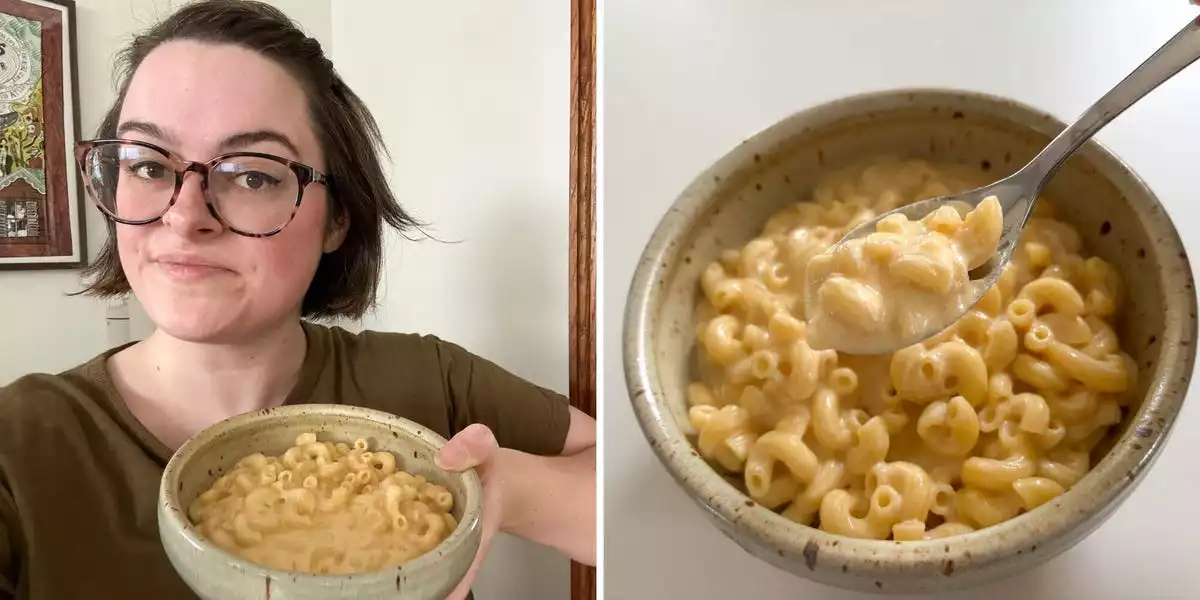

A familiar comfort food, re-engineered for the protein economy
Nourish Nutrition’s single-serving mac and cheese concept reads like a small recipe tweak, but it sits squarely at the intersection of consumer nutrition priorities, ingredient innovation, and time-compressed home cooking. The core proposition is straightforward: deliver a creamy, cheddar-forward bowl of macaroni and cheese in under 20 minutes, while reaching roughly 23 grams of protein—a number that would typically require larger portions, added meat, or specialty “protein pasta.”
What makes this notable is not that it’s “plant-based mac and cheese.” It isn’t. The recipe is explicitly hybrid, combining traditional dairy (milk, cheddar, butter) with silken tofu as a functional ingredient. That hybrid positioning mirrors a broader market reality: many consumers are not seeking strict dietary identities so much as practical upgrades—more protein, better satiety, and fewer steps—without sacrificing the sensory cues that define comfort food.
From a business and technology lens, this is a micro-example of how modern food innovation often advances: not through exotic ingredients, but through reassigning roles in the formulation. Here, tofu isn’t a “meat substitute.” It’s a texture and protein system that changes the economics and performance of the sauce.
Silken tofu as a kitchen “processing technology,” not a lifestyle statement
The most consequential move is replacing a classic roux-based pathway (flour + butter + milk, thickened over heat) with a blended silken tofu base. In industrial terms, this is a shift from heat-driven starch thickening to protein-enabled emulsification and suspension, executed with a blender rather than a saucepan.
Key technical implications for home and product developers include:
- Emulsification and mouthfeel engineering: Silken tofu’s proteins and fats help create a stable, creamy texture that can mimic the viscosity of roux-thickened cheese sauce. This reduces dependence on flour and extended stovetop reduction.
- Flavor masking through dairy-forward dominance: The recipe’s structure—garlic salt, cheddar, butter—keeps the flavor center of gravity firmly in the cheese lane, minimizing the risk that consumers perceive a “tofu taste.” That’s a critical adoption lever: many functional-food concepts fail not on nutrition, but on sensory expectation mismatch.
- Speed-to-table optimization: Fewer steps and fewer pans matter. The workflow—boil pasta, blend sauce base, fold in cheese—aligns with the market’s demand for sub-30-minute meals and low cleanup. In practice, this complements the rise of high-rpm blenders, compact food processors, and rapid-boil cooktops that turn technique into a repeatable routine.
- Modular recipe architecture: The “protein-lift blend” (tofu + milk + seasoning) is separable from the “carb matrix” (pasta). That modularity is the same logic used in scalable food manufacturing: a base system that can be swapped, tuned, and personalized without rewriting the entire process.
For AI-driven recipe platforms and smart kitchen ecosystems, modularity is especially valuable. It makes the dish easier to parameterize—protein target, calorie band, sodium limit, lactose sensitivity—while keeping the user experience simple.
Pricing pressure, time scarcity, and the rise of “functional comfort”
The recipe’s appeal is tightly coupled to today’s economic and behavioral conditions. Protein remains one of the most expensive macronutrients in many households, and consumers increasingly evaluate meals through a value-per-serving lens: cost, satiety, and nutritional density per minute of effort.
Several forces converge here:
- Protein affordability and substitution logic: Tofu is often priced below equivalent dairy protein sources and can reduce the amount of cheese needed to achieve a thick, satisfying sauce. For consumers navigating grocery inflation, this is a pragmatic hedge.
- The time-scarcity premium: Hybrid and remote work haven’t eliminated busy schedules; they’ve reshaped them. Many professionals now eat more meals at home but with tighter windows. A single-serving, high-protein comfort dish fits the “quick solo meal” use case that increasingly drives weekday food decisions.
- Health-forward comfort food demand: High-protein eating patterns—popularized by wellness influencers and reinforced by clinical discussions around satiety and muscle maintenance—have moved from niche to mainstream. The market opportunity is not just “healthy food,” but healthier versions of familiar foods that don’t feel punitive.
This is where “functional comfort food” becomes a commercially meaningful category: products and recipes that preserve indulgent cues while quietly improving macro balance. The tofu-dairy blend is a template that can travel well across channels, from content platforms to packaged foods.
Strategic playbooks for brands, meal platforms, and delivery-first operators
For industry leaders, the deeper takeaway is that hybrid formulations can unlock taste authenticity, cost control, and ESG-adjacent narratives without forcing consumers into binary choices. That opens multiple strategic lanes:
- Hybrid co-development for dairy brands: Traditional cheese and dairy processors can treat plant proteins as complementary functionality rather than competitive threat—exploring co-branded “creamy protein base” concepts that protect taste while improving nutrition labels.
- Personalization as a moat for meal kits and QSR: The modular structure lends itself to “build-your-own” comfort bowls—swap pasta shapes, add vegetables, adjust spice, choose protein targets. Layer in AI dietary profiling and you have a pathway to higher average order value through guided add-ons.
- Ghost kitchens and cloud brands: Single-serving, protein-rich comfort meals are operationally attractive: predictable prep, strong demand signals, and menu flexibility. A tofu-based sauce system can be batched, portioned, and adapted across multiple SKUs with minimal complexity.
- R&D focus on clean-label texture systems: As acceptance grows for plant-forward emulsifiers, investment will likely accelerate in next-generation protein isolates and texturizers that replicate dairy-like creaminess with fewer additives—especially where “clean label” is a purchase driver.
- Supply-chain hedging and procurement strategy: Plant proteins can diversify risk against dairy commodity volatility. Longer-term contracts and shared forecasting tools can reduce cost swings and waste, particularly for foodservice operators.
A single bowl of mac and cheese won’t transform the food industry, but the logic behind it—hybrid ingredient systems, modular design, and protein-efficient comfort—is increasingly shaping how recipes are created, how products are formulated, and how brands compete for the modern consumer’s most limited resources: time, attention, and trust.


 By
By

 By
By
 By
By

 By
By
 By
By







