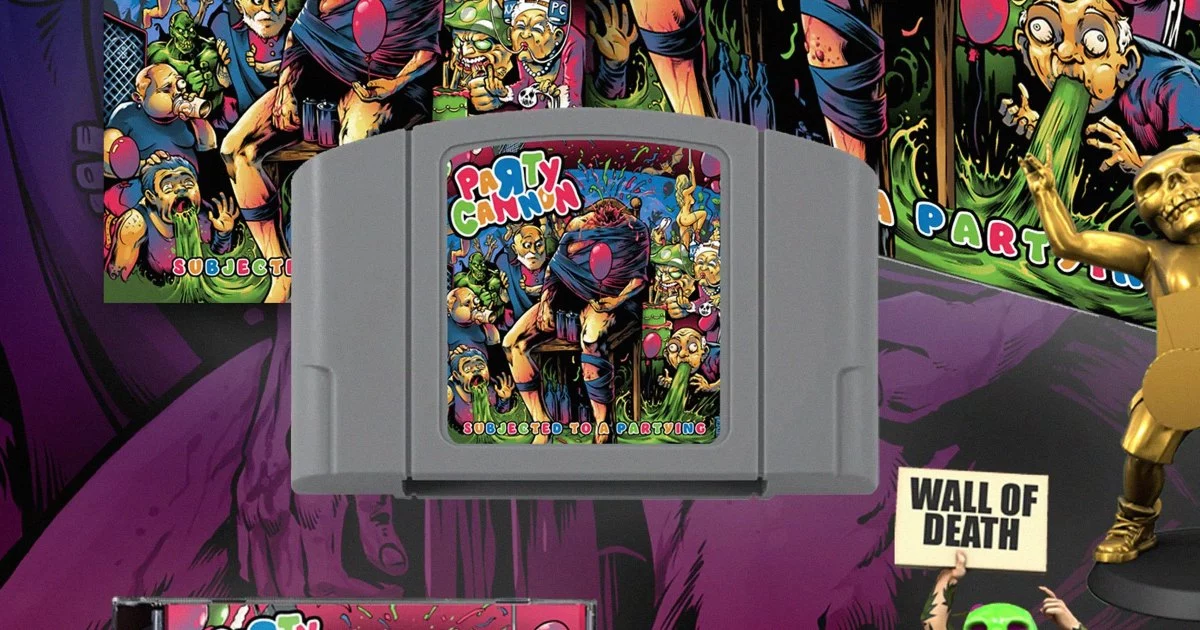

Death Metal, Cartridges, and the New Scarcity: Party Cannon’s N64 Gambit
In an era where music is as ephemeral as a swipe, Scottish death-metal band Party Cannon has chosen a delightfully anachronistic vessel for its latest EP, “Subjected to a Partying”: the Nintendo 64 cartridge. Only 100 of these relics will exist, each cradling four tracks and grainy live footage within the 64 MB confines of a Game Pak. The remaining songs will find their way to more conventional platforms, but the real story lies in the audacious fusion of retro hardware, scarcity economics, and the shifting tectonics of music distribution.
The Cartridge as Canvas: Reimagining Obsolete Tech
Repurposing a 23-year-old gaming cartridge is no longer the exclusive domain of hardware tinkerers and nostalgia hobbyists. Thanks to open-source toolchains and a thriving modding community, artists now wield legacy consoles as programmable canvases. The N64, once an icon of late-’90s living rooms, has become a medium for experimental releases—its lockout chips and memory constraints transformed from obstacles into creative boundaries.
This democratization of hardware hacking is not merely a technical feat. It signals a broader cultural moment: the blurring of lines between audio release, software ROM, and collectible artifact. Embedded video, even at a grainy 320 × 240 resolution, hints at a future where “phygital” objects—physical items that boot directly into multimedia experiences—offer a tactile antidote to the frictionless, impersonal world of streaming. Offline, self-contained, and immune to the whims of algorithms, these cartridges become both art object and time capsule.
Yet, the legal terrain is murky. Nintendo’s patents on the N64 lockout chip linger, and the resale of modified cartridges occupies a gray zone reminiscent of current disputes over AI models trained on copyrighted data. As creators push the boundaries of legacy platforms, the industry faces a fresh round of negotiations between innovation and intellectual property—an echo of the broader tensions shaping the digital landscape.
Scarcity, Nostalgia, and the Tangibility Premium
Party Cannon’s cartridge release is not simply a technical experiment; it is a masterstroke in scarcity economics. With only 100 units, the EP becomes a quasi-luxury collectible, borrowing from the playbooks of sneaker drops and NFT launches. For artists operating outside the mainstream, the economics are compelling: revenue per superfan can dwarf the paltry payouts of streaming platforms, where discovery is governed by opaque recommendation engines and the specter of algorithmic obsolescence.
The resurgence of vinyl and cassettes—formats once consigned to the dustbin of history—reflects a broader cultural counter-swing. Gen Z’s analog curiosity collides with millennial nostalgia, creating a durable, if niche, market for tangible media. Physicality is no longer a limitation; it is a status symbol, a sensory experience, and a hedge against the digital void. The cartridge, like the mechanical watch or the hardcover novel, becomes a vessel for identity and memory.
Technological advances have inverted the cost curve. Where once cartridge manufacturing demanded tens of thousands of units to break even, low-run PCB fabrication and flash memory now make micro-inventories financially viable. This shift enables artists to treat retro-console releases as high-margin merchandise, rather than mass-distribution channels—a strategy that rewards loyalty and deepens fan engagement.
Industry Ripples: From Micro-Factories to Mixed Reality
The implications ripple far beyond a single band’s experiment. Labels and rights holders are advised to view retro-console releases as data-rich loyalty tokens, capable of unlocking backstage access or future digital drops through cartridge-based authentication. Consumer electronics firms, meanwhile, would do well to monitor aftermarket demand as a barometer of latent brand equity—perhaps informing the next wave of mini-console reissues or cloud-streaming bundles.
The live-events and merchandising ecosystem stands to benefit as well. Cartridge launches can anchor experiential activations, where fans gather around CRT monitors to experience music in its most tactile form—a welcome rejoinder to the atomization of post-pandemic digital life.
Looking ahead, the convergence of music, gaming, and fashion points toward a new class of phygital collectibles, blending physical media with on-chain authentication and enabling secondary-market royalty flows. Low-fidelity ROMs may serve as testbeds for intellectual property that migrates into VR and AR, while desktop pick-and-place robotics promise a proliferation of boutique “pressing plants” for legacy formats.
Party Cannon’s N64 EP is not merely a novelty—it is a harbinger. As nostalgia, scarcity, and maker-economy technologies intersect, they are quietly redrawing the value chain of music and beyond. The lesson for industry leaders is clear: treat these experiments not as curiosities, but as the seeds of a new, hybrid era—where the physical and digital coalesce, and where the past becomes a platform for the future.

 By
By


 By
By
 By
By

 By
By
 By
By