

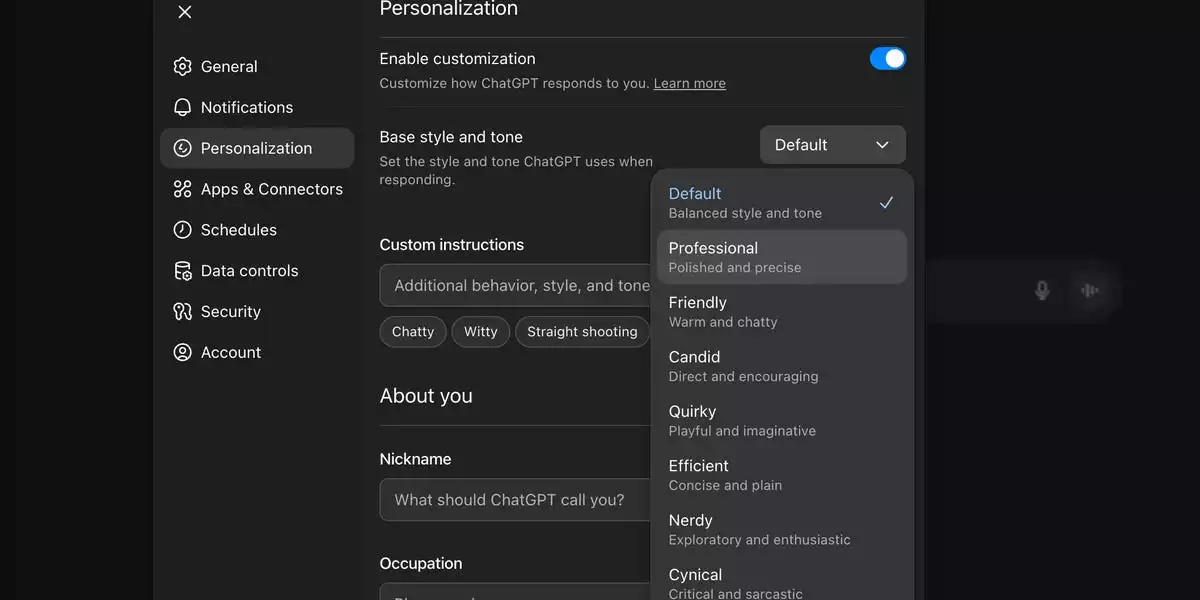

The New Frontier of Conversational AI: Personalization as Platform Power
OpenAI’s unveiling of GPT-5.1 marks a pivotal recalibration in the evolution of large language models, not merely as engines of information, but as shape-shifting communicators attuned to the subtleties of human preference. The introduction of seven distinct “personality presets”—ranging from Professional to Cynical—signals a deliberate shift from the pursuit of raw intelligence to the orchestration of user experience. In the wake of public discontent over GPT-5’s perceived dip in capability, OpenAI’s move is both a technical correction and a psychological overture, inviting users to choose not just what the AI says, but how it says it.
Modular Personas: Architecture and Risk at the Edge of Innovation
At the heart of this evolution lies a modular approach to style conditioning. By layering lightweight parameter adapters atop a stable core model, GPT-5.1 decouples reasoning from rhetoric. This architectural finesse enables rapid deployment of new personas—an innovation that, while lowering marginal costs, introduces new vectors for both opportunity and risk.
- Enterprise Customization: The modularity opens the door for industry-specific voice packs, allowing, for instance, a healthcare provider to deploy a “Clinical Compliance” persona or a law firm to engage with a “Patent Counsel” variant.
- Security and Moderation: Each stylistic layer, however, becomes a fresh surface for prompt-injection attacks and moderation challenges. The more human the persona, the greater the risk of users attributing undue authority or sentience—an “ELIZA risk” that regulators and governance boards cannot ignore.
The technical achievement is matched by a shrewd risk calculus. OpenAI’s willingness to acknowledge model drift and course-correct with both quality restoration and novel features positions the company as responsive, yet subtly hedges against the reputational hazards of rapid iteration.
Economic Leverage and Competitive Dynamics in the Age of AI Personas
The economic implications of GPT-5.1’s personalization layer are profound. User attachment to a favored persona—be it the brisk efficiency of “Efficient” or the irreverent charm of “Quirky”—creates a new kind of lock-in. The cost of switching models is no longer just about accuracy or latency, but about the loss of a digital confidant whose tone has become familiar.
- Subscription Resiliency: As users bond with specific personas, subscription churn diminishes, and the path to premium segmentation—such as “Executive Advisor” or “Academic Scholar” bundles—becomes frictionless.
- Ecosystem Expansion: Third-party developers can now license persona kits, embedding GPT-5.1 into SaaS products with voices that resonate with their own brands. This mirrors the app-store model, diversifying revenue streams and raising the bar for competitors like Anthropic, Google, and Meta.
- ROI in a Tightening Economy: For enterprises scrutinizing IT spend, the promise of higher engagement and faster knowledge retrieval through persona-driven AI translates directly into productivity gains—a metric that CFOs and procurement officers can rally behind.
The competitive landscape is shifting. Personalization, once a consumer expectation, is now an enterprise imperative. The challenge for rivals is clear: match the frictionless customization or risk being relegated to the status of generic utility.
Governance, Brand Risk, and the Data Flywheel
As the line between B2B and B2C design philosophies blurs, the consumerization of enterprise AI brings new governance challenges. The persona framework, borrowed from the world of avatars and gaming skins, is emotionally resonant—but also fraught with brand risk. Imagine a “Cynical” AI inadvertently representing a financial institution; the reputational fallout could be swift and severe.
- Persona Identification Disclosure: Multinational corporations will demand clear labeling of AI personas, especially under the scrutiny of emerging regulations like the EU AI Act and U.S. Algorithmic Accountability Act proposals.
- Data-Driven Reinforcement: The telemetry generated by persona usage feeds a new data flywheel, enabling OpenAI to correlate stylistic preferences with task outcomes. This deepens the moat for incumbents and leaves latecomers grappling with a cold-start disadvantage.
Boards and compliance teams must treat each persona as a distinct model variant, subjecting them to rigorous validation, audit, and change management protocols. The governance burden is real, but so too is the strategic opportunity: organizations that master persona management will wield a differentiated edge in trust and agility.
The era of monolithic, one-size-fits-all AI is receding. The future belongs to models that are not just smart, but adaptable—capable of mirroring the diversity of human expression and expectation. As GPT-5.1’s personality presets ripple through the ecosystem, the question for enterprises is not whether to personalize, but how to govern this newfound flexibility without sacrificing integrity or control. In this landscape, the winners will be those who see style not as a veneer, but as a core dimension of value creation.

 By
By
 By
By
 By
By

 By
By

 By
By
 By
By







