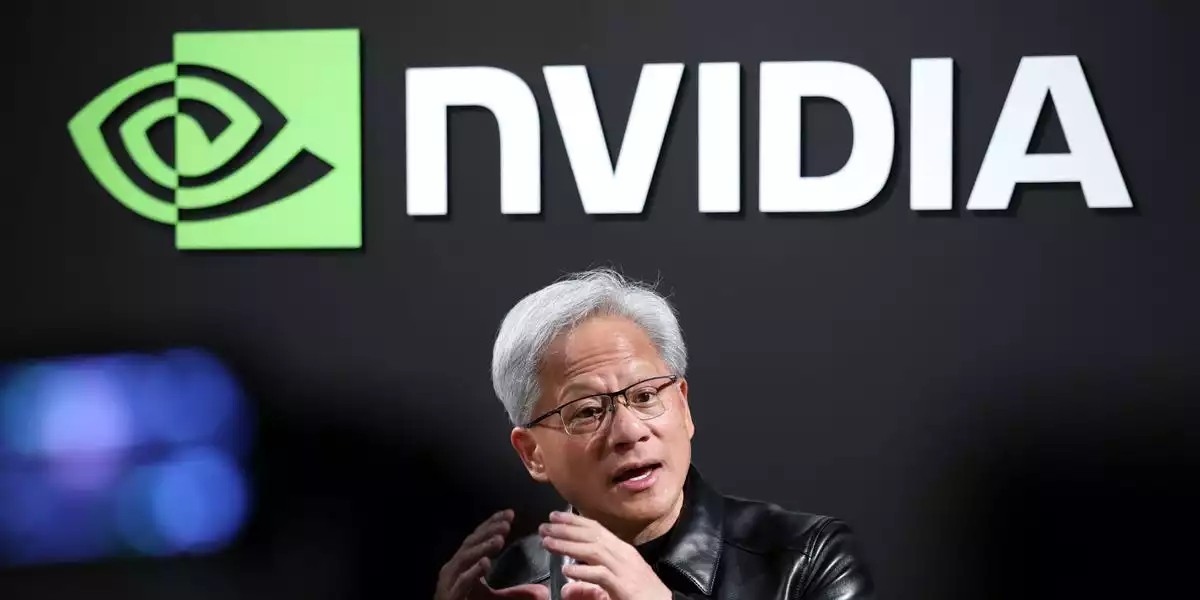

Nvidia’s bid to become the operating layer of modern AI—not just its engine
Nvidia’s reported pursuit of Hugging Face for more than $13 billion reads less like a conventional acquisition and more like a statement of intent: the company that defined the AI hardware era wants deeper influence over how models are built, shared, deployed, and optimized. Hugging Face is not merely a software asset; it is a developer nexus—an open-source model repository and collaboration platform hosting over two million AI artifacts, spanning models, datasets, and tooling that increasingly shape day-to-day machine learning practice.
For years, Nvidia has thrived as the “picks and shovels” provider of the AI boom, with GPUs and the CUDA software stack forming the default foundation for training and inference. The strategic logic now appears to be evolving toward ecosystem ownership: if the center of gravity in AI shifts from raw compute to reusable models, orchestration layers, and developer communities, Nvidia is signaling it intends to sit at that center.
This mirrors a familiar playbook from cloud and enterprise software history: infrastructure leaders often seek durable advantage by acquiring the communities and workflows that determine where workloads land. The difference is that AI’s core workflow—model development—moves at open-source speed, and the platform that hosts those artifacts can influence everything from runtime defaults to deployment patterns and even benchmark norms.
Vertical integration meets open-source gravity: the promise and the tension
An acquisition of Hugging Face would extend Nvidia’s reach beyond chips into the model-development lifecycle, tightening the coupling between popular open-source assets and Nvidia’s software stack—CUDA, Triton, NeMo, and adjacent tooling. From a product perspective, the upside is straightforward: tighter integration can yield better performance, smoother deployment, and faster iteration for teams building on Nvidia hardware.
Yet the strategic tension is equally clear. Open-source hubs create powerful network effects precisely because they are perceived as neutral infrastructure for the community. If Nvidia becomes the owner, the market will scrutinize whether neutrality can be preserved—or whether subtle defaults begin to steer the ecosystem toward Nvidia-optimized paths.
Key dynamics business and technology leaders will likely watch closely include:
- Performance-driven lock-in: If the “best” implementations and reference pipelines are increasingly tuned for Nvidia accelerators, portability may erode even without explicit restrictions.
- Workflow capture: Control of the model hub can influence which frameworks, inference servers, quantization methods, and deployment templates become standard.
- Data and telemetry advantages: Platform-level visibility—what models are downloaded, fine-tuned, and deployed—can become an intelligence layer informing Nvidia’s roadmap and optimization priorities.
- Governance credibility: Hugging Face’s standing rests on trust with researchers, startups, and enterprises; maintaining transparent governance would be essential to avoid community fragmentation or migration.
This is where the analogy to major platform acquisitions (such as infrastructure companies buying developer ecosystems) becomes instructive. The value is not only in revenue; it’s in setting the default choices that shape an industry’s trajectory.
A defensive moat against custom silicon—and a capital strategy to scale demand
Nvidia’s ecosystem push is also a defensive maneuver against a credible long-term threat: leading AI labs exploring proprietary silicon. Organizations such as OpenAI and Anthropic have openly considered or pursued strategies to reduce dependency on Nvidia by designing in-house accelerators or partnering for custom chips. If the most influential AI developers control both the models and the hardware, Nvidia risks being disintermediated in the highest-margin, highest-volume segments of the market.
Owning or deeply integrating with a platform like Hugging Face can counter that risk by strengthening Nvidia’s relationship with the broader developer base—startups, enterprises, and independent researchers—who collectively determine much of the tooling and deployment reality outside a handful of frontier labs. The strategic bet is that developer allegiance and ecosystem defaults can be as powerful as raw hardware leadership.
At the same time, Nvidia’s ambitions are being underwritten by unusually aggressive financial positioning. The company has reportedly committed nearly $48 billion in private-market deals this year, up sharply from $22.3 billion in January, and is working with Wall Street institutions to channel as much as $500 billion into AI infrastructure. This is not just investment activity; it functions as strategic leverage:
- Demand assurance: Large-scale financing pipelines help ensure that data centers and AI-native startups can place orders at the scale Nvidia’s roadmap assumes.
- Architecture standardization: When capital is aligned with Nvidia-backed ecosystems, it subtly biases procurement, tooling, and hiring toward Nvidia’s stack.
- Competitive pressure: Rivals must compete not only on silicon performance, but on financing access, ecosystem maturity, and developer mindshare.
In a macro environment shaped by budget scrutiny, supply-chain constraints, and geopolitical export controls, Nvidia’s willingness to front-load investments stands out. It is a high-conviction strategy: expand the market, shape its defaults, and reduce the probability that the next wave of AI value creation routes around Nvidia.
What enterprise leaders, investors, and regulators should be preparing for next
If Nvidia becomes both the dominant compute provider and a primary steward of the open-source model distribution layer, the implications extend well beyond product roadmaps. Enterprises building AI capabilities will need to weigh integration efficiency against strategic flexibility, while regulators will examine whether ecosystem control creates exclusionary dynamics.
Practical considerations that will likely define the next phase:
- Procurement strategy: Enterprises may pursue multi-accelerator approaches (where feasible) to preserve negotiating leverage and reduce single-vendor exposure.
- Platform governance and interoperability: Participation in open standards and portability initiatives becomes a strategic hedge, not a philosophical preference.
- Competitive responses: Expect AMD, Intel, and AI-chip startups to intensify platform alliances, open-source sponsorships, and developer tooling investments to counterbalance Nvidia’s gravitational pull.
- Antitrust sensitivity: U.S. and EU regulators are increasingly attentive to dominant-platform behavior; any perception that a model hub is being used to preference a hardware stack could invite scrutiny.
Nvidia’s proposed Hugging Face acquisition, paired with its sweeping capital-market partnerships, signals a company aiming to evolve from category leader to ecosystem architect. The next contest in AI may not be decided solely by who builds the fastest chip, but by who defines the default workflows developers trust—and which institutions finance the infrastructure that turns those defaults into global scale.

 By
By
 By
By
 By
By


 By
By
 By
By
 By
By