

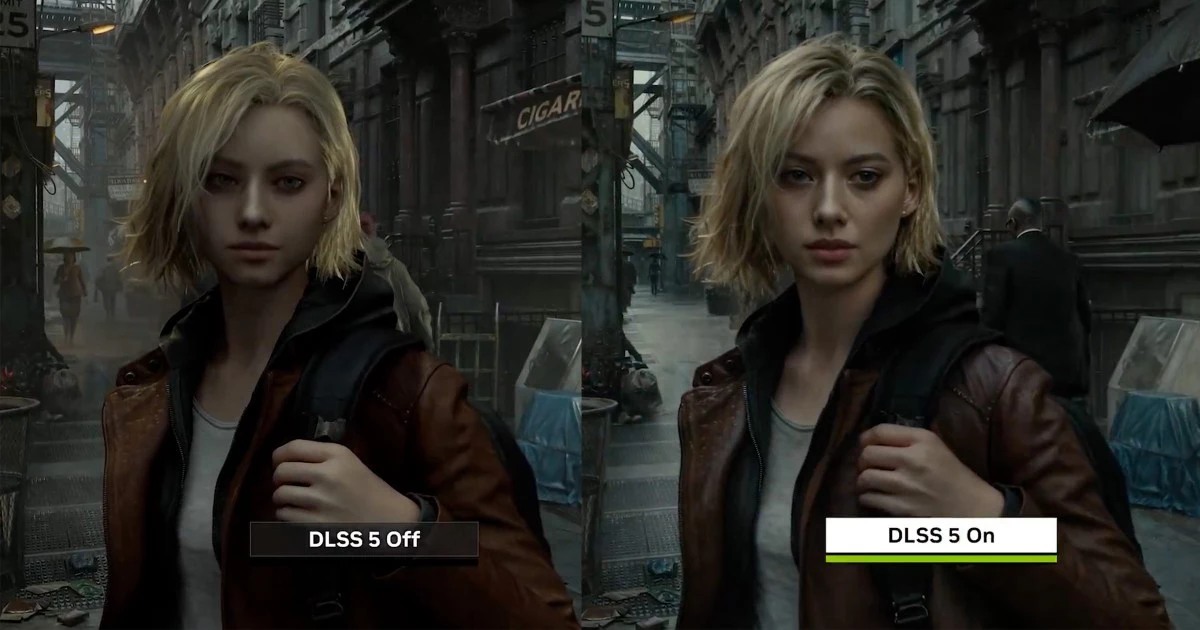

DLSS 5 and the shift from “rendering assistance” to GPU-native scene authorship
Nvidia’s unveiling of DLSS 5 is being framed by the company as a watershed: the most consequential leap in real-time graphics since ray tracing. The claim is not merely about sharper frames or higher performance per watt. It is about a deeper architectural pivot—from AI as a supporting tool (upscaling, denoising, reconstruction) to AI as a co-equal participant in image formation, operating directly on color and motion vectors to reshape what the player ultimately sees.
That distinction matters because it positions DLSS 5 as a form of neural rendering, not just a performance feature. In practice, it suggests a future where the GPU is no longer only executing a studio’s rendering pipeline, but also interpreting and “improving” it in real time through learned priors about lighting, materials, texture detail, and motion.
For the industry, this is the next wave of a trend already visible across content pipelines: procedural tools and physically based rendering are now being complemented—sometimes challenged—by generative AI techniques. Nvidia’s bet is that the market is ready for a GPU-resident model that can deliver a more photorealistic image than traditional handcrafted techniques can achieve at comparable frame rates. The controversy is that “photorealistic,” when encoded into a model, can become a default aesthetic rather than a neutral enhancement.
The “beauty filter” backlash: when statistical realism collides with art direction
Early DLSS 5 demos triggered a swift and unusually pointed response from gamers and developers. The recurring critique is not that the technology fails to impress technically, but that it appears to over-smooth, homogenize, and re-interpret scenes in ways that feel disconnected from a game’s intended visual identity. The shorthand accusation—DLSS 5 as a default “beauty filter”—captures a deeper anxiety: that neural rendering may optimize toward a generalized notion of “appeal” and inadvertently erase the deliberate imperfections that define a franchise’s look.
This is a familiar fault line across creative AI adoption. In music, AI mastering can converge toward a loudness-and-clarity norm that flattens genre nuance. In writing tools, default rewrites can sand down voice. In graphics, the stakes are amplified because visual identity is intellectual property—a competitive moat for major franchises and a signature for smaller studios.
Key tensions now coming into focus include:
- Artistic intent vs. algorithmic priors: A model trained to enhance “realism” may treat stylization as noise to be corrected.
- Consistency across scenes and assets: Neural enhancement can introduce a uniform “finish” that clashes with handcrafted variation.
- Trust and control: If creators cannot predict or tune outcomes, AI becomes a creative risk rather than a creative multiplier.
- Player perception: Gamers often read visual changes as editorial choices; if the GPU appears to be “regrading” the image, it can feel like a loss of authenticity.
The debate is not simply aesthetic. It is about authorship: who is the final arbiter of the frame—the studio’s art director or the GPU’s model? DLSS 5 forces that question into the mainstream.
Publisher adoption and Nvidia’s leverage: performance feature or de facto standard?
Despite the backlash, Nvidia has secured notable publisher alignment, with Capcom, Bethesda, Ubisoft, and Warner Bros. reportedly preparing fall deployments in high-profile titles such as *Resident Evil Requiem* and *Starfield*. That adoption signals a pragmatic calculus: even if neural rendering is contentious, the promise of higher frame rates, improved reconstruction, and premium visual output can be difficult to ignore—particularly for blockbuster releases where performance headroom translates into broader hardware compatibility and stronger review narratives.
From a business and platform perspective, DLSS 5 also functions as a strategic lever:
- GPU market positioning: Nvidia’s leadership in AI-capable GPUs allows it to frame DLSS 5 as a reason to upgrade, supporting premium pricing and a new enthusiast cycle ahead of key seasonal sales windows.
- Toolchain gravity: Integration quality in Unreal Engine, Unity, and proprietary engines will determine whether DLSS 5 becomes a routine checkbox or a specialized feature. The more studios build pipelines around it, the more Nvidia shapes middleware norms.
- Influencer-driven sentiment risk: Gaming communities and creators can materially affect launch momentum. If DLSS 5 becomes associated with “AI overreach,” publishers may face reputational friction even when performance gains are real.
This is where Nvidia’s advantage becomes delicate. The company can accelerate adoption through engineering support and marketing co-promotion, but it cannot easily compel cultural acceptance. In interactive media, perception is part of the product.
Competitive, regulatory, and strategic implications: the next battleground is controllability
DLSS 5’s debut is already creating openings for competitors. AMD and Intel have a clear incentive to position their own AI-infused rendering roadmaps as more transparent, more creator-friendly, or more stylistically faithful—especially if they can secure partnerships that reassure studios about cross-vendor portability. For developers, the strategic question becomes whether to embrace Nvidia’s momentum or hedge with GPU-agnostic alternatives to preserve negotiating leverage and protect long-lived IP.
Beyond competition, the “beauty filter” critique also brushes against emerging policy and ESG conversations. If neural rendering is perceived as enforcing narrow aesthetic norms—however unintentionally—it could attract scrutiny in an era when regulators are exploring AI transparency, labeling, and consumer disclosure. Even absent formal regulation, reputational dynamics can move faster than compliance regimes, particularly when visual media intersects with representation and identity.
For Nvidia, the path to durable success likely runs through control surfaces as much as model quality. The market signal from the backlash is not “stop neural rendering,” but “make it governable.” Practical steps that could reshape the narrative include:
- Art-directable parameters that allow studios to modulate enhancement intensity and preserve stylized intent
- Style-aligned presets (cel-shaded, painterly, retro, gritty realism) that treat non-photorealism as a first-class target
- Clear documentation and preview tooling so creators can predict outcomes and avoid late-stage surprises
- Optional disclosure modes for players, reinforcing trust by making AI enhancement a choice rather than an invisible override
DLSS 5 is a technical milestone, but its commercial legacy will be decided by something more human than compute: whether neural rendering can scale without standardizing taste. In the next phase of real-time graphics, the winning platforms will be those that deliver performance and spectacle without quietly rewriting the art direction that made players care in the first place.

 By
By
 By
By
 By
By

 By
By

 By
By
 By
By







