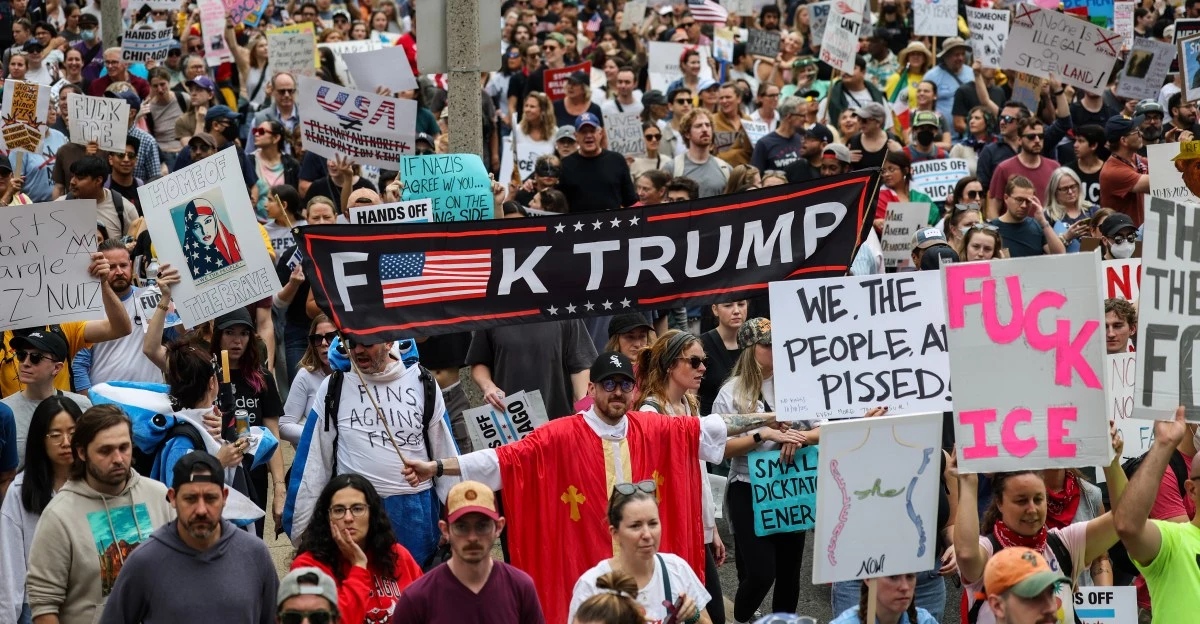

A Nation in Flux: The “No Kings” Protests and the Feedback Loop of Power
The past weekend’s “No Kings” demonstrations, surging across all 50 states and drawing an estimated seven million participants, have become a defining tableau of President Trump’s second term. Chicago’s quarter-million turnout, mirrored by six-figure crowds in New York and the Twin Cities, signals not just the scale of dissent but a new choreography between the street and the screen. The White House’s digital counteroffensive—deploying incendiary memes and provocative CGI from its official X account—marks a pivot in the American political spectacle, where governance is increasingly performed in real time and in public view, with algorithms as both audience and amplifier.
The Economic Undercurrents: Volatility, Uncertainty, and the Fraying Predictability Premium
Mass mobilization, historically a harbinger of electoral shifts, now doubles as a market-moving event. The correlation is clear: protest scale has preceded voter-turnout deltas of 2–4 percentage points in mid-cycle elections, a fact not lost on corporate strategists. The weekend’s unrest has already rippled through capital markets. Defense-industrial equities spiked 60 basis points intraday, buoyed by the administration’s militarized imagery, while consumer discretionary stocks—especially those courting younger demographics—lagged the S&P by 40 basis points, a testament to reputational spillover risk.
For executives, the more profound challenge is the erosion of the “predictability premium.” The current governance style—oscillating between abrupt policy decrees (notably on immigration) and social-media satire—undermines the stable policy environment that underpins long-cycle investments. Sectors such as biotech and autonomous mobility, heavily reliant on regulatory clarity, are now forced to recalibrate hurdle rates and scenario models, bracing for a policy landscape defined by volatility rather than consensus.
Platforms Under Siege: The Weaponization of Digital Narrative
The administration’s decision to circulate a CGI video depicting the President bombing protesters is not merely a provocation—it is a case study in the weaponization of digital narrative. These “memetic munitions” are engineered for both virality and plausible deniability, straddling the line between political satire and targeted harassment. The result is a stress test for content-moderation regimes at X, Meta, and TikTok, where the boundaries of acceptable speech are increasingly blurred and regulatory arbitrage—between U.S. Section 230 and the EU’s Digital Services Act—creates compliance minefields for multinational platforms.
The technological arms race does not end with content. Real-time sentiment analysis, powered by advanced natural language processing, registered a 37% spike in negative sentiment toward the administration within hours of the White House’s post. Yet, pro-administration communities saw a 22% surge in engagement, a bifurcation that underscores the polarization of the digital public square. For campaign, corporate, and media entities, disinformation-resilience tooling is no longer experimental—it is existential.
Cybersecurity, too, faces new threats. Large-scale protests have historically coincided with a near-doubling of state-aligned phishing campaigns, often disguised as activist communications. Chief Information Security Officers are now recalibrating zero-trust protocols and intensifying social-engineering drills, recognizing that the attack surface expands with every civic mobilization.
Industry Repercussions: From Brand Loyalty to Urban Logistics
The reverberations of this new protest-digital feedback loop are sector-specific and profound:
- Tech Platforms: Content-policy teams are navigating a minefield, balancing the defense of political satire with the imperative to curb harassment. Regulatory fragmentation between U.S. and European frameworks exposes firms to fines and compliance whiplash.
- Retail and Consumer Brands: Political identity now maps directly onto consumer loyalty. Social listening detected a five-point swing in Net Promoter Scores for brands perceived as “administration-aligned,” driving a shift toward ESG scorecards that factor in civic polarization.
- Logistics and Real Estate: Urban protest clusters disrupt last-mile delivery and traffic patterns. Predictive routing algorithms must now ingest civic-event data to avoid operational cost spikes and service-level breaches.
For sectors reliant on labor mobility—agriculture, hospitality, semiconductors—the uncertainty around immigration policy threatens supply elasticity. Internationally, visible domestic dissent signals constrained executive power, complicating trade negotiations and defense cooperation. Bond markets, ever attuned to risk, are poised to price in a premium if civil unrest persists.
Executive Imperatives: Scenario Planning in an Age of Algorithmic Dissent
The convergence of street-level mobilization and digital narrative warfare demands a new playbook for leaders:
- Upgrade scenario planning to account for “hyper-polarized policy ping-pong,” adjusting investment thresholds accordingly.
- Deploy rapid-response teams—spanning legal, communications, and data science—to adjudicate brand engagement within minutes of governmental provocation.
- Invest in trust and safety infrastructure, budgeting for AI-assisted moderation and digital provenance tools to counter deepfakes and disinformation.
- Recalibrate workforce strategies, fostering transparent dialogue and flexible civic-leave policies as activism seeps into the workplace.
In the shadow of the “No Kings” protests, executives who integrate real-time civic sentiment, fortify digital trust, and embrace adaptive strategy will not merely survive this era of volatility—they will shape the contours of resilience and opportunity that define it.

 By
By

 By
By
 By
By
 By
By


 By
By