
Two sleeper trains, two philosophies of value: mobility utility versus “moving hotel”
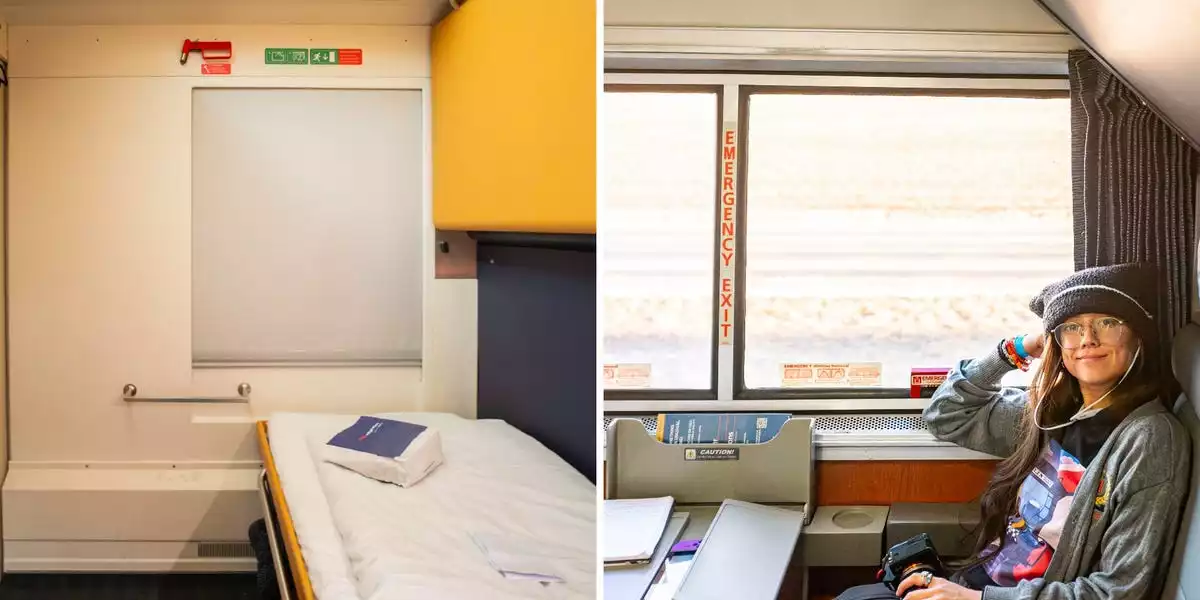
A side-by-side look at ÖBB’s Nightjet (Venice–Vienna, ~11 hours, ~US$200 private cabin) and Amtrak’s California Zephyr (Chicago–Emeryville, ~53 hours, ~US$2,200 bedroom) does more than compare amenities—it reveals how two rail ecosystems define “value” in fundamentally different ways.
On Nightjet, the proposition is efficient overnight transport: a compact private cabin, a basic wash-stand, and a morning breakfast that supports the core promise—arrive rested, on time, and ready to connect into Europe’s dense rail network. The California Zephyr, by contrast, sells time itself as the product. The longer journey is framed as an experience: a private room with a bathroom, thicker bedding, full dining-car meals, lounge cars, and a social rhythm that resembles a boutique hotel on rails—set against one of the most scenic long-distance routes in the United States.
For business and technology leaders, the comparison is instructive because it highlights a broader market question: Is overnight rail primarily a decarbonized substitute for short-haul flights, or a premium hospitality category that happens to move? Europe and the U.S. are currently answering that question in different ways—shaped by infrastructure, subsidy regimes, consumer expectations, and digital maturity.
Engineering and operations: why cabin size, plumbing, and maintenance shape the business model
The most visible differences—cabin footprint and private bathrooms—are also the most operationally consequential. Nightjet’s roughly 30-square-foot cabin emphasizes capacity efficiency and modularity. By limiting en-suite plumbing and keeping the onboard systems simpler, operators reduce maintenance complexity and turnaround time. That matters on multi-country routes where reliability, depot coordination, and rapid servicing determine whether overnight rail can scale as a repeatable network product.
Amtrak’s larger ~50-square-foot bedroom with private bath reflects a hospitality-centric architecture. It is compelling for travelers, but it also implies heavier mechanical requirements: water and waste systems, more intensive cleaning cycles, and higher risk of service disruption over a 53-hour run. On long-haul operations, small failures—HVAC issues, plumbing faults, door mechanisms—compound quickly into customer dissatisfaction and cost.
This is where technology becomes more than a convenience feature. Both systems have room to deepen digital service integration, but the U.S. opportunity is particularly pronounced:
- Booking and yield management
– ÖBB benefits from a more unified European booking environment that supports clearer inventory control across a dense network.
– Amtrak’s more fragmented, legacy-leaning platform environment can constrain real-time pricing, upgrades, and itinerary flexibility—key levers for premium revenue optimization.
- Predictive maintenance and onboard IoT
– Sensor-driven monitoring for wheelsets, HVAC, electrical systems, and onboard utilities can reduce downtime and prevent mid-route failures.
– Over multi-day journeys, predictive maintenance is not just cost control—it is brand protection, because premium pricing amplifies expectations.
In practical terms, the Nightjet model is optimized for repeatability and throughput, while the Zephyr model is optimized for experience differentiation—and each choice cascades into staffing, depot design, spare-parts strategy, and service recovery protocols.
Pricing, subsidies, and competition: what each market is really selling
The headline price gap—roughly US$200 versus US$2,200—is not simply a matter of “better” versus “worse.” It reflects different economic structures and competitive landscapes.
Europe’s passenger rail is supported by a well-funded subsidy framework and a regulatory environment that increasingly favors rail for sub-800 km travel. Carbon policy, airport constraints, and strong intercity rail alternatives make overnight trains a practical option for travelers who want to avoid flying without sacrificing connectivity. Nightjet’s pricing and service design align with that reality: it competes as transportation, not as a once-in-a-lifetime tourism product.
In the U.S., long-distance rail occupies a more niche position. Without widespread high-speed rail and with air travel often faster and competitively priced, routes like the California Zephyr compete less as mass transit and more as experiential tourism. That positioning helps explain why Amtrak’s sleeper product leans into hospitality: dining-car meals, lounge spaces, and social dining are not ancillary—they are central to the perceived value.
The Zephyr also illustrates a strategic tension familiar to many network businesses: premium products can become a mechanism for cross-subsidization, supporting less profitable services and sustaining national coverage. That can be defensible public policy, but it also makes pricing politically and operationally sensitive—especially when demand spikes, equipment is constrained, or service reliability falters.
The next competitive frontier: decarbonization, “work from train,” and platform-style mobility
Both models are being pulled forward by macro forces that extend beyond rail enthusiasts. Decarbonization mandates, infrastructure investment, and shifting travel patterns are turning sleeper rail into a testbed for the future of intercity mobility.
Several themes stand out for executives and policymakers evaluating overnight rail as a scalable category:
- Premiumization will increasingly be digital
– Travelers paying for privacy and comfort will expect reliable Wi‑Fi, abundant power, and app-based service controls.
– AI-driven personalization—lighting, climate, meal timing, accessibility preferences—can convert “nice-to-have” into measurable loyalty and ancillary revenue.
- Manufacturing capacity is strategy
– Scaling sleeper cars and dining cars depends on specialized rolling-stock supply chains and depot modernization.
– Localization pressures and geopolitical uncertainty elevate the importance of domestic or regional production resilience.
- Interoperability and integrated ticketing are growth multipliers
– Europe’s interoperability norms and network density make overnight rail easier to stitch into door-to-door journeys.
– North America’s fragmentation suggests upside for harmonized standards, multi-operator coordination, and mobility-as-a-service platforms that bundle rail, local transit, lodging, and experiences under unified loyalty schemes.
Ultimately, the Nightjet and the California Zephyr are not merely two trains—they are two market blueprints. One treats the sleeper as a high-efficiency mobility instrument; the other treats it as hospitality with motion. The next era of overnight rail will likely reward operators that can borrow from both: Europe’s operational discipline and network integration, paired with America’s experiential storytelling and onboard monetization—delivered through modern booking, predictive maintenance, and a service layer designed for the expectations of a digitally fluent, carbon-aware traveler.

 By
By
 By
By
 By
By


 By
By
 By
By