

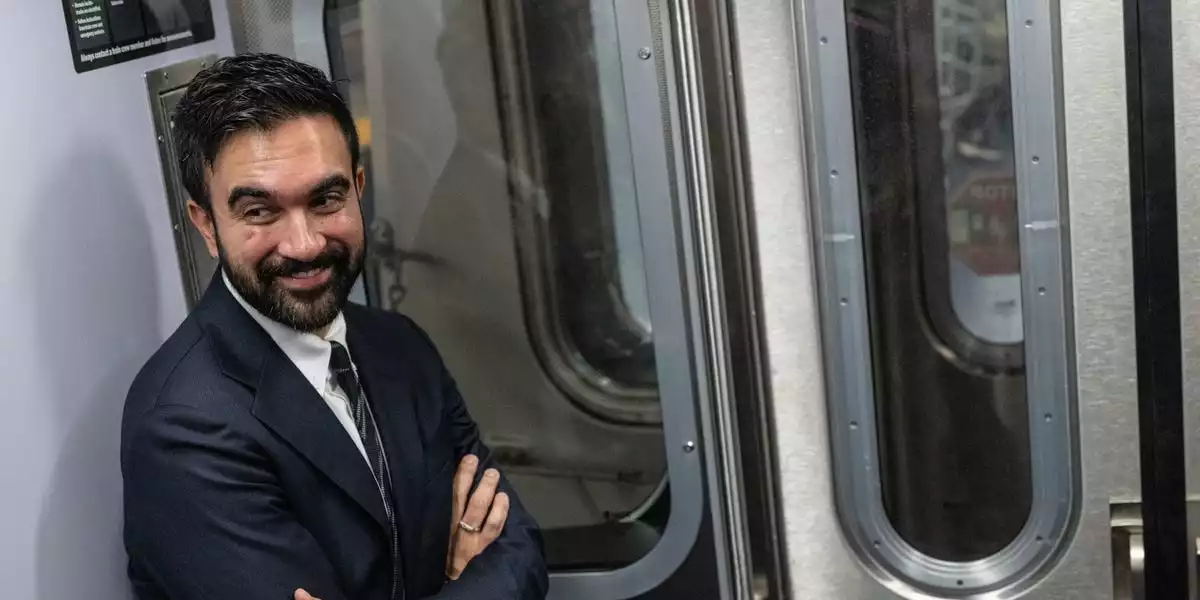

A commute that doubles as an economic indicator for New York City
New York City’s daily commute is more than a logistical routine—it is a high-frequency signal of economic health, labor-market access, and civic equity. Mayor Zohran Mamdani’s emphasis on improving bus service lands in a city where mobility is both a necessity and a dividing line: while roughly a quarter of residents drive, the subway still carries around six million trips per day, and buses remain the connective tissue for neighborhoods that rail does not serve well.
The latest framing, informed by the 2024 American Community Survey, is especially consequential because it challenges a simplistic narrative that “higher pay equals longer commute.” Instead, commute burdens appear stratified in more complex ways—by occupation, geography, and schedule rigidity. Middle-income workers can end up with the longest travel times, often because they are priced out of living near job centers yet lack the flexibility and bargaining power that higher-income professionals increasingly wield through hybrid work.
At street level, the stakes are immediate: unpredictable delays are not merely an inconvenience; they translate into missed shifts, childcare complications, and lost income—costs that compound fastest for workers with the least slack in their budgets and schedules. For employers and the city’s broader economy, the same delays become a quieter tax on productivity and reliability.
Why buses are becoming the center of the equity-and-performance debate
The political and operational focus on buses is not accidental. Buses are comparatively faster to improve than subways—through dedicated lanes, signal priority, stop consolidation, and enforcement—and they disproportionately serve riders whose commutes are already long and fragile. In that sense, bus upgrades function as both service optimization and equity intervention.
Yet the bus conversation also exposes a core tension in New York’s transit ecosystem: riders experience “quality” as a blend of speed, predictability, safety, and crowding, while agencies often measure performance through narrower operational metrics. The gap between those perspectives is where frustration grows—and where policy credibility is won or lost.
Key dynamics shaping the bus-first push include:
- Reliability over raw speed: For many riders, a consistent 45-minute trip is preferable to a 30-minute trip that unpredictably becomes 70.
- Geographic fairness: Peripheral neighborhoods often depend on buses to reach subways, job centers, and hospitals—making bus performance a proxy for access to opportunity.
- The enforcement problem: Dedicated lanes and priority signals only work when rules are enforced; otherwise, buses inherit the same congestion as private vehicles and delivery traffic.
- The “last-mile” reality: Even a world-class subway system can leave riders stranded without dependable surface transit connections.
This is where the mayor’s emphasis intersects with the city’s broader discourse: transit is not just infrastructure—it is time distribution. Who gets time back in their day, and who continues to spend it in motion, is an equity question with measurable economic consequences.
The technology stack New York needs: from real-time visibility to predictive operations
The analysis points to a transit modernization agenda that is increasingly defined by data and software, not only concrete and steel. New Yorkers’ tolerance for delays is famously low, but the system’s ability to anticipate and manage disruption remains uneven. The next leap forward is less about adding information screens and more about building predictive, integrated operations.
Several technology imperatives stand out:
- Predictive analytics for headway consistency: Machine-learning models fed by vehicle telematics, station sensors, and historical delay patterns can help reduce bunching, smooth service, and shorten dwell times. The goal is operational stability—especially during peak periods and incident recovery.
- Integrated Mobility as a Service (MaaS): A unified platform that combines subway, bus, and microtransit options—enhanced with crowding and air-quality metrics—would allow riders to make dynamic choices and reduce perceived uncertainty. Public–private partnerships could accelerate deployment, but governance and data stewardship would be decisive.
- Electrification paired with operational redesign: Electric bus fleets support climate targets, but electrification alone does not guarantee better service. Charging logistics, depot capacity, and route planning must be optimized to avoid reliability trade-offs.
- Automation as a targeted tool, not a blanket solution: Autonomous shuttles on low-density routes and controlled corridors could reduce operating costs over time, but the near-term value may lie in limited pilots that prove safety, reliability, and labor integration.
For business and technology stakeholders, the subtext is clear: transit agencies are becoming platform operators, and the city’s competitiveness will increasingly depend on whether it can run mobility with the rigor of a modern, data-driven enterprise.
Hybrid work, fare policy, and the human side of delay—where the next fights will be won
The post-pandemic commute is no longer a single pattern; it is a portfolio of behaviors. Hybrid work has introduced a new calculus in which some professionals accept longer rides in exchange for fewer in-office days—an option unavailable to many service-sector and frontline workers. That divergence risks creating a two-tier commute economy: one group optimizing for flexibility, another absorbing the full volatility of the system.
Economists’ warnings about the productivity drag of unpredictable delays align with what employers increasingly see in retention and attendance data. Meanwhile, community voices—such as Father Chris Lawton’s emphasis on personal and spiritual coping strategies—highlight something metrics rarely capture: commuting is also a mental load. Stress, fatigue, and the sense of powerlessness that comes with uncertainty can erode well-being long before they show up in economic statistics.
Policy choices now cluster around three pressure points:
- Affordability and fare design: Flat fares can be regressive for riders traveling from the edges of the city. Proposals such as income-adjusted tiers, monthly caps, or distance-sensitive pricing aim to balance equity with revenue stability.
- Service upgrades and displacement risk: Better transit can raise property values and accelerate gentrification, potentially displacing the very riders upgrades are meant to help—making coordination with affordable housing policy non-negotiable.
- Decentralized work nodes: Satellite offices and neighborhood co-working hubs could shorten commutes structurally, reducing peak strain and redistributing economic activity beyond Manhattan’s traditional core.
New York’s transit debate is ultimately a debate about what the city wants to optimize: raw throughput, rider experience, climate outcomes, labor-market access, or all of the above. The most durable strategy will be the one that treats commuting time as a scarce civic resource—managed with modern technology, priced with fairness, and improved with an unflinching focus on reliability for the people who keep the city running.

 By
By
 By
By


 By
By

 By
By
 By
By







