

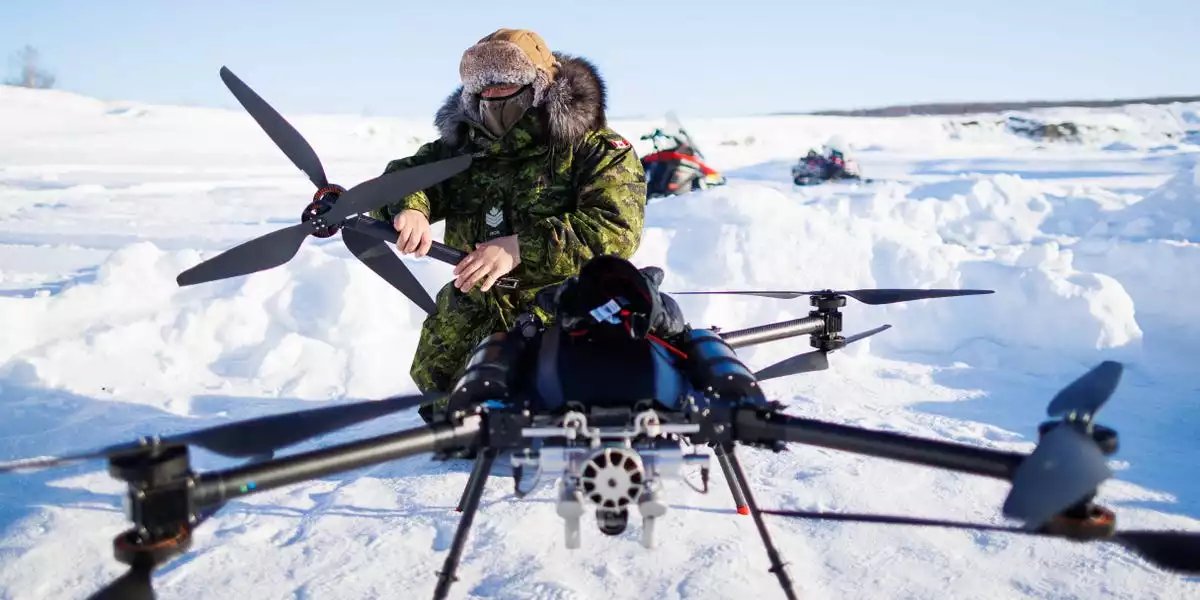

The Arctic’s strategic re-rating: from remote frontier to connective theater
NATO’s attention is moving north with unusual speed, and the reasons are structural rather than cyclical. The Arctic is no longer a distant buffer; it is becoming a connective operating space that links North America and Europe through newly accessible sea routes, while also exposing long coastlines, undersea infrastructure, and air approaches that were once naturally protected by ice and distance. As Russia and China expand their military and logistical presence in the High North, the region is increasingly framed as an arena where situational awareness, endurance, and logistics matter as much as traditional force projection.
A recent analysis from the Center for European Policy Analysis (CEPA) underscores a central tension: NATO’s strategic need for persistent surveillance and sustainment is rising faster than its ability to field Arctic-tailored capabilities. In that context, low-cost, expendable unmanned aerial systems (UAS)—including drone swarms—are being positioned as a pragmatic answer to a harsh operational reality: extreme cold, long periods of darkness, sparse basing, and limited communications infrastructure.
The logic is straightforward. Drones can extend coverage without putting pilots or ground teams at comparable risk, and they can be deployed in numbers that make attrition tolerable. Yet the Arctic is a domain where “commercial off-the-shelf” often becomes “commercial off-the-shelf—until it freezes,” and the gap between concept and capability can widen quickly.
—
Why Arctic drone fleets are attractive—and why the environment punishes shortcuts
The case for Arctic UAS is rooted in persistence and scale. Satellites provide wide-area coverage but can be constrained by revisit rates, cloud cover, and tasking priorities. Manned aircraft are powerful but expensive, maintenance-intensive, and exposed. By contrast, a distributed fleet of drones can create a near-continuous operational picture—especially valuable for maritime domain awareness, monitoring chokepoints, and tracking activity around ports, airfields, and undersea assets.
However, the Arctic imposes failure modes that are less common in temperate theaters. Key technical hurdles highlighted by experts include:
- Cold-weather power degradation: Conventional lithium-ion batteries can lose capacity sharply in sub-zero temperatures, reducing range, loiter time, and payload performance.
- Material brittleness and mechanical stress: Polymers and composites can embrittle; moving parts become less tolerant to vibration and shock.
- Ice accretion: Even thin layers of ice can degrade lift, destabilize flight, and impair sensors—turning routine missions into high-risk sorties.
- Electromagnetic detectability and contested sensing: Low ambient electromagnetic clutter can make emissions stand out, raising the premium on disciplined communications and passive sensing.
- Bandwidth and latency constraints: Sparse infrastructure and long distances make it harder to stream data continuously, pushing more processing onto the platform.
These constraints elevate the importance of edge autonomy and sensor fusion. In months of polar night, electro-optical cameras alone are insufficient; multi-spectral payloads, synthetic aperture radar (SAR), and onboard machine learning become central to maintaining reliable detection and classification. The strategic implication is that Arctic drones are not merely airframes—they are integrated computing, sensing, and energy systems that must be engineered for a punishing thermal envelope.
—
Procurement friction meets industrial opportunity: the business of Arctic-ready autonomy
The CEPA warning about “fractured, slow-moving procurement” is not a procedural footnote; it is a strategic variable. In a theater where adversaries are building presence and practice, the side that iterates faster can seize operational initiative. NATO’s challenge is that Arctic UAS capability is inherently cross-domain—touching air, maritime, cyber, space, and logistics—while acquisition remains largely national and program-specific.
From a business and technology perspective, this creates a dual reality:
Arctic operations reward suppliers that can deliver measurable performance in cold-weather reliability and maintainability, including:
- Hybrid power architectures (fuel cells, supercapacitors, advanced electrolytes)
- Thermal regulation (phase-change materials, insulated battery bays, waste-heat reuse)
- Anti-icing coatings and self-deicing subsystems
- Low-temperature electronics and ruggedized sensors
- Modular payload bays enabling rapid mission reconfiguration
Critical inputs—advanced batteries, precision optics, semiconductors—remain concentrated in limited geographies. For NATO members, “Arctic-ready” increasingly implies supply-chain resilience, not just performance. That opens space for North American and Nordic industrial bases to expand, but it also demands coordinated sourcing strategies to avoid bottlenecks and strategic dependencies.
A particularly consequential angle is dual-use synergy. Arctic shipping, environmental monitoring, fisheries enforcement, and natural-resource exploration all benefit from persistent sensing. If structured carefully, public-private partnerships can amortize R&D costs, accelerate fielding, and keep fleets active in peacetime—without blurring governance lines around military tasking and data rights.
—
What a credible NATO Arctic UAS posture looks like: standards, corridors, and shared data
If NATO is to translate drone potential into deterrence value, the differentiator will be less about any single platform and more about systems integration and alliance coordination. A credible posture would likely include:
- Open-architecture UAS standards so payloads and software can be swapped across allied fleets, reducing fragmentation and improving interoperability.
- “Arctic drone corridors” with preplanned routes, waystations for repair/refuel, and secure mesh communications nodes for data offload—treating UAS operations as infrastructure, not ad hoc sorties.
- Distributed training and simulation that reproduces Arctic navigation, icing, comms denial, and sensor limitations, accelerating readiness without waiting for seasonal windows.
- A centralized NATO Arctic UAS acquisition cell to harmonize requirements, pool orders, and negotiate framework agreements—driving down unit costs while speeding delivery.
- Shared, trusted data streams that turn surveillance into deterrence by denial: the ability to see, attribute, and communicate activity quickly raises the political and operational cost of coercive moves.
The Arctic is becoming a test of whether advanced alliances can modernize at the pace of geography and technology. Drone fleets—especially low-cost, expendable systems—offer NATO a scalable way to persist, observe, and supply in a region that punishes inertia. The decisive question is whether procurement and industrial coordination can move fast enough to make that promise real before the High North’s emerging sea lanes and strategic corridors harden into someone else’s advantage.

 By
By


 By
By
 By
By

 By
By
 By
By







