

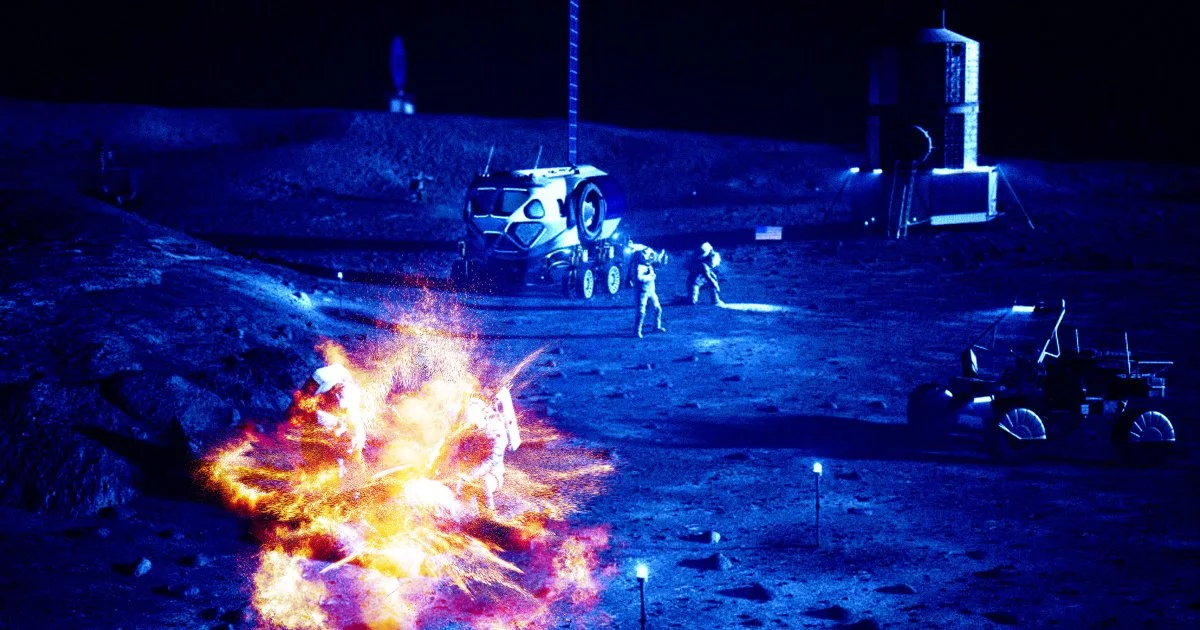

A lunar fire test with outsized implications for Artemis-era habitation
NASA’s planned Flammability of Materials on the Moon (FM2) experiment—targeted for launch in late 2026—signals a pragmatic shift in how space agencies and industry will validate safety for long-duration lunar living. Rather than treating fire behavior as a solved problem carried over from Earth-based certification, FM2 treats combustion as an environmental variable that changes meaningfully with gravity, atmosphere, and habitat design.
The experiment builds on prior microgravity flame studies conducted aboard the Northrop Grumman Cygnus vehicle, but it advances the field in a crucial way: it moves combustion testing into partial gravity on the lunar surface. FM2 will ignite four solid-fuel samples inside controlled, oxygen-rich atmospheres, capturing high-resolution data on flame spread, burn rates, and extinction thresholds. The central question is deceptively simple: do materials that pass today’s NASA flammability standard remain safe when gravity drops to 1/6 of Earth’s?
That question matters because current certification frameworks—most notably NASA-STD-6001B, anchored to a one-G, six-inch flame test—were designed around terrestrial buoyancy and convection. If partial gravity reshapes how oxygen reaches a flame and how heat is transported away from it, then “non-flammable” on Earth may translate into “riskier than expected” on the Moon. FM2 is positioned to convert that possibility into measurable engineering thresholds.
Why partial gravity can rewrite flame behavior—and why standards may follow
Combustion is not just chemistry; it is fluid dynamics. On Earth, buoyancy-driven convection pulls hot gases upward and draws fresh oxygen into the flame zone. In lunar gravity, those flows weaken, and the intuitive assumptions behind flame spread can break.
FM2’s value lies in turning long-suspected effects—seen in drop towers and sounding rockets—into a structured dataset that can support standards revision and predictive modeling. Key physical mechanisms under scrutiny include:
- Blowoff dynamics and oxygen replenishment: Reduced buoyancy can change how readily a flame detaches or extinguishes, and how oxygen is resupplied at the combustion boundary.
- Surface “cling” and altered spread patterns: With weaker convection, flames may persist differently on vertical or irregular surfaces, challenging terrestrial expectations about where heat accumulates and how quickly ignition propagates.
- Extinction thresholds in oxygen-rich environments: Lunar habitats may operate at oxygen partial pressures that differ from Earth norms; FM2’s controlled atmospheres help isolate how oxygen concentration interacts with partial gravity.
Equally important is FM2’s instrumentation strategy. By combining high-definition cameras, radiometers, and oxygen sensors, the experiment can produce time-synchronized evidence of flame morphology, radiative heat output, and local oxygen depletion/replenishment. That combination supports a shift from empirical “pass/fail” logic toward physics-based predictive models—the kind needed for designing habitats, vehicles, and emergency systems that must work reliably far from immediate rescue.
If FM2 confirms that some materials behave more aggressively in partial gravity, the downstream effect is straightforward: flammability certification for lunar missions becomes a new category, not a subset of Earth testing.
Engineering, autonomy, and the rise of “digital fire safety” off-Earth
FM2 is also a systems experiment in how safety research will be conducted on the Moon: autonomously, remotely, and with fault tolerance. That operational posture is not a footnote—it is a preview of how lunar outposts will manage risk when crew time is scarce and response windows are tight.
Several technology trajectories converge here:
- Autonomous execution and data buffering: Remote experimentation requires robust sequencing, anomaly handling, and secure telemetry—capabilities that translate directly into future habitat safety diagnostics.
- Digital twins for lunar habitats: High-fidelity combustion datasets can feed simulation environments that model fire growth, smoke transport, and suppression effectiveness under lunar gravity. This enables virtual fire-safety drills and design stress tests without endangering astronauts.
- Sensor-driven prevention over manual response: FM2’s multi-modal measurements reinforce a broader trend: safety becomes software-defined, with continuous monitoring and predictive alerts rather than reliance on procedural drills alone.
Notably, the relevance extends beyond space. Environments on Earth that disrupt “normal” convection—such as submarines, underground mines, and high-altitude facilities—face their own combustion edge cases. FM2-derived models could improve terrestrial fire resilience where airflow, pressure, or ventilation constraints complicate traditional assumptions.
Markets, insurance models, and standards leadership in the emerging lunar economy
FM2’s most immediate business impact may be the creation of a clearer, more enforceable definition of “lunar-safe materials.” Once partial-gravity flammability thresholds are quantified, procurement and certification will tighten—especially for habitat interiors, suit fabrics, insulation, polymers, and life-support plumbing.
Expect pressure and opportunity across several fronts:
- Materials innovation and IP formation: If current polymer formulations underperform in partial gravity, demand will rise for low-gravity-optimized flame retardants, composite laminates, and coatings. Suppliers that qualify early can command premium positioning in Artemis-aligned supply chains.
- A new certification services layer: As standards evolve, a market emerges for third-party validation—labs and facilities offering parabolic flight, drop tower, and lunar-analog chamber testing to support compliance claims and reduce mission risk.
- Insurance and underwriting recalibration: Insurers will likely adjust models once FM2 clarifies the true hazard profile. Premiums may rise initially, but better quantification typically unlocks investment by making risk priceable and mitigation verifiable.
- Geopolitical leverage through standards: Safety standards often become de facto trade rules. If NASA’s post-FM2 updates influence ISO working groups or bilateral lunar agreements, standards leadership becomes a form of strategic influence—shaping what materials, designs, and suppliers are admissible in multinational missions.
FM2 ultimately frames fire safety as infrastructure: not merely a compliance checkbox, but a prerequisite for scalable lunar operations—from pressurized rovers to ISRU processing plants and commercial habitat modules. In a lunar economy where logistics are unforgiving and redundancy is expensive, the ability to predict and prevent fire under partial gravity may become one of the quiet determinants of who can build—and who can stay.

 By
By
 By
By

 By
By


 By
By
 By
By







