

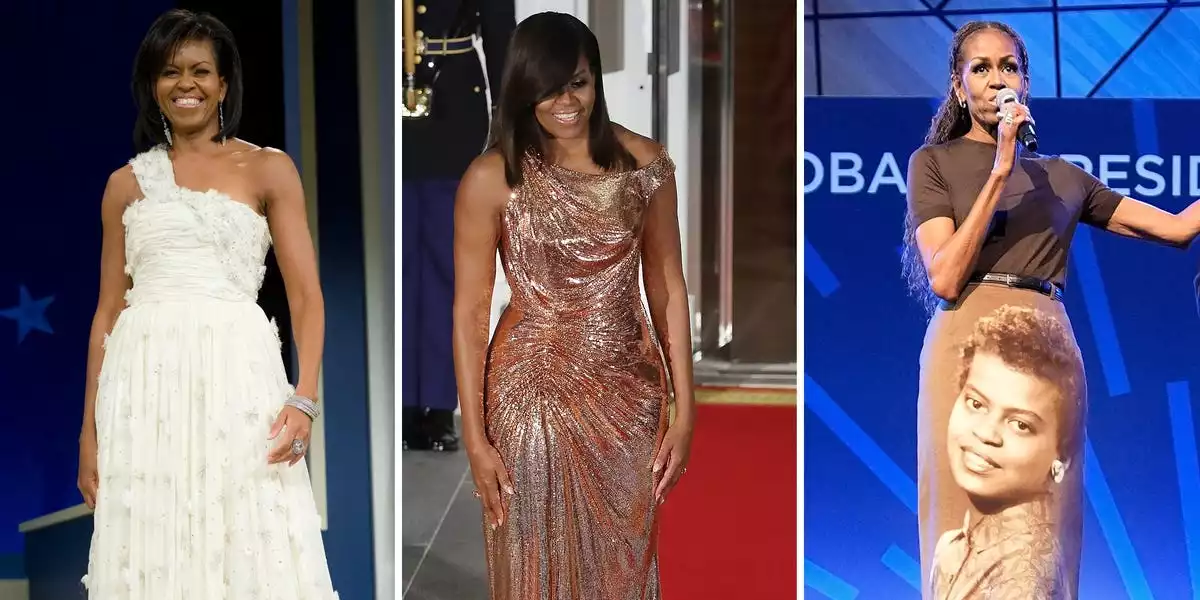

From protocol to personal narrative: Michelle Obama’s wardrobe as a leadership signal
Michelle Obama’s fashion evolution reads less like a style timeline and more like a case study in modern brand leadership—one that moves from institutional representation to self-authored identity. During the White House years, her clothing choices often operated within the constraints of diplomatic protocol and public scrutiny, yet still carried deliberate cues: the turquoise dress at the 2008 Democratic National Convention, the red wrap dress on election night echoing Barack Obama’s tie, and the now-iconic Jason Wu white inaugural gown that elevated an emerging designer overnight.
As First Lady, she navigated a careful balance between accessibility and aspiration, pairing mainstream appeal with high-fashion credibility. Her selection of designers—ranging from established houses to rising talents—signaled a nuanced understanding of fashion as both cultural language and economic platform. Even moments of controversy, such as debate around wearing Alexander McQueen and the optics of international sourcing, underscored how quickly apparel can become a proxy for larger conversations: domestic industry support, globalization, and the expectations placed on public figures as symbolic representatives.
Post-White House, the tone shifts decisively. On the “Becoming” book tour and subsequent public appearances, Obama’s wardrobe becomes more overtly expressive: bold palettes, statement tailoring, all-white ensembles, vibrant suits, and patterned dresses that reference heritage and personal milestones, including tributes connected to her late mother. The throughline is consistent: clothing as a tool to project confidence, communicate values, and shape narrative—an approach increasingly mirrored by executives, founders, and public-facing leaders across industries.
Authenticity economics and the “Michelle Obama effect” on consumer demand
Obama’s style trajectory aligns with a broader market reality: authenticity has become a primary consumer currency. Audiences—especially digitally native ones—reward coherent storytelling over polished uniformity. In this context, fashion is not merely aesthetic; it is positioning.
For brands and retailers, the implications are tangible:
- Story-driven consumption: Consumers increasingly buy into *meaning*—heritage references, personal symbolism, and intentional design choices—rather than trend compliance alone.
- Trickle-down retail dynamics: High-visibility adoption of designers such as Jason Wu (and later contemporary labels like Acne Studios) can accelerate brand awareness, shorten the path to mass-market relevance, and prompt:
– capsule collaborations
– licensing opportunities
– faster wholesale expansion
- Demand for “identity fit,” not just product fit: Obama’s post-First Lady looks reinforce a shift toward fashion that helps wearers articulate who they are—an insight that extends to beauty, wellness, and even consumer tech branding.
This is where the “Michelle Obama effect” becomes measurable: a single high-profile appearance can function like a market-moving endorsement, influencing search trends, sell-through rates, and retailer assortment strategies. In a fragmented media environment, recognizable figures who can still command broad attention become rare—and therefore commercially potent—distribution channels for aesthetic ideas.
Soft power, designer equity, and the geopolitics of what gets worn
Fashion has long operated as a form of soft power, but Obama’s tenure illustrates how systematically it can be deployed. State dinners and global appearances are not only ceremonial; they are visual diplomacy, capable of signaling respect, alliance, and cultural fluency. Choices that incorporate designers with cross-cultural resonance—such as Indian-American design fusion—can subtly reinforce bilateral warmth and shared values without a word spoken.
At the same time, these moments reveal the business mechanics behind cultural influence:
- Designer elevation as an economic event: When a relatively unknown designer is worn on a global stage, the result can be immediate:
– surging brand recognition
– investor interest (including private equity)
– accelerated international expansion
– long-tail value through brand mythology
- Sourcing scrutiny as reputational risk: The McQueen debate highlighted a persistent tension for public figures and brands alike: global luxury supply chains versus expectations of domestic sourcing and local economic support. In today’s environment—defined by trade volatility and politicized consumption—“where it’s made” can matter nearly as much as “what it looks like.”
For corporate leaders, the lesson is direct: symbolic choices are rarely neutral. Whether in apparel, partnerships, or procurement, stakeholders interpret decisions as signals about values, alliances, and priorities.
Digital feedback loops, ESG traceability, and inclusion as competitive advantage
The modern fashion influence engine is inseparable from digital platforms. Instagram and TikTok have turned public appearances into real-time focus groups, where sentiment, engagement, and remix culture rapidly shape what becomes desirable. For brands, this creates both opportunity and pressure: the cycle from runway (or stage) to consumer demand is shorter, louder, and more data-rich than ever.
Key strategic implications emerging from this dynamic include:
- Real-time analytics as creative infrastructure: Brands can mine engagement metrics and sentiment analysis to refine design direction, forecast demand, and reduce inventory risk.
- Influencer-driven commerce at scale: Public figures with strong narrative credibility can catalyze direct-to-consumer behavior, especially when paired with:
– shoppable posts
– limited-edition drops
– tightly framed storytelling campaigns
- ESG and provenance expectations: Symbolism and heritage references increasingly intersect with sustainability-minded consumer behavior. That pushes brands toward:
– transparent sourcing
– verifiable labor standards
– traceability tools (including blockchain-style provenance systems)
- Diversity as innovation strategy: Obama’s consistent elevation of designers from varied backgrounds maps onto a wider industry reckoning: inclusion is not only reputational—it correlates with stronger ideation and market responsiveness. Supplier diversity and creative leadership diversity are becoming performance levers, not compliance checkboxes.
Michelle Obama’s wardrobe evolution ultimately functions as a blueprint for how influence operates in the current economy: identity expressed through design, amplified by digital distribution, scrutinized through ESG expectations, and converted into cultural—and commercial—capital. In a marketplace where consumers demand meaning alongside quality, the most enduring brands will be those that treat storytelling not as decoration, but as strategy.

 By
By
 By
By
 By
By
 By
By



 By
By







