

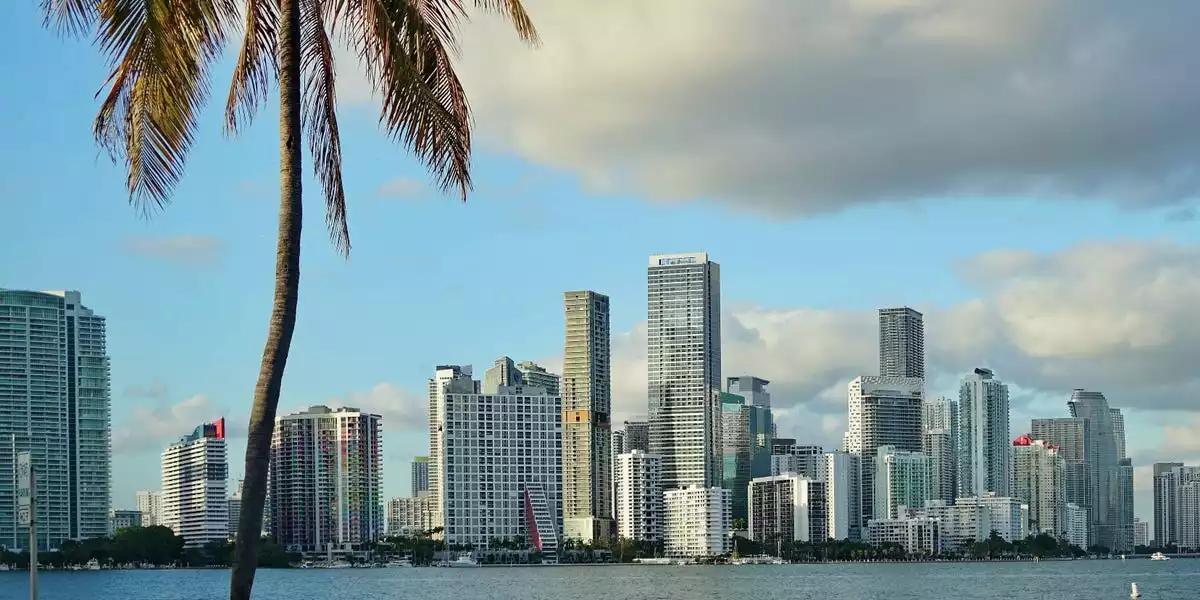

Miami’s hedge fund narrative meets the gravity of established financial ecosystems
Miami’s pandemic-era ascent as an aspirational alternative to New York and other legacy financial capitals is now confronting a more sober operating reality. The latest headcount signals from major multistrategy hedge funds—firms such as Citadel, Millennium, and Point72—suggest that the city’s role is stabilizing as a satellite node rather than consolidating into a true peer of the world’s dominant asset-management hubs.
The numbers are telling. Eight large multistrategy platforms collectively employed 218 investment professionals in Miami in 2025, then reduced that figure by 20 in 2026, even as their global headcount rose by 11%. That divergence matters: it implies not a sector-wide slowdown, but a reallocation of incremental growth away from Miami and toward locations with deeper institutional infrastructure.
This is not a repudiation of Miami as a business destination. It is, instead, a recalibration of what Miami can reliably offer hedge funds at scale—especially those built on high-velocity decision-making, dense collaboration, and specialized talent. The city’s early appeal—tax advantages, lifestyle, and climate—remains intact. What has weakened is the assumption that these benefits alone can substitute for the network effects embedded in New York, London, and increasingly Dubai.
Talent, collaboration, and the limits of “remote-first” for high-performance investing
The pandemic proved that distributed work can function. It did not prove that distributed work is optimal for every part of the investment value chain—particularly inside multistrategy hedge funds where performance depends on tight feedback loops between portfolio managers, analysts, quants, risk teams, and technologists.
A key friction point is talent depth and career optionality. For many mid-career professionals—analysts, associates, and sector specialists—the decision to relocate is rarely just about cost of living or weather. It is about the density of opportunity: the ability to change firms, pivot strategies, access mentors, and plug into adjacent industries such as fintech, data, and professional services. That ecosystem remains more mature in legacy centers, where the labor market is thick with:
- Specialized buy-side and sell-side talent pools (sector analysts, execution specialists, risk managers)
- Service-provider networks (legal, compliance, audit, prime brokerage, expert networks)
- Institutional client proximity (pensions, endowments, sovereign wealth intermediaries)
- Alumni and recruiting pipelines that continuously replenish teams
Miami’s challenge is not that it lacks talent; it is that it lacks redundancy—the kind that allows firms to hire quickly, replace quickly, and expand into new strategies without building every supporting function from scratch. As living costs rise and the novelty of relocation fades, the “Miami premium” becomes harder to justify for employees who view their careers as a sequence of optional moves within a broader financial metropolis.
Real estate commitments signal intent—but ecosystems are built by complements, not towers
The persistence of major real-estate projects underscores that Miami is still on the strategic map. Citadel’s 58-story headquarters is a statement investment, and Brevan Howard’s planned office reinforces the perception that the city remains a meaningful outpost for global finance. Yet real estate is an input, not an outcome. Office towers can anchor a presence, but they do not automatically create the self-reinforcing cluster that makes a financial center durable.
For hedge funds, a “turnkey” environment requires more than Class A space. It requires a mesh of operational and technical capabilities that reduce friction and risk, including:
- Compliance and regulatory expertise with onshore depth
- Risk-modeling and portfolio analytics talent that can scale across pods
- Market data, compute, and secure infrastructure aligned with modern quant workflows
- Recruiting pipelines tied to universities, training programs, and feeder firms
- A critical mass of peer firms that normalizes relocation and career mobility
Without those complements, Miami risks becoming a city where senior leaders and select teams locate for quality-of-life reasons, while the core engine—strategy buildout, large-scale hiring, and operational command—continues to concentrate elsewhere.
The headcount shifts reinforce this interpretation. Citadel’s Miami presence fell by 15 investment professionals despite a 77-person increase overall, while Millennium reduced its Miami roster from 53 to 48. A minority of firms expanded locally—ExodusPoint and Walleye among them—but the broader pattern points to continued growth in New York, London, and Dubai, where infrastructure and client adjacency remain decisive.
The emerging model: networked hubs, technology-enabled distribution, and strategic optionality
What is taking shape looks less like “Miami replaces New York” and more like a constellation strategy: firms maintain multiple offices to balance talent acquisition, time-zone coverage, regulatory considerations, and resilience. Miami fits naturally into that framework as a high-visibility, lifestyle-forward node—useful for executive presence, selective hiring, and brand signaling—without necessarily becoming the default destination for large-scale investment staffing.
Technology both enables and constrains this evolution. Cloud-native research environments, AI-assisted analytics, and secure collaboration tools reduce geographic dependence. But hedge funds still face hard realities:
- Latency sensitivity and proximity to major exchanges and data centers remain important for certain strategies
- Data governance and cross-border compliance complicate fully distributed research and trading stacks
- Cultural cohesion and knowledge transfer are harder to sustain when teams fragment into small pods
The result is a pragmatic middle ground: Miami remains part of the footprint, but not always the growth engine. Meanwhile, firms explore alternative hubs—New Zealand, Germany, and other jurisdictions mentioned as emerging options—while trimming or reshaping legacy outposts such as Chicago. This is less about chasing the next fashionable city and more about portfolio-managing geography the way these firms portfolio-manage risk: diversify, hedge, and preserve optionality.
Miami’s story, then, is not one of failure but of maturation. The city has proven it can attract capital, attention, and marquee commitments. The next test is whether it can deepen the institutional scaffolding—talent pipelines, specialized services, and finance-tech infrastructure—required to convert a compelling destination into a compounding financial ecosystem that grows even when the headlines move on.

 By
By

 By
By
 By
By
 By
By


 By
By







