

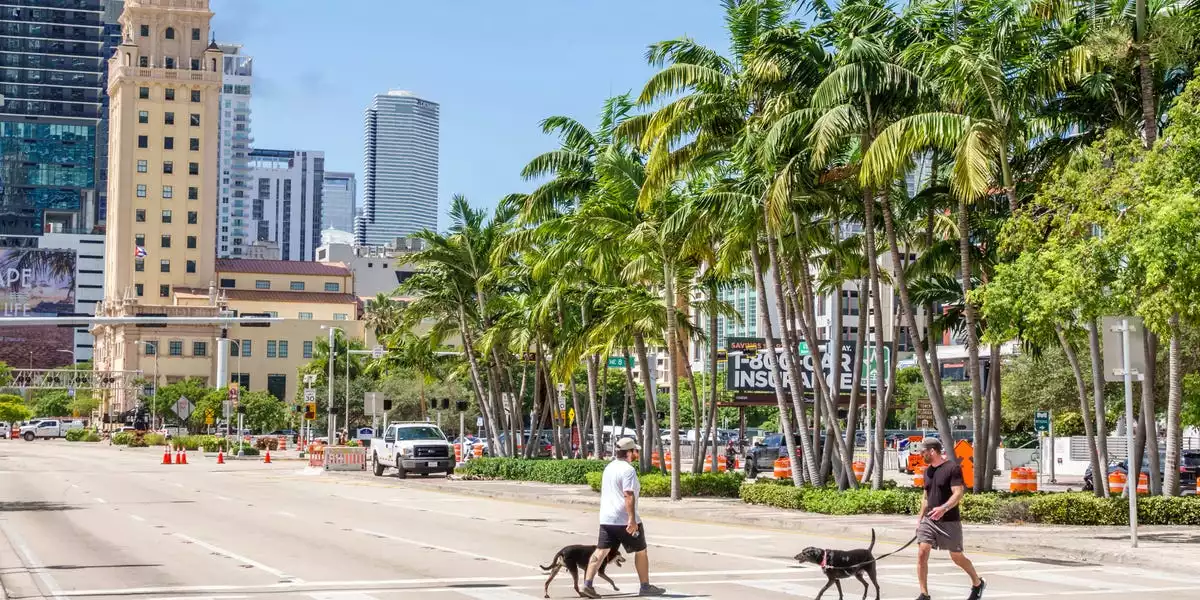

Miami’s tech narrative shifts from “pandemic refuge” to bi-coastal exchange engine
For much of the early 2020s, Miami’s rise in technology circles was framed as a one-way migration story: founders and financiers leaving the Bay Area for sunshine, lower taxes, and cheaper space. The latest talent and investment signals suggest something more durable—and more strategically interesting. Miami is increasingly behaving like a two-way node in the U.S. innovation network, with technologists and capital moving between South Florida and Silicon Valley in a pattern that looks less like an exodus and more like circulation.
That distinction matters. A city that merely attracts relocations can be vulnerable to the next macro turn; a city that becomes embedded in the talent supply chain can compound advantages over time. Data points referenced from LinkedIn and Revelio indicate that engineers, data scientists, and fintech specialists are not simply “arriving and staying,” but cycling between ecosystems, carrying playbooks, standards, and professional networks across coasts. The result is a form of cross-pollination: Miami gains operational maturity and technical depth, while Silicon Valley gains a credible partner hub for distributed teams and market expansion.
High-profile moves help anchor the narrative—Citadel’s global headquarters and Palantir’s presence via Denver are emblematic—but the more consequential story is the ecosystem underneath: a widening base of small and midsize firms across fintech, software, healthtech, logistics, and adjacent services that make a tech economy resilient when headlines fade.
Talent, infrastructure, and the hybrid-work dividend reshape Miami’s competitive position
Miami’s labor market has not been immune to the broader tech slowdown. Hiring reportedly fell roughly 20% in 2023 and another 10% in early 2024, reflecting the same interest-rate pressure and post-boom recalibration seen across the sector. Yet the more telling indicator is the trajectory: by late 2025, tech employment returned to positive year-over-year growth, suggesting that Miami’s tech base is not purely speculative or event-driven.
Several forces appear to be reinforcing that stabilization:
- Hybrid-first operating models: Startups and incumbents can recruit locally while also tapping remote talent from Silicon Valley and other hubs. This reduces overhead, shortens hiring cycles, and enables teams to scale without committing to Bay Area cost structures.
- Sectoral clustering with institutional anchors: Financial-services heavyweights and hedge-fund-linked capital form a gravitational center for fintech and analytics, while healthcare data, adtech, and crypto/DeFi ventures add breadth.
- Connectivity as a strategic asset: Investments in data centers, fiber networks, and satellite connectivity—paired with municipal ambitions—position Miami as a low-latency environment for real-time analytics and cloud services. In an AI era where data movement, inference speed, and reliability shape product quality, infrastructure becomes a competitive differentiator, not a background utility.
This is where Miami’s evolution becomes legible to enterprise decision-makers. A credible tech hub is not defined solely by venture rounds or a handful of unicorns; it is defined by whether companies can reliably access talent, ship product, and maintain uptime at scale. Miami’s push toward being a high-connectivity, cloud-ready metro signals an intent to compete on operational fundamentals, not just lifestyle appeal.
Capital flows, real estate signals, and the new calculus under higher rates
Funding patterns also reflect a maturing market. Seed-stage deals peaked in 2021—consistent with the global venture surge—and have tapered since. That cooling is not unique to Miami; it is the prevailing condition of a higher-rate environment where investors demand clearer paths to revenue, stronger unit economics, and defensible differentiation. What stands out is that mid-market and early-stage activity remains supported by a mix of local and out-of-state investors, implying that Miami is not dependent on a single capital source or narrative cycle.
The real estate dimension adds another layer. Purchases by prominent tech leaders—Mark Zuckerberg, Larry Page, and other founders—are often dismissed as lifestyle choices. In a business context, they can also be interpreted as network infrastructure: physical proximity that enables private convenings, client entertainment, informal deal flow, and in some cases space for small labs or angel syndicates. Real estate, in this framing, becomes a strategic asset that embeds decision-makers into the local fabric and increases the probability of repeat investment and repeat hiring.
Miami’s economic proposition is further sharpened by cost arbitrage and tax structure. Florida’s zero state income tax and generally lower real estate and labor costs allow firms to extend runway—an especially material advantage when venture capital is more selective and debt is more expensive. At the same time, Miami’s relative headcount stability—contrasted with waves of layoffs in Silicon Valley—supports a perception of the city as an employment safe harbor, even if it remains exposed to the same macro cycles.
The strategic frontier: LATAM gateway, regulatory experimentation, and climate resilience
Miami’s most distinctive advantage may be its role as a gateway to Latin America. Geography and culture translate into practical operating leverage: bilingual product management, cross-border fintech design, nearshore service delivery, and faster market entry for companies building for the Americas rather than for a single domestic corridor. For fintech in particular—where trust, compliance, and local user behavior matter—Miami can function as a staging ground for products that must work across currencies, remittance rails, and regulatory regimes.
There are also non-obvious adjacency plays that could deepen Miami’s moat:
- Cultural convergence as product advantage: Multicultural UX and marketing instincts can be a differentiator in consumer finance and commerce.
- Entertainment-tech crossover: AR/VR, live-event streaming, sports, hospitality, and tourism create fertile ground for experiential technology ventures.
- Regulatory experimentation in crypto and tokenization: Florida’s evolving posture may attract builders seeking faster iteration than in more cautious jurisdictions, though this advantage depends on regulatory clarity and enforcement consistency.
The largest long-term constraint is also the most physical: climate risk. Sea-level rise and hurricane exposure are not abstract considerations for data centers, insurance costs, or workforce continuity. Miami’s ability to sustain tech growth will increasingly hinge on credible, funded resilience—flood defenses, hardened grids, microgrids, and distributed compute—supported by public-private partnerships that treat continuity as a prerequisite for capital formation.
What emerges is a picture of Miami not as Silicon Valley’s rival, but as its complement: a second operating center that helps companies diversify risk, access different markets, and recruit from a broader talent graph. The winners will be the firms that treat this as a deliberate multi-hub strategy—balancing R&D, headquarters functions, compliance posture, and infrastructure investment—while Miami continues the harder work of every enduring tech city: turning momentum into institutions, and institutions into staying power.

 By
By

 By
By
 By
By
 By
By

 By
By
 By
By







