


London’s billboard backlash and the accelerating politics of AI wearables
The past week in London offered a vivid snapshot of how AI-enabled smart glasses are colliding with public expectations of privacy, consent, and everyday safety. The activist collective Everyone Hates Elon staged two high-visibility advertisements targeting Meta’s “smart glasses”—not by debating technical specifications, but by reframing the product as a symbol of ambient surveillance.
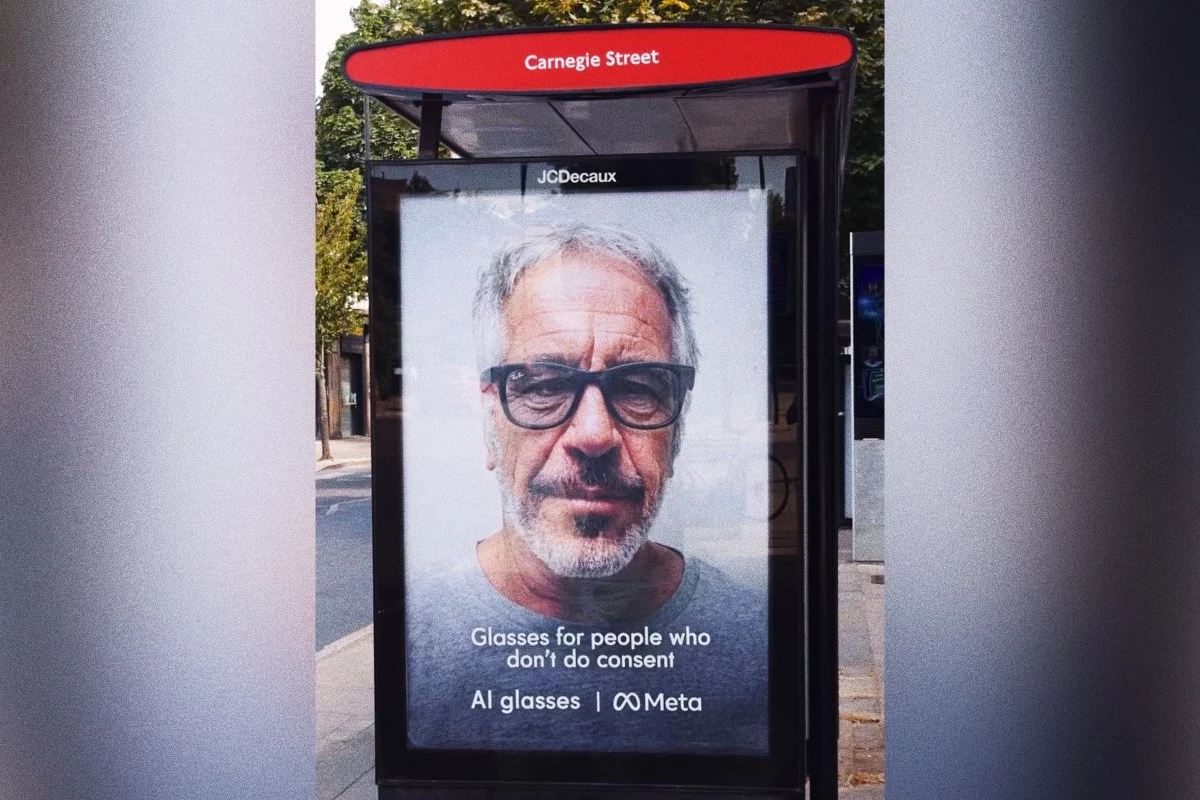
The first image—Kylie Jenner’s face composited onto the alien invader from *John Carpenter’s They Live* with the line “We’re always watching”—was designed to make a single point legible at a glance: smart glasses can turn ordinary social space into a potential recording environment. When Meta’s attempts to curb “manfluencer” misuse and non-consensual filming failed to quiet criticism, the group escalated with a second, more incendiary installation: Jeffrey Epstein depicted wearing the glasses beside the phrase “Glasses for people who don’t do consent.” The provocation is deliberate. It anchors the debate not in novelty or convenience, but in the moral stakes of covert recording and power asymmetry.
Online reaction—particularly across social media and Reddit—has leaned toward stricter oversight, clearer safeguards, and in some cases outright bans on wearables capable of recording without explicit permission. For Meta and its competitors, the episode underscores a hard truth: in consumer technology, legitimacy is a feature, and it can be lost faster than it is built.
The technology at issue: edge AI, “always-on” design, and the consent gap
At the heart of the controversy is not merely the presence of a camera, but the convergence of miniaturized sensors with on-device machine learning. Meta’s approach reflects a broader industry trajectory toward edge computing—processing computer vision and contextual inference locally, rather than sending raw video to the cloud. That shift brings real benefits: lower latency, reduced bandwidth, and potentially less centralized data retention. Yet it also complicates governance, because many familiar privacy controls have historically been enforced server-side.
Three technical dynamics are shaping the risk profile:
- Pervasive capture by design: Smart glasses are optimized for hands-free, frictionless recording. The same “ease” that makes them compelling for users can make them threatening to bystanders, especially when recording is not obvious.
- On-device intelligence, off-device ambiguity: When recognition and inference happen locally, it can be harder for outsiders—including regulators—to verify what is being detected, stored, or inferred in real time.
- Weak signaling mechanisms: If the public cannot reliably tell when recording is occurring, the product fails a basic social requirement: notice. LED indicators and audible cues help, but only if they are tamper-resistant, standardized, and trusted.
This is why the backlash is less about a single brand and more about a category: AI wearables are pushing computing into the realm of “ambient” presence, where the boundary between personal device and public surveillance becomes contested. The emerging question for product teams is no longer “Can we build it?” but “Can we prove it respects consent under real-world misuse?”
Business stakes: Meta’s diversification bet meets activist-driven reputational drag
Meta’s investment in smart glasses is widely understood as part of a strategic attempt to diversify beyond advertising and seed the next platform shift toward AR/VR and ambient computing. Hardware can create new distribution, new developer ecosystems, and eventually new monetization surfaces. But hardware also imports a different kind of risk: reputational damage can suppress adoption early, before network effects and economies of scale have time to take hold.
The London campaign illustrates how activist communications can outpace corporate messaging. A viral image can function like a market signal—raising perceived risk for consumers, retailers, and policymakers simultaneously. For a product category that depends on normalization in public spaces, the cost is not just negative press; it is the possibility of social non-acceptance, where the device becomes stigmatized regardless of its technical safeguards.
Competitive dynamics may shift accordingly:
- Privacy-first challengers—especially firms operating under stringent data protection norms—can position themselves as safer alternatives, using consent and transparency as differentiators.
- Enterprise-focused wearables may gain relative momentum, as corporate environments can impose clearer rules, training, and enforcement than consumer public spaces.
- Brand trust becomes a moat—or a liability: companies with recent privacy controversies face a steeper credibility curve when asking the public to accept always-available sensors on faces.
For Meta, the strategic risk is that smart glasses—intended as a bridge to future computing platforms—become a flashpoint that drains trust capital precisely when the company needs it most.
Regulation and standards: from reactive policy to enforceable “privacy by design”
The most consequential outcome of episodes like this may be regulatory, not reputational. Wearables with recording capability are increasingly likely to be governed the way drones, CCTV, and doorbell cameras have been: through a mix of regional laws, sector rules, and technical standards. The likely direction of travel is away from after-the-fact moderation (“don’t film people without consent”) and toward architectural constraints that make misuse harder.
Expect policy debates to center on enforceable mechanisms such as:
- Hardware-level recording indicators that cannot be disabled without rendering recording inoperable
- Physical kill switches and verifiable “camera-off” states
- Cryptographic watermarking or provenance signals to identify footage captured by smart glasses
- Third-party certification models—akin to safety labs in consumer electronics—to validate compliance claims
- Audit-friendly APIs that allow regulators or approved watchdogs to test behavior under controlled conditions
A patchwork is also plausible: Europe’s evolving AI governance, U.S. state privacy regimes, and even city-level exclusion zones for recording wearables in sensitive venues. For global manufacturers, compliance becomes a product roadmap input, not a legal afterthought.
The London billboards may read like provocation, but they are also a market diagnostic: the public is demanding proof of consent, not promises of restraint. In the race to make computing disappear into daily life, the companies that endure will be those that can make privacy and accountability just as frictionless as the technology itself.

 By
By
 By
By
 By
By

 By
By


 By
By







