

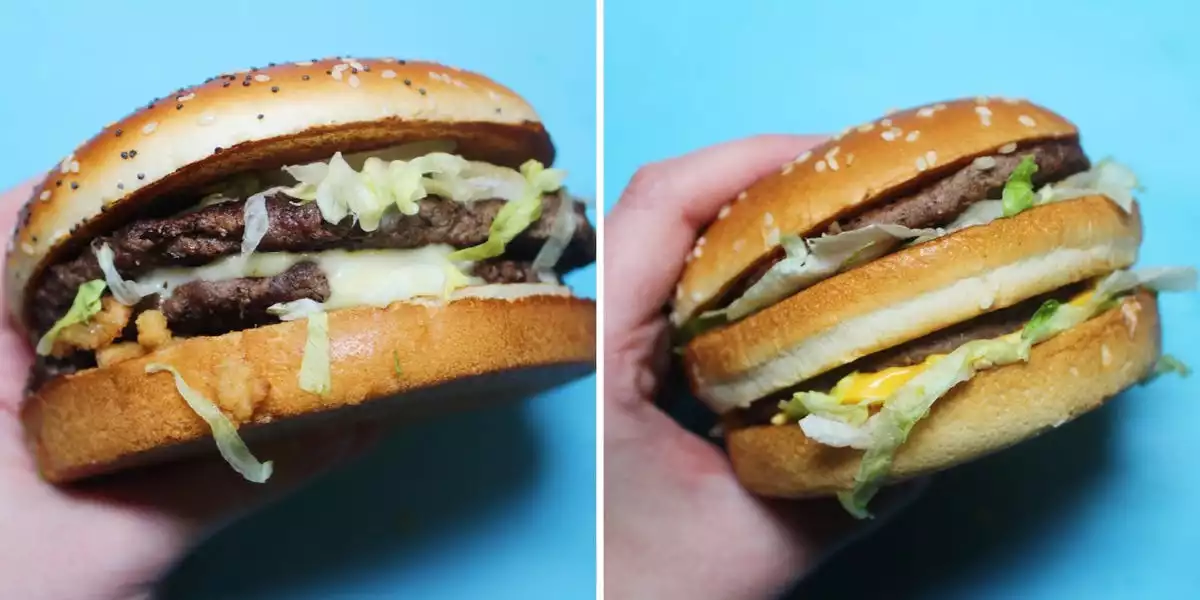

A supersized limited-time burger as a strategic signal, not just a menu stunt
McDonald’s decision to introduce the Big Arch—positioned as its largest-ever burger and offered as a limited-time menu item (LTO)—reads less like a novelty and more like a deliberate test of how far the brand can stretch into premium fast food without losing its mass-market center of gravity. Debuting March 3, the Big Arch stacks two quarter-pound beef patties, three slices of white cheddar, crispy and raw onions, lettuce, pickles, and a tangy Big Arch sauce on a sesame–poppy seed bun.
The pricing is equally declarative: at $11.59, it sits well above the $8.39 Big Mac, effectively reframing “value” away from entry-level affordability and toward portion heft, ingredient signaling, and indulgence. That shift matters because McDonald’s has historically been the category’s bellwether for value-based fast food; when it experiments with premiumization at scale, the broader quick-service restaurant (QSR) market tends to follow.
A recent blind taste test circulating in media commentary adds fuel to the narrative: reviewers favored the Big Arch for size, savory intensity, and overall impact, while critiquing the Big Mac’s milder flavor profile and the signature middle bun as less satisfying by comparison. Whether or not such tests are definitive, they function as cultural accelerants—turning product design into conversation and conversation into demand.
—
Premiumization and the new math of “value” in fast food pricing
The Big Arch lands squarely in a widening industry pattern: premium-sized, higher-margin offerings designed to capture “occasion-driven” consumption—late-night cravings, social gatherings, and the dopamine loop of limited availability. In an inflation-pressured environment, consumers often oscillate between deal-seeking and selective splurging. The Big Arch is engineered for the latter.
What’s notable is how McDonald’s appears to be recalibrating value perception. A near 40% premium over a Big Mac could be a deterrent in a purely price-sensitive frame. But the Big Arch sells a different proposition: one large, visually dramatic item that can substitute for multiple smaller purchases, and that photographs well in the social-media economy.
Key value levers embedded in the Big Arch strategy include:
- Portion-driven justification: “More food” as the primary rationale for a higher ticket.
- Ingredient upgrades as signals: white cheddar and a proprietary sauce help communicate differentiation beyond size.
- LTO urgency: scarcity supports trial and reduces the need for long-term price anchoring.
- Shareability and social proof: a product built to be talked about, compared, and posted.
For McDonald’s, the bet is that premiumization can expand average check while the core menu and app-based offers continue to protect the brand’s value reputation. The risk is that repeated high-price headline items could subtly shift consumer expectations—especially if wage growth and discretionary spending soften.
—
CEO-as-influencer marketing meets real-time brand feedback loops
The Big Arch’s viral lift was amplified by CEO Chris Kempczinski’s Instagram promotion, a modern example of executive-led social marketing. This “CEO-as-influencer” model can humanize a global corporation and create a sense of proximity to decision-making. It can also backfire if audiences perceive the content as overly scripted, tone-deaf, or too eager to chase internet culture.
In today’s QSR marketing environment, virality is not simply a bonus; it is increasingly part of the product launch architecture. But virality comes with a governance challenge: brands must balance edginess and shareability against heritage and trust. McDonald’s, in particular, operates with a brand identity built on familiarity and consistency—qualities that can be strained when marketing tries to behave like a creator economy channel.
For business and technology observers, the more durable story is how marketing, product, and data systems are converging. The Big Arch is well-suited to McDonald’s digital ecosystem if integrated tightly into:
- App and loyalty personalization (targeted offers, timed upsells, bundles)
- Geo-targeted notifications (driving trial in specific markets or dayparts)
- First-party data capture (measuring repeat purchase, substitution effects, and price elasticity)
The strategic advantage is clear: digital channels can turn an LTO from a broad national bet into a measured experiment, with rapid iteration based on sales, sentiment, and operational performance.
—
Operational throughput, supply chain complexity, and the competitive chessboard
A larger, more complex sandwich is not operationally neutral. The Big Arch introduces additional demands across kitchen throughput, training, inventory management, and point-of-sale configuration. New ingredients—custom bun, three cheese slices, and a new sauce SKU—create friction points that can slow assembly during peak periods if not carefully engineered.
From a unit economics perspective, the margin story hinges on whether premium pricing can outpace:
- higher ingredient costs (cheese, sauce, bun specifications)
- potential labor inefficiencies (assembly time, error rates, re-makes)
- supply variability (consistent sourcing at scale, waste management)
Competitively, McDonald’s is operating in a market where rivals have also leaned into bigger, bolder builds—Burger King’s “Big King” variants and Wendy’s premium protein-forward offerings reflect the same gravitational pull toward indulgence. The differentiator is not merely who launches the largest sandwich; it’s who can sustain a cadence of differentiated LTOs without bloating menu complexity or degrading service speed.
The Big Arch therefore functions as a proving ground for a broader question facing the fast-food industry: can global QSR giants marry premium product theater with industrial-scale consistency while consumers simultaneously demand more transparency around health, sourcing, and sustainability? McDonald’s next moves—how it ties LTO procurement to longer-term contracts, whether it pilots lower-emission beef or regenerative inputs, and how it uses app data to refine menu architecture—will determine whether the Big Arch is remembered as a viral moment or as a blueprint for the next phase of fast-food premiumization.

 By
By
 By
By

 By
By
 By
By


 By
By







