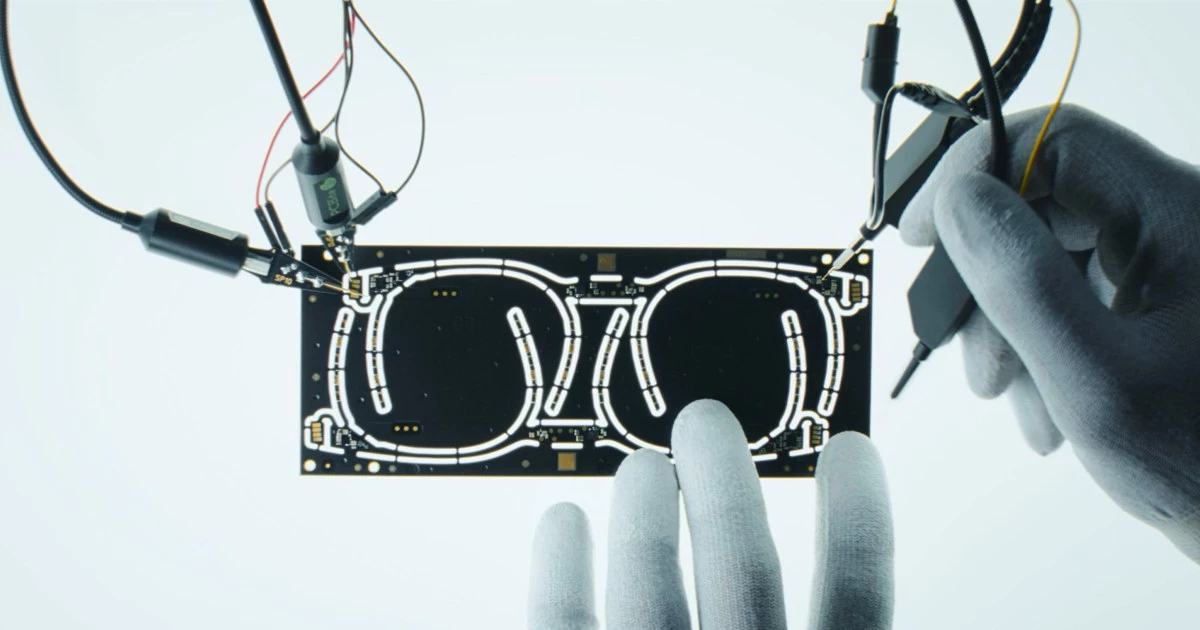

Liquid-Crystal Lenses: The Dawn of Responsive Vision
In the brisk, innovation-rich air of Helsinki, IXI has quietly set the stage for a new epoch in vision technology. Their unveiling of liquid-crystal “dynamic lenses” is not merely a feat of optical engineering but a harbinger of how personal hardware will soon adapt, in real time, to the shifting needs of the human body. The promise is as elegant as it is audacious: glasses that, through a ballet of embedded electronics and eye-tracking, adjust their focus seamlessly from near to far, eliminating the bifocal’s unsightly lines and the progressive lens’s notorious distortion.
At the heart of IXI’s offering lies a confluence of disciplines—liquid-crystal physics, micron-scale sensing, and low-power silicon design—coalescing into a product that feels less like eyewear and more like a wearable instrument. The company’s $36 billion funding round, led by Amazon, signals not just confidence but a strategic land grab: vision correction as a new frontier for ambient computing and digital health.
Engineering the Future of Sight: Core Innovations and Trade-Offs
IXI’s approach is a study in technical minimalism. The lenses themselves are layered with liquid-crystal cells, their refractive index modulated by precise, low-voltage electric fields. This mechanism, reminiscent of the autofocus in digital cameras, is miniaturized to fit within the slender confines of a 50-millimeter lens. Unlike competing Japanese prototypes, which often resemble science fair goggles with external battery packs, IXI’s design aspires to blend invisibly into the aesthetics of high-end eyewear.
The real magic, however, is in the sensing architecture. By deploying micron-sized infrared LEDs and on-temple photodiodes, the glasses triangulate gaze distance every few milliseconds—eschewing outward-facing depth cameras and thus shielding the user from ambient light variability. This closed-loop system, orchestrated by a custom low-power ASIC, sips less than 100 milliwatts—on par with today’s noise-cancelling earbuds, yet demanding daily charging, a psychological hurdle for the uninitiated.
IXI’s intellectual property moat is formidable. Cross-licensed display patents and proprietary liquid-crystal chemistries enable a diopter swing from −10 to +8, a range broad enough to serve both severe myopes and presbyopes. Such breadth, coupled with the ability to reuse existing LCD fabrication lines (albeit with a 25–30% yield penalty on curved substrates), positions IXI for scale, even as initial retail prices hover above $1,200.
Market Dynamics: Disruption, Distribution, and Data
The global prescription eyewear market, a $140 billion behemoth, has long been ripe for disruption. With presbyopia alone affecting nearly two billion people, the addressable market for dynamic lenses is vast—particularly if the product can command a premium akin to the progressive-lens revolution of the 1980s. Amazon’s investment is more than financial; it is a strategic foothold in the convergence of healthcare delivery, hardware, and cloud-based analytics. Vision correction, once a staid medical service, is being recast as a platform for biometric sensing and, ultimately, augmented reality overlays.
Competitive pressure is mounting. Japanese incumbents such as Elcyo and ViXion bring engineering rigor but are hamstrung by clunky form factors and medical-device distribution channels. IXI’s consumer-grade design and alignment with fashion-forward retail partners—think Luxottica, not just optometry clinics—suggest a distribution model that could mirror Warby Parker’s direct-to-consumer playbook. Yet, regulatory complexity looms: FDA Class II clearance is likely, but the integration of biometric data and IR emitters invites scrutiny under HIPAA and GDPR, especially for enterprises managing sensitive health information.
The Road Ahead: Platform Potential and Strategic Imperatives
The implications of dynamic optics ripple far beyond consumer eyewear. The same eye-tracking modules that power IXI’s lenses are foundational for foveated rendering in AR/VR headsets—a hardware flywheel reminiscent of Sony’s dominance in CMOS image sensors. Adjacent markets beckon: automotive heads-up displays, military visors, even continuous ocular health monitoring. For component manufacturers, the race is on to perfect curved-substrate liquid-crystal alignment and ultra-low-power driver ICs. Health-tech platforms, meanwhile, are eyeing the integration of accommodation data into predictive analytics for early-stage eye disease.
Supply chain resilience remains a lurking concern. With liquid-crystal precursors concentrated among a handful of Japanese and German suppliers, geopolitical or logistical shocks could reverberate through the entire ecosystem. Dual-sourcing and localized blending facilities are not just prudent—they are essential for margin stability as the category scales.
In the next two years, expect early adopters—particularly those frustrated by the compromises of progressive lenses—to drive initial uptake. As LCD fabs optimize for curved substrates and ASICs shrink to more efficient nodes, price compression will broaden the addressable market, forcing incumbent giants to choose between cannibalizing their own cash cows or ceding ground to electronics-native entrants. Over the longer term, dynamic optics may well become the backbone of hybrid medical and AR devices, transforming glasses from passive vision aids into active, context-aware edge-compute nodes.
The arrival of IXI’s liquid-crystal lenses is not just a technological milestone; it is a signal that the boundaries between medical device, consumer electronics, and digital platform are dissolving. For decision-makers across the value chain, the question is not whether to engage, but how quickly—and how deeply—to stake a claim in the coming architecture of vision.

 By
By
 By
By

 By
By
 By
By


 By
By