

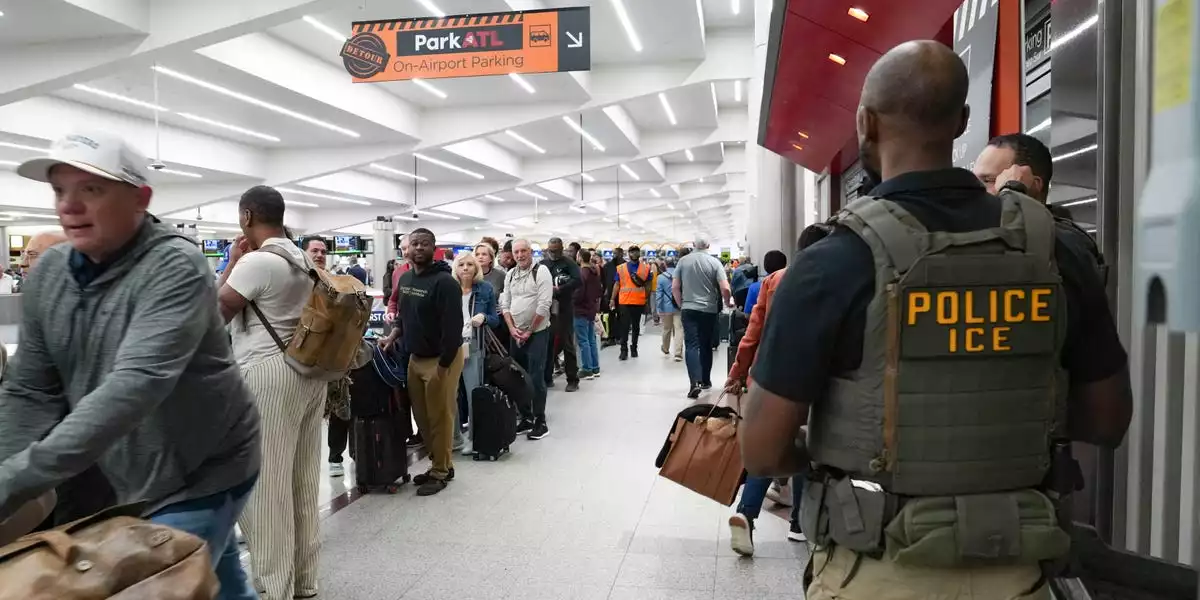

A stopgap deployment that exposes structural fragility in U.S. airport security
The decision to keep U.S. Immigration and Customs Enforcement (ICE) agents deployed at 14 major U.S. airports until Transportation Security Administration (TSA) checkpoint operations return to “100%” is more than an emergency staffing maneuver—it is a revealing stress test of how tightly U.S. aviation security remains coupled to human availability and federal budget continuity. The partial government shutdown created a sudden operational vacuum: since mid-February, roughly 500 TSA officers reportedly resigned or went on leave without pay, and the system’s sensitivity to that attrition quickly became visible to travelers and airlines alike.
The operational symptoms—security lines reported up to four hours at Houston (IAH) and 30-plus minutes at New York (JFK)—are not merely inconveniences. They represent a measurable degradation in throughput at critical national infrastructure nodes. Even after President Trump’s executive order to backfill TSA pay, the immediate capability gap persisted, underscoring a basic reality of frontline operations: restored compensation does not instantly restore staffing levels, training readiness, or morale.
ICE agents have been used for identification checks and exit-lane security, functions adjacent to—but not identical with—TSA’s core screening mission. That distinction is now central to the controversy. Flight attendants’ unions have objected that ICE participation risks distraction from aviation-security priorities and have implemented reporting procedures for any ICE officers perceived to be operating beyond formal training. The result is an operational patch that may stabilize queues in the near term, while simultaneously intensifying scrutiny over mission boundaries, training standards, and passenger experience.
—
Technology modernization moves from “nice-to-have” to operational necessity
This episode sharpens the business case for accelerating security automation, biometrics, and analytics-driven workforce planning. The underlying lesson is not simply that staffing shortages are disruptive; it is that a security model heavily dependent on manual labor becomes brittle when exposed to fiscal shocks, labor-market volatility, or political standoffs.
Several technology vectors stand out as likely beneficiaries of this moment:
- Automated imaging and next-generation screening: Greater adoption of computed tomography (CT) scanners and advanced imaging can reduce reliance on manual bag checks and secondary screening. For airports and vendors, the return on investment becomes easier to quantify when measured against queue-time costs and airline performance penalties.
- Biometric identity verification: Biometric checkpoints can shorten ID verification time and standardize throughput—though they also raise governance questions around consent, retention, and auditability.
- Predictive workforce management: Real-time attrition monitoring and predictive analytics could help TSA and airport operators anticipate staffing cliffs earlier, triggering structured contingency plans rather than improvised interagency redeployments.
Yet modernization is not frictionless. Introducing ICE into checkpoint workflows without deep process and IT alignment can create duplicative inspections, data mismatches, and privacy-compliance risks—particularly for international travelers whose data may intersect with multiple legal regimes and expectations. For executives, the key takeaway is that technology adoption and governance must advance together: automation that improves throughput but erodes trust can become a strategic liability.
—
The hidden economic costs: airlines, airports, and supply chains absorb the shock
Long security lines are often framed as a passenger-experience issue, but their economic footprint is broader and more quantifiable. Delays at checkpoints ripple into:
- Airline on-time performance: Missed departure windows cascade into aircraft rotation disruptions, crew reassignments, and higher compensation and rebooking costs.
- Airport operations and labor costs: Congestion drives overtime, increases the need for crowd management, and can strain terminal services.
- Cargo and time-sensitive logistics: Passenger-side disruption can signal broader airport congestion, potentially constraining belly cargo capacity and complicating just-in-time supply chains—especially for perishable goods and high-value components.
The labor dynamics are equally consequential. A visible exodus of TSA personnel during uncompensated periods sends a market signal: frontline security labor is not infinitely elastic, and retention can break quickly under financial stress. Over time, that may open space for private-sector security firms to argue for expanded roles—whether through supplemental staffing models, managed services, or technology-led screening solutions under federal oversight.
Complicating investment decisions is the ongoing budget uncertainty. While the Senate passed a DHS funding bill, the House remains divided, with Republicans seeking enhanced ICE budgets and Democrats pressing for immigration-enforcement reforms amid agency controversies. For airport capital planning, this translates into a familiar but damaging condition: budget volatility that delays procurement, defers terminal upgrades, and slows multi-year modernization programs.
—
Policy and trust: when aviation security and immigration enforcement visually converge
Perhaps the most strategically sensitive dimension is the blurring of mission boundaries. Even if ICE agents are performing limited functions, their presence at checkpoints can be perceived—fairly or not—as a fusion of aviation security with immigration enforcement. That perception matters because airports are not just transportation hubs; they are high-visibility civic spaces where public trust is operationally relevant.
Several policy aftershocks are plausible:
- Tighter rules for interagency tasking in sterile areas, potentially including clearer certification requirements, role definitions, and liability frameworks.
- New guidance prompted by labor groups, including flight attendants, on what constitutes appropriate conduct and scope for non-TSA personnel in aviation-security zones.
- International traveler perception effects, particularly at global gateways where heightened law-enforcement visibility can influence tourism sentiment and business travel decisions.
For the aviation sector, the strategic imperative is to treat this moment as both a warning and a catalyst: a warning that operational resilience cannot depend on last-minute interagency substitutions, and a catalyst to build scalable security architectures—combining automation, robust staffing models, and transparent governance—that can withstand political and fiscal turbulence without compromising passenger confidence.
The airports that emerge strongest will be those that convert today’s staffing crisis into a disciplined modernization agenda—one that reduces single-point dependence on human staffing levels while preserving the legitimacy and clarity of the security mission in the eyes of the traveling public.

 By
By

 By
By
 By
By
 By
By


 By
By







